
For millions of metalheads around the world, the roar of a Harley-Davidson onstage is as essential to Judas Priest as Rob Halford’s banshee scream or the twin-guitar firepower of Glenn Tipton and K.K.Downing.
Today, it’s impossible to imagine a Priest concert without the leather-laden “Metal God” rumbling into view through smoke and floodlights like some apocalyptic messiah of chrome and gasoline.
But the truth—the wild, unpredictable, almost unbelievable truth—is that this sacred tradition was born from a twist of fate, a rebellious decision, a few angry authorities, and a series of near-fatal accidents that could have ended the legend before it even began.
This is the real story behind the motorcycle moment that changed heavy metal shows forever.
It begins in the late 1970s, when Judas Priest were not yet the fully armored, metal-studded gods we know today, but a band still crafting the visual and sonic identity that would define the genre.
In November 1978, they released Killing Machine, a razor-sharp record dripping with attitude and menace—so much so that their American label panicked.
The title was “too violent,” executives feared, and the album was swiftly rebranded Hell Bent for Leather for its U. S. debut in February 1979.
Little did anyone know that the title change would ignite a transformation that would rewrite heavy metal theatrics forever.
At the center of this evolution was guitarist Glenn Tipton’s adrenaline-soaked anthem Hell Bent for Leather, a song written entirely by him—common in the pre-agreement days when the band had not yet standardized shared songwriting credits.
Tipton described the track as a story about a “godlike creature, part man, part machine,” tearing across the edge of sanity with unstoppable force.
The metaphor would soon become literal.
But in 1978, Hell Bent for Leather had no motorcycle.
No engine.
No stage spectacle.
In fact, the most notorious piece of Priest stagecraft at the time belonged to the song Genocide, during which Rob Halford would storm onstage wielding a machine gun—yes, an actual gun—and fire blanks into the audience.
It was shocking, theatrical, and extremely dangerous, and it nearly landed Halford in jail.
But before the authorities could fully clamp down, something else—something louder, heavier, and far more iconic—was about to take over.
On October 29, 1978, at Victoria Hall in Hanley, England, Judas Priest were preparing to perform Hell Bent for Leather live for the first time.
Outside the venue, as always, was a sea of roaring motorcycles and leather-clad fans—bikers who lived the life Priest sang about.
And that was when Rob Halford had a wild idea.
He walked into the parking lot and asked the riders if he could bring one of their bikes onstage.
The bikers erupted in excitement.
Arguments broke out as they desperately tried to convince Halford to choose their motorcycle.
Eventually, he selected the biggest machine among them—a beast of metal that seemed almost destined for this moment.
That night, Halford rode the Harley into the swirling stage lights.
The crowd lost its collective mind.
Roars, screams, fists in the air.
It was instant electricity.
It was myth-making.
It was metal being reborn right before their eyes.
And Judas Priest knew instantly: this wasn’t a gimmick.
This was the future.
From that night forward, the motorcycle was not simply a prop—it was a declaration of identity.
A symbol of rebellion.
A ritual.
And Halford treated it as such, fighting tooth and nail to protect the moment at every turn.
When the band arrived in Dublin for their first-ever Irish show in July 1979, authorities panicked.
The political tension of the era was high, and officials feared that a roaring motorcycle inside a packed venue could incite violence.
They banned it.
Halford refused: “No bike, no show.” The tension mounted.
Canceling the performance risked riots, and the authorities eventually backed down.
The legend grew.
When police later warned Halford that bringing the motorcycle onstage was illegal and threatened to arrest him, he waited until security wasn’t looking and rode it out anyway.
Fans went insane.
And the police—once again—backed down, terrified of provoking chaos.
But metal history isn’t built on triumph alone.
It’s also forged in fire, danger, and disaster.
The first major accident came in Minneapolis during the Killing Machine tour in 1979, when Halford misjudged the stage edge and rode the bike straight off the front, plunging into the orchestra pit.
Miraculously, he survived with only cuts and bruises.
The fans, however, were traumatized—and eternally loyal.
But nothing compares to the chaos of the Painkiller tour finale in Toronto years later, a night so insane it remains one of the most infamous moments in heavy metal history.
The band was exhausted, emotionally fried from the stress of the controversial “subliminal message” trial.
Backstage confusion was rampant.
When the intro tape for Hell Bent for Leather started too early, Halford assumed this was his cue.

He mounted the bike, gunned the engine, and rode forward—straight into a set of stairs hidden by dense stage fog.
The impact knocked him unconscious.
The bike crashed.
Halford collapsed.
And the band? They kept playing.
They couldn’t see him.
For the first and only time ever, Hell Bent for Leather was performed as a pure instrumental until Glenn Tipton stumbled upon Rob’s motionless body on the floor.
Even that didn’t stop the tradition.
In 2011, during the Epitaph tour in São Paulo, Halford rode out for the encore—and the motorcycle tipped over the second he stopped.
He fell again.
More accidents would follow across the years: stalls, slips, crashes, malfunctions, close calls.
But each mishap only added more mythology to the lore of Judas Priest.
Because this is metal.
And metal thrives on danger.
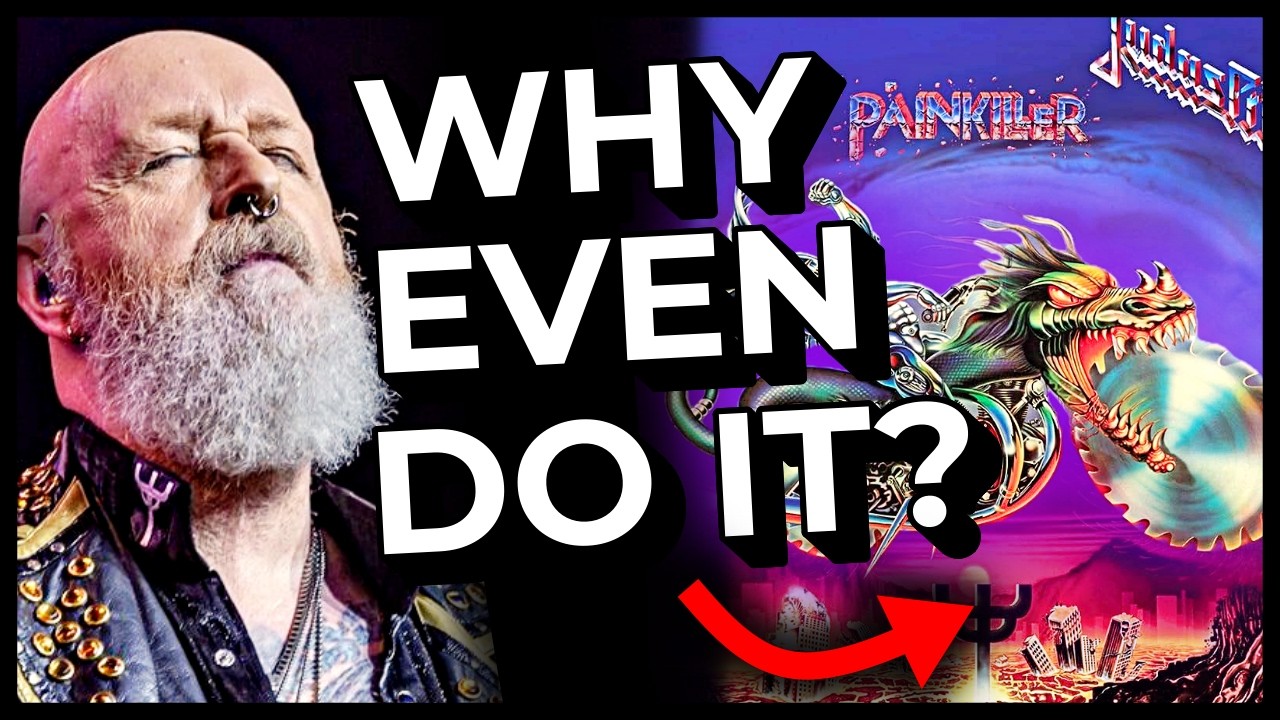
The truth is, the motorcycle became more than theatrics.
It became a ritual.
A symbol of loyalty between Priest and their fans.
A testament to risk, rebellion, and raw authenticity.
Even now—45 years later, in a world of pyro explosions, laser shows, and massive LED screens—nothing compares to that moment when the lights dim, the engine growls, and Rob Halford emerges through the smoke astride a Harley.
Metalheads still lose their minds.
Every.
Single.
Night.
And they still argue fiercely about what the next Priest motorcycle should look like.
The paint.
The lights.
The modifications.
The rumors.
The speculation.
Because after nearly half a century, the Harley is no longer just part of the show.
It is part of heavy metal history.
It is sacred.
And we are lucky—no, blessed—to still witness it in the 21st century: a defiant, roaring reminder of where metal came from and why Judas Priest will always be the true Metal Gods.
News
The Song that Bob Dylan Wrote About Elvis Presley
Bob Dylan and Elvis Presley are two of the most legendary figures in American music history. One is known as…
Raul Malo, Lead Singer of The Mavericks, has died at age 60
The music world is mourning the loss of Raul Malo, the charismatic lead singer of The Mavericks, who passed away…
At 69, Steve Perry Confessed This Was the Song He Couldn’t Finish
Steve Perry’s voice is one of rock’s most iconic and enduring sounds. As the lead singer of Journey, he gave…
Top 6 SHOCKING Things Axl Rose Said About Other Rock Legends!
Axl Rose, the legendary frontman of Guns N’ Roses, is known not only for his iconic voice and music but…
‘You Had ONE Job!’ How Powerman 5000 FUMBLED a Platinum Future
Powerman 5000’s story is one of bold creativity, underground buzz, and a dramatic crossroads that nearly derailed their ascent to…
‘He Knew Last Show Would Kill Him’ Ozzy Osbourne’s Final Moments | Sharon Osbourne Interview
Ozzy Osbourne, the legendary rock icon, cultural pioneer, and beloved family man, gave his final performance knowing it might be…
End of content
No more pages to load






