
Creedence Clearwater Revival (CCR) remains one of the most iconic American rock bands, known for their raw, rhythm-and-blues-infused sound that resonated deeply with working-class America during the late 1960s and early 1970s.

Yet behind their nine Top 10 hits and vast popularity lies a story marked by creative control struggles, family betrayal, legal battles, and a fractured legacy.
This is the story of CCR’s meteoric rise and painful fall.
CCR’s origins trace back to El Cerrito, California, a blue-collar suburb in the Bay Area far from the southern swamps their music often evoked.
The band started as a garage band called The Blue Velvets, formed by four high school friends: John Fogerty, his older brother Tom Fogerty, bassist Stu Cook, and drummer Doug Clifford.
Unlike many of their San Francisco contemporaries chasing psychedelic experimentation, these four sought to revive the raw, foundational sounds of early rock and roll, rhythm and blues, and southern blues.
For nearly a decade, they worked day jobs, served in the military, and changed band names, slowly honing their craft.
Tom Fogerty worked at Fantasy Records, the label that would later both make and torment the band.
Between 1966 and 1968, John Fogerty and Doug Clifford were drafted into the U.S.Army Reserve during the Vietnam War.
John’s time at Fort Knox was critical for his songwriting, as hours of marching allowed musical ideas to crystallize in his mind.
More importantly, witnessing the inequities of draft exemptions—where the wealthy avoided service while working-class men like him served—ignited a burning anger that would fuel some of CCR’s most powerful protest songs.

After John’s discharge, the band renamed themselves Creedence Clearwater Revival, a name symbolizing belief, purity, and rebirth.
John’s voice and vision took center stage, and the band’s garage-band grit transformed into something extraordinary.
While the Bay Area exploded with psychedelic sounds, CCR delivered tight, minimalist rock infused with rhythm and blues.
Their breakthrough came with “Suzie Q,” an extended jam that climbed to number 11 on the Billboard Hot 100.
But their real explosion came in 1969 with the album *Bayou Country* and the hit “Proud Mary,” which reached number two on the charts.
“Proud Mary” epitomized their swamp rock style—a sound that felt authentic and raw, despite being crafted by Californians who had never been to the South.
The band’s music spoke directly to working-class Americans and soldiers in Vietnam, who found honesty and grit in CCR’s songs, a stark contrast to the excesses of the psychedelic scene.
CCR’s success was staggering.
In 1969 alone, they released three platinum albums: *Bayou Country*, *Green River*, and *Willy and the Poor Boys*.
They followed with *Cosmo’s Factory* in 1970, which topped the charts.
During this period, CCR became arguably the most played band on American radio, delivering hit after hit: “Bad Moon Rising,” “Down on the Corner,” “Fortunate Son,” “Up Around the Bend,” and more.
Yet despite nine Top 10 singles, five peaked stubbornly at number two.
“Proud Mary,” “Bad Moon Rising,” “Green River,” “Travelin’ Band,” and “Lookin’ Out My Back Door” all missed the number one spot, earning the band a strange curse—the curse of second place.
CCR was a major act at Woodstock in August 1969, scheduled for prime time.
However, the Grateful Dead’s extended set delayed them until past midnight, when the exhausted crowd was mostly asleep.
John Fogerty later described their performance as brilliant but to an audience that was half-conscious.
Worse, John pulled their footage from the iconic Woodstock film and soundtrack, deeming it unremarkable.
His perfectionism and need for control robbed CCR of what could have been a defining moment immortalized in rock history.
While other bands achieved legendary status through Woodstock, CCR’s absence from the film meant their triumph slipped away.
Beneath the band’s unity was a structural flaw—John Fogerty’s absolute control.
He wrote, produced, and sang lead on every track, leaving Tom Fogerty, Stu Cook, and Doug Clifford as little more than backing musicians.
The creative dictatorship bred resentment.
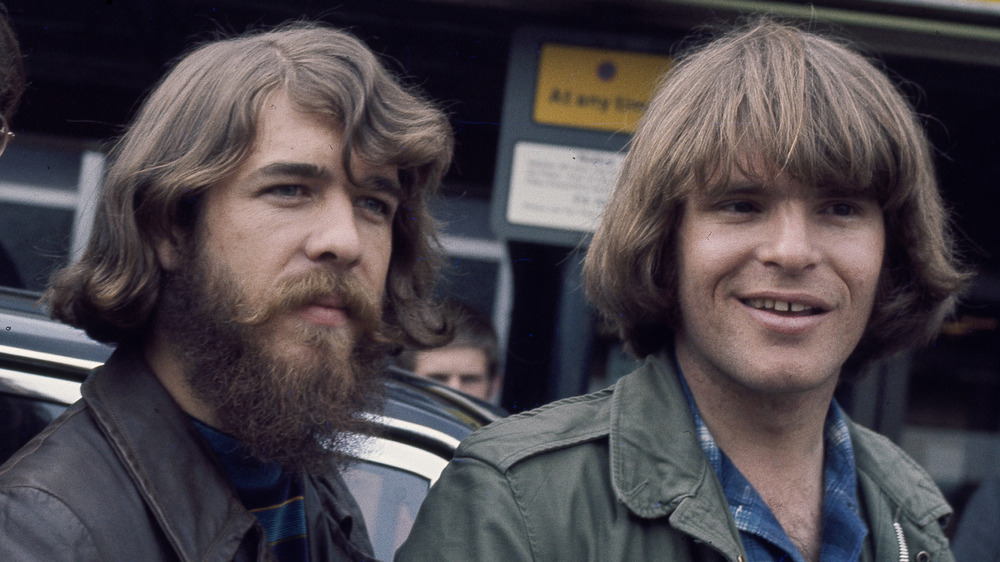
Tom Fogerty, John’s older brother and founding member, felt increasingly marginalized.
The relationships deteriorated, and in 1971, Tom quit the band, marking the official death of the original brotherhood.
John’s inability to share creative power culminated in the 1972 album *Mardi Gras*, where Stu Cook and Doug Clifford were given equal songwriting and vocal duties.
The album was critically panned, lacking the cohesive vision that John’s leadership had provided.
It was a test—and John’s point was proven: without his control, CCR faltered. The band dissolved soon after.
The breakup was only the beginning of decades of turmoil.
John Fogerty fought a bitter legal battle with Fantasy Records owner Saul Zaentz over ownership of CCR’s music rights.
Feeling exploited, John vowed never to perform CCR hits again, refusing to enrich the man he saw as a betrayer.
In an ironic twist, Zaentz sued John for plagiarizing himself over similarities between John’s solo song “The Old Man Down the Road” and CCR’s “Run Through the Jungle,” which Zaentz controlled.
John won the case, but the legal trauma scarred his career.
Adding to the pain, Tom Fogerty sided with Zaentz against his own brother.
John described this as a dagger in his heart, and the brothers never reconciled before Tom’s death in 1990.
In 1993, CCR was inducted into the Rock and Roll Hall of Fame. Yet the bitterness remained raw.
John refused to perform with Stu Cook and Doug Clifford, instead playing with session musicians.
Cook and Clifford walked out in protest, and the world witnessed a band that once sang of unity unable to share a stage.
Despite internal strife, CCR’s music endured.
Their concise, powerful songs became timeless anthems, especially “Fortunate Son,” which remains a definitive Vietnam War protest song.
In the digital age, CCR’s catalog has found new life, with billions of streams worldwide.
In 2023, John Fogerty reclaimed ownership of his publishing rights from Fantasy Records, a victory decades in the making.
He began re-recording CCR classics with his sons, transforming past bitterness into a joyful family legacy.
John also found peace with his past, forgiving Tom for siding with Zaentz.
The boy who once marched at Fort Knox, channeling rage into music and controlling every aspect of his art at great personal cost, finally found something elusive for decades: peace.
Creedence Clearwater Revival’s story is a testament to how great music often emerges from deep pain.
Four working-class kids created a soundtrack for America that outlasted their brotherhood, lawsuits, and bitterness.
The curse of second place never broke them, corporate betrayal couldn’t silence them, and death couldn’t erase their legacy.
In the end, the music won.
News
The Song that Bob Dylan Wrote About Elvis Presley
Bob Dylan and Elvis Presley are two of the most legendary figures in American music history. One is known as…

Raul Malo, Lead Singer of The Mavericks, has died at age 60
The music world is mourning the loss of Raul Malo, the charismatic lead singer of The Mavericks, who passed away…

At 69, Steve Perry Confessed This Was the Song He Couldn’t Finish
Steve Perry’s voice is one of rock’s most iconic and enduring sounds. As the lead singer of Journey, he gave…

Top 6 SHOCKING Things Axl Rose Said About Other Rock Legends!
Axl Rose, the legendary frontman of Guns N’ Roses, is known not only for his iconic voice and music but…

‘You Had ONE Job!’ How Powerman 5000 FUMBLED a Platinum Future
Powerman 5000’s story is one of bold creativity, underground buzz, and a dramatic crossroads that nearly derailed their ascent to…

‘He Knew Last Show Would Kill Him’ Ozzy Osbourne’s Final Moments | Sharon Osbourne Interview
Ozzy Osbourne, the legendary rock icon, cultural pioneer, and beloved family man, gave his final performance knowing it might be…
End of content
No more pages to load






