
Lynyrd Skynyrd is one of the most iconic bands in the history of southern rock, a band whose story is as legendary as their music.

From humble beginnings in a Jacksonville carport to filling American stadiums with their signature triple-guitar attack, their journey was marked by soaring success and devastating tragedy.
Their story is one of brotherhood, rebellion, and ultimately, loss — a tale that still resonates decades after the tragic plane crash that claimed six lives and forever changed the band’s destiny.
The story begins in the sweltering summer of 1964 in Jacksonville, Florida.
In a cramped carport, five teenage boys—Ronnie Van Zant on vocals, Gary Rossington and Allen Collins on guitars, Bob Burns on drums, and Larry Junstrom on bass—came together not dreaming of fame, but of freedom.
For these working-class kids, music was a way to escape the grinding reality of their lives.
Ronnie Van Zant, known for his tough upbringing and fierce determination, channeled his aggression and raw energy into the band’s early sound.
They cycled through names before settling on one inspired by their strict gym teacher, Leonard Skinner, who had famously suspended band members for having long hair.
The name “Lynyrd Skynyrd” was a rebellious tribute, a declaration against authority and conformity.
In 1969, Lynyrd Skynyrd recorded their first demo single, “Need All My Friends,” a raw and unfiltered expression of their ambition.
It wasn’t until 1972 that their fortunes changed, thanks to legendary producer Al Kooper, who saw their potential during a gritty bar performance in Atlanta.

Kooper signed them to Sounds of the South, distributed by MCA Records.
Their debut album, *Pronounced ‘Lĕh-‘nérd ‘Skin-‘nérd*, released in 1973, was a slow burner.
It peaked at number 27 on the Billboard 200 but introduced the world to songs that would become anthems: “Simple Man” and “Free Bird.
” “Simple Man” was a heartfelt message about humility and hard work, resonating deeply with their working-class fans.
“Free Bird,” with its soaring guitars and epic solos, became a symbol of freedom and musical mastery.
Their relentless touring and electrifying live shows built a loyal fan base, and by the time “Free Bird” was released as a single in 1974, it had become a staple on radio and at concerts.
Their second album, *Second Helping* (1974), featured “Sweet Home Alabama,” a song that would become their biggest hit and a cultural touchstone.
The track was a pointed response to Neil Young’s “Southern Man,” which criticized the South’s history of racism.
Ronnie Van Zant’s lyrics used sarcasm and sharp wit to defend their home and culture, mocking political figures and flipping the narrative.
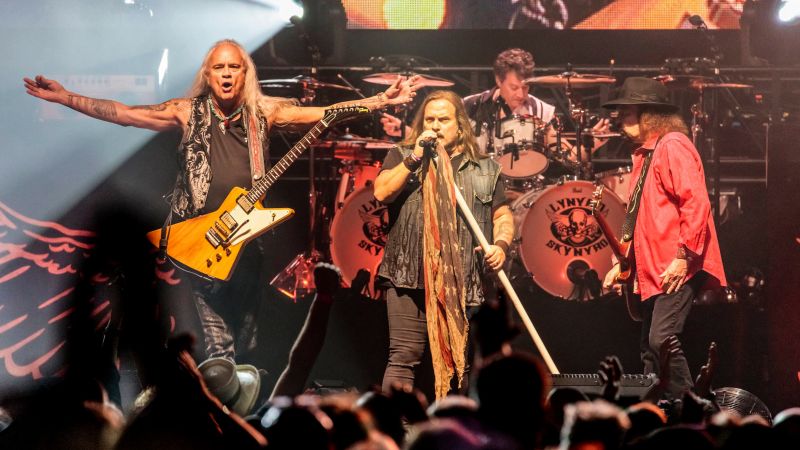
Rather than blind regionalism, the song represented the pride of working-class Southerners who felt misunderstood and unfairly judged.
It became an anthem for anyone who had been dismissed or stereotyped and solidified Lynyrd Skynyrd’s place in rock history.
By 1975, Lynyrd Skynyrd was dominating the road with their powerful triple-guitar lineup.
Their third album, *Nuthin’ Fancy*, reached the top 10, and singles like “Saturday Night Special” further proved their staying power.
But behind the scenes, the band was unraveling.
The “Torture Tour” of 1975 became infamous for internal strife, substance abuse, and violence.
Ronnie Van Zant’s aggressive leadership style led to tension and dangerous incidents, including the notorious “Bloodbath in Hamburg,” where a drunken Van Zant attacked guitarist Gary Rossington with broken glass, nearly ending Rossington’s career.
Ed King, a key guitarist and co-writer of “Sweet Home Alabama,” abruptly quit the band mid-tour, citing the escalating violence as his reason for leaving.
Rossington himself suffered a serious car accident in 1976, further disrupting the band’s momentum.

In 1977, guitarist Steve Gaines joined the band, bringing fresh energy and talent.
The band released *Street Survivors* in October 1977, an album that marked a creative rebirth.
The songs were tighter, stronger, and more focused, but the album also carried a dark, haunting message.
Ronnie Van Zant’s lyrics reflected the band’s self-destructive path, warning of the “smell of death” surrounding them. It was a plea to his bandmates to wake up before it was too late.
Just three days after the release of *Street Survivors*, disaster struck.
On October 20, 1977, the band’s chartered Convair CV-240 took off from Greenville, South Carolina, headed for Baton Rouge, Louisiana.
Shortly after takeoff, oil began leaking, and engine problems escalated.
Despite warnings and flashing fuel gauges, the pilots pressed on until the engines failed completely.
The plane crashed into a remote swamp near Gillsburg, Mississippi.
The impact was catastrophic.
Six people died instantly, including lead vocalist Ronnie Van Zant, guitarist Steve Gaines, his sister and backing vocalist Cassie Gaines, assistant road manager Dean Kilpatrick, and both pilots.
Twenty others survived but suffered severe injuries.
Gary Rossington was pinned under wreckage, badly injured but alive.
Drummer Artimus Pyle crawled through the swamp to find help.
Pianist Billy Powell later revealed the grim reality of their final years, including the physical abuse Van Zant inflicted to maintain order.
The original album cover of *Street Survivors*, featuring the band
News
The Song that Bob Dylan Wrote About Elvis Presley
Bob Dylan and Elvis Presley are two of the most legendary figures in American music history. One is known as…
Raul Malo, Lead Singer of The Mavericks, has died at age 60
The music world is mourning the loss of Raul Malo, the charismatic lead singer of The Mavericks, who passed away…

At 69, Steve Perry Confessed This Was the Song He Couldn’t Finish
Steve Perry’s voice is one of rock’s most iconic and enduring sounds. As the lead singer of Journey, he gave…
Top 6 SHOCKING Things Axl Rose Said About Other Rock Legends!
Axl Rose, the legendary frontman of Guns N’ Roses, is known not only for his iconic voice and music but…

‘You Had ONE Job!’ How Powerman 5000 FUMBLED a Platinum Future
Powerman 5000’s story is one of bold creativity, underground buzz, and a dramatic crossroads that nearly derailed their ascent to…
‘He Knew Last Show Would Kill Him’ Ozzy Osbourne’s Final Moments | Sharon Osbourne Interview
Ozzy Osbourne, the legendary rock icon, cultural pioneer, and beloved family man, gave his final performance knowing it might be…
End of content
No more pages to load






