
Göbekli Tepe: The 12,000-Year-Old Enigma That Rewrote Human History

High on a limestone plateau in southeastern Turkey lies a site so ancient that it pre-dates pottery, metal tools, and even farming.
When German archaeologist Klaus Schmidt arrived there in 1994, the locals called it Göbekli Tepe—“the belly hill.”
Farmers had been pulling mysterious carved stones from the soil for generations. What Schmidt uncovered beneath the surface stunned the scientific world.
The team soon realized the mound was no ordinary settlement. Beneath 15 meters of packed earth were circular enclosures, each framed by T-shaped limestone pillars up to six meters tall and weighing more than twenty tons.
These stones were not crude blocks; their surfaces were polished smooth, and their faces carved with reliefs of lions, snakes, foxes, cranes, and scorpions—images so vivid they still catch the light like fresh etchings.

Radiocarbon dating placed the oldest layers around 9600 BCE, at the very end of the Ice Age. Until then, scholars believed that large stone temples appeared only after humans learned to farm and settle.
Göbekli Tepe flipped that timeline upside down. Here were hunter-gatherers building a monumental sanctuary thousands of years before agriculture.
Archaeologists estimate that constructing the site required hundreds of workers, careful planning, and a social organization no one expected from the Stone Age.
The discovery suggested that spiritual belief may have come before civilization itself—that humans gathered to worship first and learned to farm later to support that ritual life.
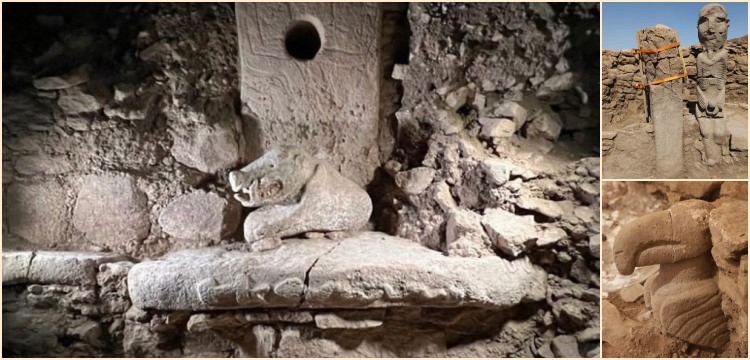
Four main circles have been excavated—labeled A, B, C, and D—but radar and LIDAR scans reveal at least twenty more still buried.
Each circle has two central pillars facing one another, like silent sentinels, surrounded by smaller stones arranged in perfect symmetry.
Some bear arms, hands, and belts carved in relief, hinting that the pillars may represent human—or divine—figures.
The builders hauled these monoliths from a nearby quarry using stone hammers and wooden sledges.
Every surface shows intentional design: channels for drainage, postholes for roofing, and low benches where participants may have sat during ceremonies.
The engineering sophistication rivals that of monuments erected millennia later.

Sometime around 8000 BCE, the people of Göbekli Tepe deliberately covered the entire complex with tons of soil and rubble.
This act preserved the site almost perfectly but created a mystery that endures today. Was the burial a ritual closure, a farewell to a sacred era?
Or was it protection against invaders, climate change, or something they feared?
No one knows. But the care with which it was done—layer by layer, stone by stone—suggests reverence rather than destruction.
Each carving seems to encode meaning. Astronomers have noticed that some animal motifs correspond to constellations visible in the ancient sky, perhaps marking solstices or recording an event such as a comet strike near the end of the Ice Age.
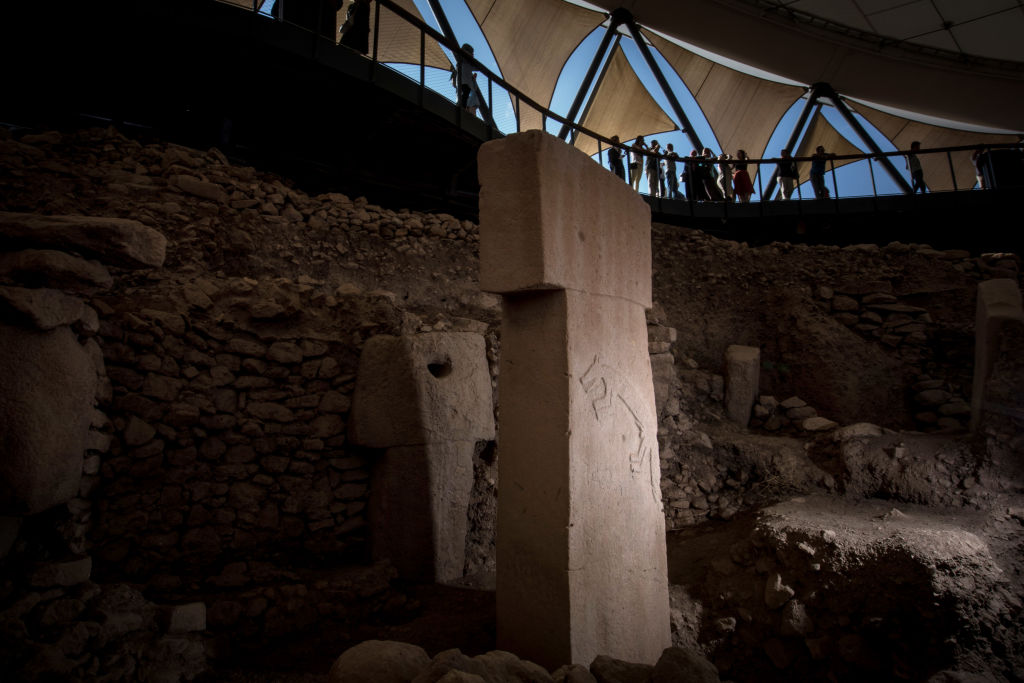
Others interpret the artwork as a symbolic language about death and rebirth. Whether astronomical or spiritual, it reveals a level of abstract thought once thought impossible for prehistoric people.
For modern scientists, the “life” still lingering under the mound is not biological but intellectual: a living record of the moment human consciousness expanded.
When archaeologists describe Göbekli Tepe as alive, they mean its ideas still pulse through us—the capacity to imagine gods, build monuments, and organize communities around belief.
After Schmidt’s death in 2014, excavations continued under the German Archaeological Institute and the Turkish Ministry of Culture. Only about five percent of the site has been uncovered.

Advanced ground-penetrating radar shows additional rings, corridors, and possible chambers extending across nearly 20 acres.
Drones map every contour; 3-D scans preserve each carving in microscopic detail.
Conservation teams now protect the pillars beneath a vast steel canopy to shield them from wind and rain.
Each season brings new revelations. In 2019, workers uncovered a small limestone figurine with fine facial features—the first evidence of representational art at the site.
In 2021, analysis of animal bones confirmed large feasts held here: aurochs, gazelles, and wild boar roasted in quantities far beyond a family’s need.
These were community gatherings on a scale never imagined for the Stone Age.
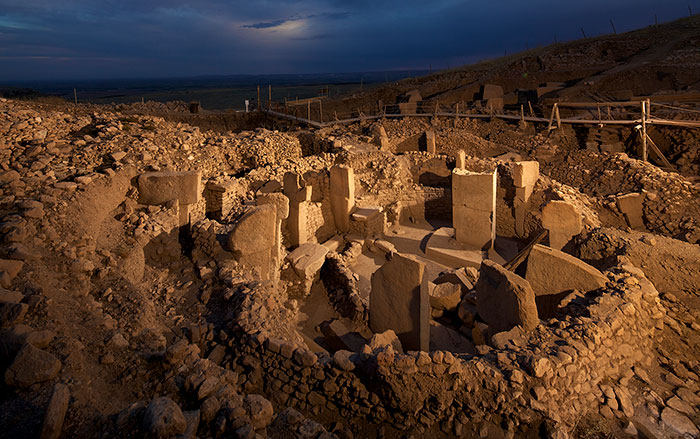
Göbekli Tepe forces historians to rewrite the origins of civilization. It shows that human cooperation and creativity flourished long before the invention of writing or the wheel.
It hints that religion—or at least shared myth—was the catalyst for culture itself. As one Turkish archaeologist put it, “Here the human spirit woke up.”
Visitors who walk among the excavated pillars today often describe a strange stillness. The air vibrates faintly, the way it does in old cathedrals.
Looking across the circles, one senses that something intangible remains—an awareness, a memory, an echo of the hands that carved these stones.
No animals stir below the ground, no forgotten chambers hum with life, but the site feels awake.

The knowledge buried there—our ancestors’ first attempt to connect earth and sky—is still speaking through its silence.
So when a researcher whispers, “Something is still alive down there,” they are not talking about flesh or bone.
They are speaking of human curiosity itself—the spark that lit in those ancient builders and continues to burn in us.
After 12 millennia, Göbekli Tepe remains more than ruins.
It is a living question, carved in stone, reminding us that the oldest thing buried in the earth is not a secret creature…but the beginning of who we are.
.
.
.
.
.
.
.
.
.
.
.
.
.
.
.
.
.
.
.
.
News

Ryan Clark DESTROYS Dan Orlovsky For Coming At Shedeur Sanders!
It began like any other calm afternoon in ESPN’s glittering studio — a casual chat about “generational quarterbacks.” But within…
🧿 “Scientists at CERN Accidentally Unlocked Another Universe — and It’s Watching Us Back 👁️🌀”
WORLD STUNNED — CERN’S QUANTUM SIMULATION JUST DISCOVERED EVIDENCE OF A MYSTERIOUS NEW WORLD Inside a fortified complex beneath the…

🧿🚨 Before His Last Breath, Astronaut Charles Duke SHOCKS World by Revealing What NASA HID on the Moon — The Dark, Hidden Truth That Could Change Everything We Know About Space Exploration! 🌕👽
Before His Last Breath, Astronaut Charles Duke SHOCKS World by Revealing What NASA HID on the Moon — The Dark,…

🧿✈️ Before He Dies, Rick Gillespie Reveals the SHOCKING Location Where Amelia Earhart’s Plane Was REALLY Found — The Hidden Truth That Could Rewrite Aviation History Forever! 🌍🕵️♂️
Before He Dies, Rick Gillespie Reveals the SHOCKING Location Where Amelia Earhart’s Plane Was REALLY Found — The Hidden Truth…

🧿🤖 Voynich Manuscript FINALLY Decoded by AI — The SHOCKING and DARK Secrets Hidden for Centuries That Authorities Didn’t Want You to Know! 📜🕵️♂️
Voynich Manuscript FINALLY Decoded by AI — The SHOCKING and DARK Secrets Hidden for Centuries That Authorities Didn’t Want You…

🧿 AI JUST TRANSLATED ANCIENT SUMERIAN TEXTS — THE SHOCKING REVELATIONS THAT COULD COMPLETELY REWRITE HISTORY AS WE KNOW IT 🌍📜🔥
🧿 AI JUST TRANSLATED ANCIENT SUMERIAN TEXTS — THE SHOCKING REVELATIONS THAT COULD COMPLETELY REWRITE HISTORY AS WE KNOW IT…
End of content
No more pages to load






