
Scientists now believe the hill under the church in Cholula is actually the largest pyramid on Earth — a colossal man-made mountain built over centuries.
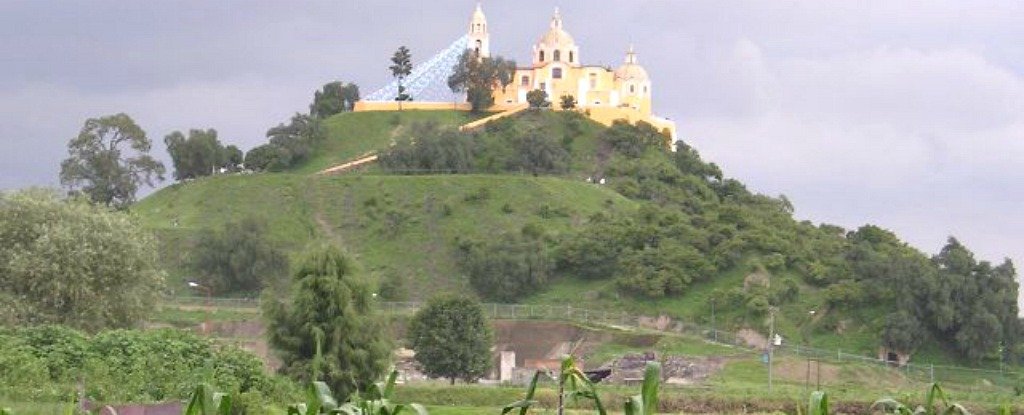
For centuries, travelers arriving in the Mexican town of Cholula saw nothing more than a gentle, grass-covered hill crowned by a gleaming yellow church.
Locals called it a sacred site, tourists admired the sweeping views from its summit, and historians assumed it was simply one of the region’s many natural rises.
Yet beneath that quiet hill—known today as the Great Pyramid of Cholula—rests a structure so immense, so deliberately engineered, and so layered with forgotten civilizations that many archaeologists now believe it is one of the most astonishing monuments ever constructed.
What looked like a mound was, in fact, a colossal human-made pyramid: the largest on the planet by total volume, surpassing even Egypt’s Great Pyramid of Giza.
The revelation of this hidden pyramid came slowly. In the 20th century, as construction projects threatened the area, archaeologists began to investigate the hill’s unusual shape.
When they dug, they discovered not dirt but ancient adobe bricks. Then came the first tunnel, followed by a second, and eventually more than eight kilometers of subterranean passages. These excavations exposed a cross-section of human ingenuity layered over a millennium.
Instead of one pyramid, researchers uncovered multiple construction phases—each one built atop the previous structure, expanding outward until the mound grew so large that future generations assumed it must be natural.
Today, the pyramid’s sheer scale is almost impossible to grasp at first glance.
Its base stretches roughly 450 meters on each side, its total volume estimated at about 4.45 million cubic meters—nearly twice the mass of the Great Pyramid of Giza. Though not as tall, the Cholula pyramid outweighs every ancient monument known to archaeology.
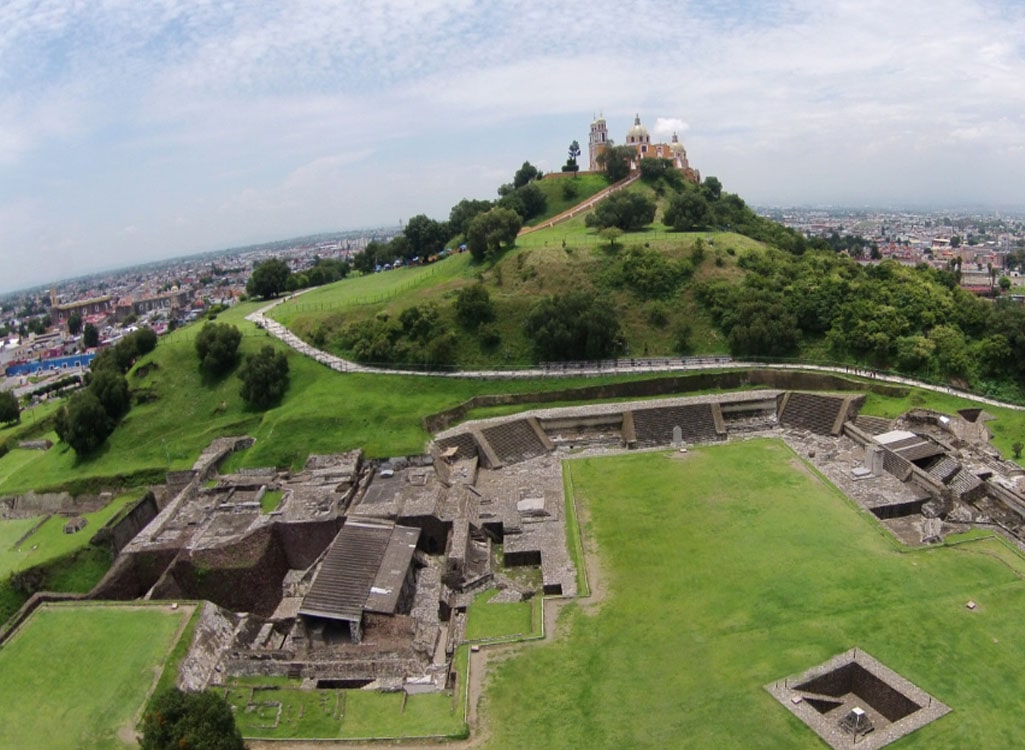
Even more astonishing, it was not built by a single empire but by different cultures across different eras, each adding new layers, staircases, platforms, and ceremonial spaces. The pyramid is a physical timeline: a massive archive of shifting beliefs, technologies, and ruling elites.
The tunnels reveal vivid details of life in ancient Cholula. Archaeologists have uncovered altars, buried stairways, and ceremonial rooms.
One of the most striking finds is the famed Mural of the Drinkers, a wall painting depicting more than a hundred figures consuming pulque, an intoxicating beverage made from fermented agave.
Another mural shows grasshoppers with black skulls, a motif scholars believe may represent themes of death, fertility, or agricultural cycles.
These paintings offer glimpses of rituals that once animated this ceremonial city, suggesting a culture deeply connected to cosmic symbolism and communal rites.
But the pyramid itself was only the heart of a great urban center. Pre-Hispanic Cholula was a major religious and commercial hub, a place where traders, pilgrims, and rulers convened for ceremonies and exchanges.
In its prime, the city may have been one of the largest in Mesoamerica, rivaling great metropolises like Teotihuacan.
Its influence stretched across central Mexico, and its spiritual authority was so significant that even the Aztecs later recognized Cholula as a holy city.
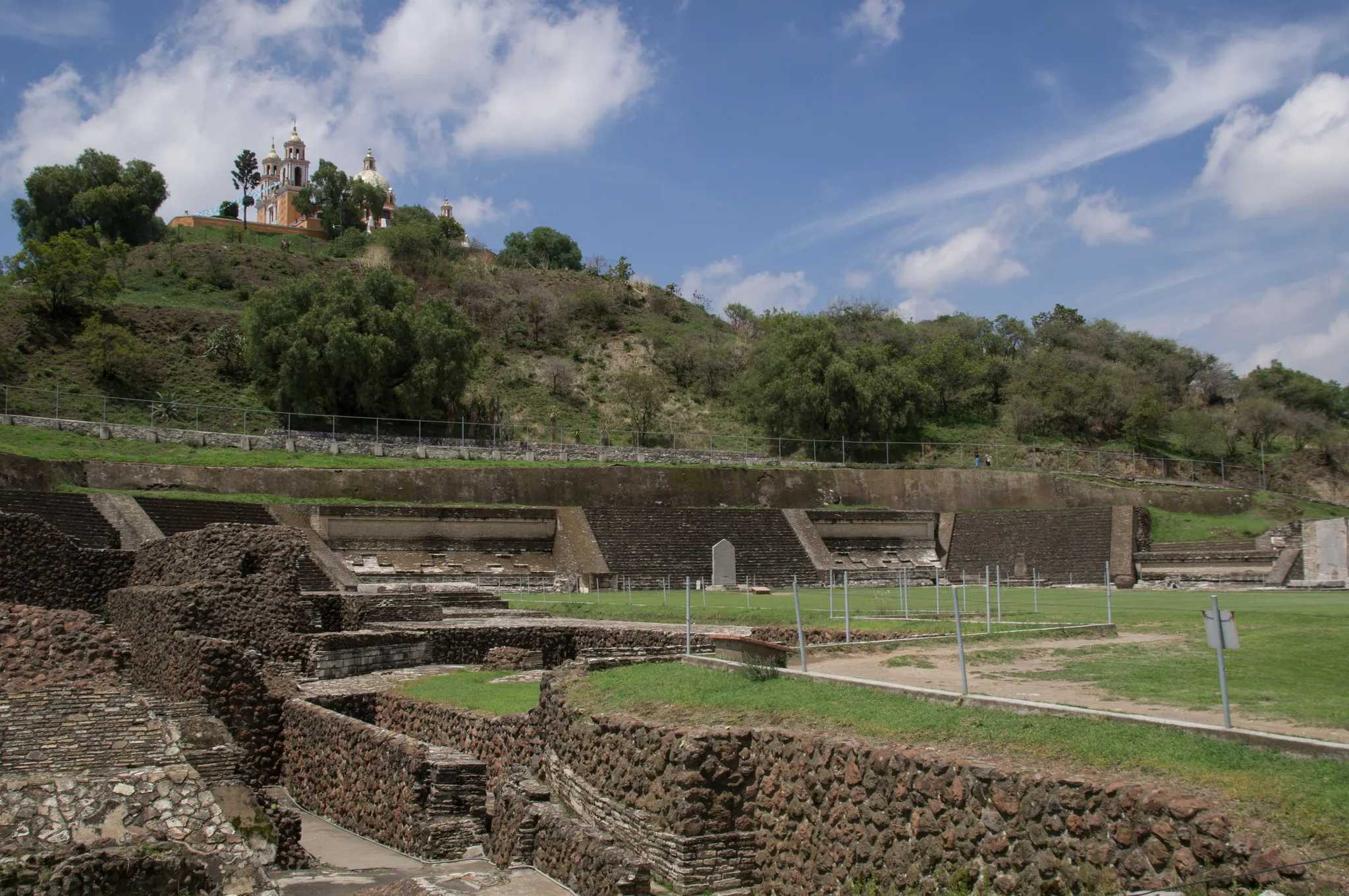
Then came the Spanish conquest in the 16th century, a turning point that forever changed the region.
After the fall of the indigenous rulers, Spanish authorities chose the hill as the site for the Iglesia de Nuestra Señora de los Remedios, a symbol of colonial dominance built directly atop the ancient ceremonial center.
The church still stands today, its foundations penetrating the remnants of the ancient temple beneath it. Over time, the pyramid was swallowed by vegetation, leaving only the church visible. The largest pyramid in the world disappeared into the landscape—hidden in plain sight.
Yet modern excavations have triggered controversy. Cholula is a living city, filled with homes, markets, and modern infrastructure, and beneath much of it lie unexplored archaeological layers.
As the city grows, construction pressures increase, placing fragile ancient structures at risk. Conservationists argue that urban expansion threatens murals, tunnels, and undocumented ruins, while residents weigh economic development against cultural preservation.
The debate has become a flashpoint: a struggle between the needs of the present and the responsibility to protect the past.
Advanced technologies are now offering fresh insights. Archaeologists using ground-penetrating radar and remote sensing technologies have identified anomalies around the pyramid that may indicate additional buried structures.
Some experts believe vast portions of the ancient city remain untouched, potentially holding temples, residences, and ceremonial platforms still waiting to be uncovered.
Others suggest the pyramid may extend deeper than previously believed, hiding chambers or passageways that could reshape our understanding of Mesoamerican architecture.

The scale and complexity of the Great Pyramid of Cholula raise profound questions. How did multiple civilizations coordinate such massive construction projects over centuries? What rituals took place in the cavernous rooms beneath the structure?
Why did ancient builders repeatedly expand the pyramid rather than abandoning earlier iterations? And how many mysteries remain entombed beneath layers of earth and modern streets?
What is clear is that Cholula stands as a testament to the ingenuity and spiritual devotion of ancient peoples who shaped their world through extraordinary engineering feats.
While more famous pyramids capture global attention, this monumental structure lay silent for generations—overshadowed, misidentified, and nearly forgotten.
Only now is the world waking up to the true significance of the “man-made mountain,” a place where myth, science, and history intersect.
As researchers continue their work and technology peels back new layers, the pyramid may reveal stories even more astonishing than what has already been uncovered.
The hill that once seemed ordinary is now recognized as one of the greatest architectural achievements ever undertaken.
And with each discovery, one unsettling question grows louder: if such a colossal wonder could hide beneath our feet for centuries, what other ancient secrets might remain buried—waiting for the right moment to be revealed?
News

Doomsday From the Sky: The Shocking New Timeline of the Day the Dinosaurs Were Erased
A reconstructed scientific timeline details the minute-by-minute destruction unleashed when the Chicxulub asteroid struck Earth 65 million years ago. …
Descubrimiento de una Civilización Perdida Bajo Angkor Wat: Un Enigma Científico
A vast urban network buried beneath Angkor Wat has been revealed through LiDAR and radar imaging, uncovering roads, canals, reservoirs,…

Palace Denies Prince Harry Informed Them About Canada Trip, but His Team Says He Did
Prince Harry traveled to Canada for Remembrance Day events, surprising Buckingham Palace aides despite his team claiming they informed them….

Exiled and Exposed! Former Prince Andrew Spotted Riding Alone at Windsor as Royal Titles Erased and Falklands Honors Vanish!
Former Prince Andrew was spotted horseback riding at Windsor Castle for the first time since losing his royal titles and…

BBC Issues Rare Apology to Kate Middleton After Remembrance Broadcast Backlash
The network received criticism over the Princess of Wales’ titles after covering the royal family’s Remembrance tributes In…

Wall Street in ‘extreme fear’ as stocks plunge AGAIN amid fears world’s biggest company is a dud
Wall Street suffered another sharp sell-off as major indexes and Bitcoin extended their steep November declines. Investors are gripped by…
End of content
No more pages to load






