
A reconstructed scientific timeline details the minute-by-minute destruction unleashed when the Chicxulub asteroid struck Earth 65 million years ago.

In a revelation that has stunned even seasoned planetary scientists, new high-resolution analyses of rock cores from the Chicxulub crater have enabled researchers to reconstruct, minute by minute, what happened the day a mountain-sized asteroid slammed into Earth and ended the reign of the dinosaurs.
The destructive sequence—long imagined as apocalyptic—turns out to have been far worse, faster, and more complex than previously believed.
And with NASA astronomers warning that Earth-crossing asteroids remain an active threat today, the cataclysm of 65 million years ago reads not only as ancient history, but as a chilling preview.
Picture North America in the late Cretaceous: dinosaurs roaming lush coastal plains under a star-filled sky.
Then, on what began as an ordinary night, a bright point of light appeared overhead—a celestial object that, over hours, grew steadily more luminous yet seemed barely to move.
It was not a star. It was an asteroid estimated at 11 to 80 kilometers wide, racing toward Earth at more than 72,000 kilometers per hour.
Had any creature understood what was coming, there was nothing it could have done. In the final hour, that bright point had become a blazing, head-on missile aimed at what is now the Yucatán Peninsula.
As the asteroid struck the top of Earth’s atmosphere, it did not slow down as smaller meteors do. Instead, it punched through the entire atmospheric column—nearly 100 kilometers thick—in three seconds.
Over Central America, the object released a planetary-scale sonic boom so violent it would have shattered eardrums across multiple continents.
Any creature unlucky enough to see the fireball directly was vaporized in an instant. Scientists now believe that no terrestrial animal over 25 kilograms survived unless it could burrow or seek deep water.
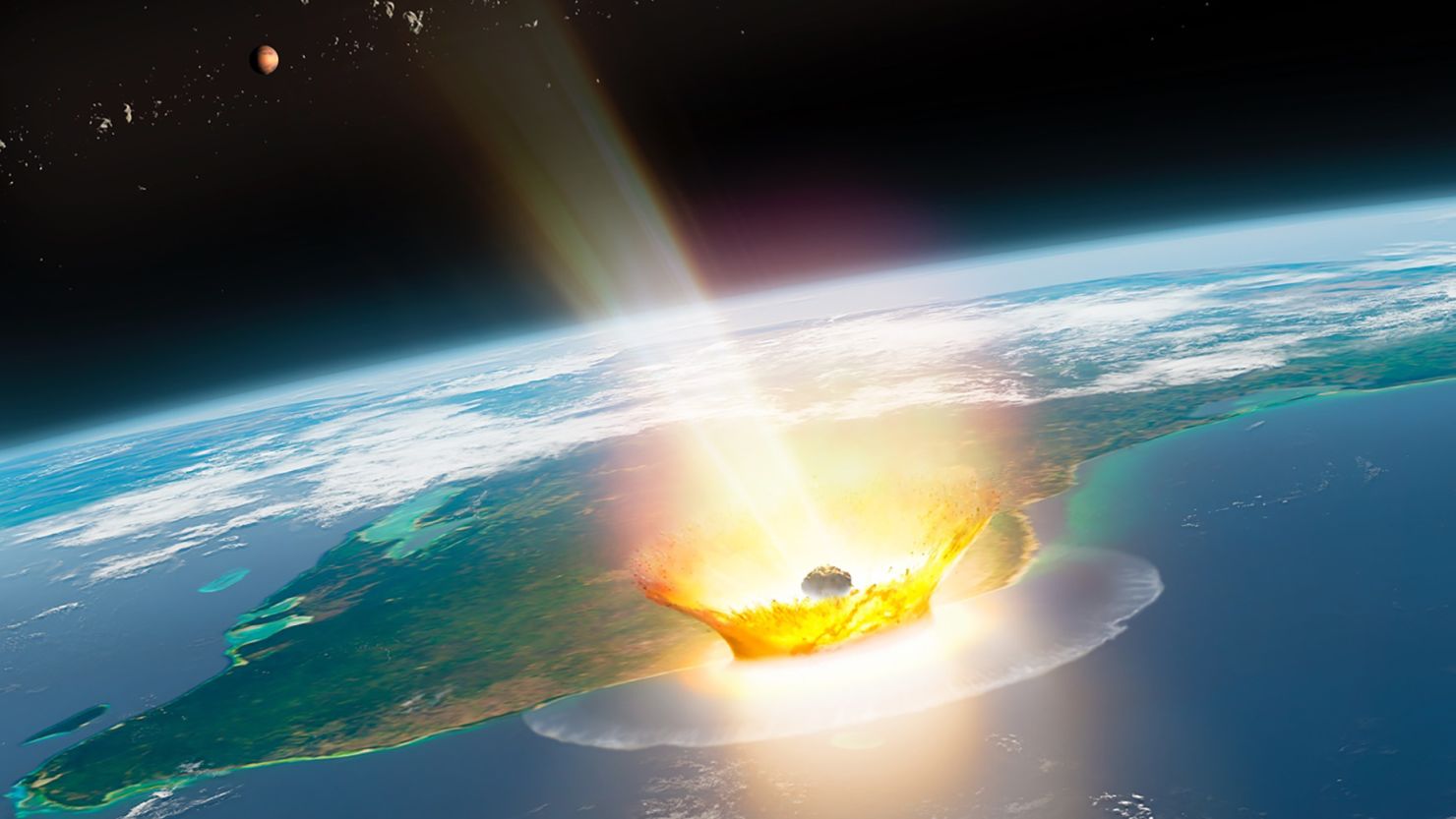
Before the asteroid even touched the surface, compressed air beneath it had already heated to thousands of degrees, flash-vaporizing the shallow sea covering the region.
Milliseconds later, the full mass of the rock plowed into solid Earth, converting its kinetic energy into raw, incandescent heat.
The numbers are staggering: the collision delivered more energy than a billion Hiroshima-scale nuclear detonations. Bedrock behaved like liquid. The ground splashed outward in a blistering 32-kilometer-high ejecta plume.
Then the Earth rebounded like a struck bell, thrusting a temporary mountain taller than Everest skyward at speeds approaching 1,600 kilometers per hour before collapsing again into what became the crater’s peak ring.
The atmosphere ignited. Rock and soil became plasma hotter than the surface of the Sun.
A blast wave expanded outward at nearly 1,000 miles per hour, the kind of pressure wall that—had it happened today—would vaporize everything in Texas, rupture eardrums in New York, and shatter windows as far away as Buenos Aires.
Shockwaves raced through the Earth’s crust at 4 kilometers per second, triggering earthquakes around the world. Within an hour, tsunamis the height of skyscrapers slammed into coastlines from the Gulf of Mexico to what are now the eastern United States.
Six hours later, walls of ocean hundreds of feet high were colliding with the shores of Europe, Africa, and beyond. Within 15 hours, every coastline on Earth had been hit.
But the tsunamis, as disastrous as they were, represented only the beginning. The impact hurled an estimated 25 trillion tons of debris into ballistic arcs, with some fragments escaping Earth’s gravity entirely.
The remainder rained back down within an hour as super-heated glassy projectiles called tektites, many traveling at over 200 miles per hour.
Across the globe, fiery hail fell in quantities so overwhelming that frictional heating from their descent broiled the surface of the planet.
Forests ignited. Animals far from the impact zone faced a lethal, planet-wide heat pulse. Survival required deep water, deep burrows, or extraordinary luck.

Then came the chemical fallout. The asteroid had struck a region saturated with oil and sulfur deposits.
Impact temperatures vaporized 100 billion tons of sulfur, seeding the atmosphere with aerosols that condensed into torrents of acid rain. Oceans acidified. Inland, superstorms dumped staggering quantities of snow and ash.
Simultaneously, tens of thousands of cubic kilometers of pulverized carbon and oil soot were blasted into the stratosphere, forming a black insulating veil around the planet.
Unlike dust or smoke, this soot did not wash out quickly; it remained suspended for years, blocking up to 90 percent of sunlight.
The result was a global deep freeze. After a brief period of furnace-like heat, Earth plunged into temperatures nearly 50 degrees colder on average. Rainfall dropped by as much as 80 percent.
Entire continents transformed into barren deserts. Only a few regions—including Madagascar, India, and Indonesia, then isolated tropical islands—escaped the worst of the cooling.
What the impact itself had not killed, the prolonged climate collapse finished. Within a geological heartbeat, three-quarters of all species had vanished.
Where did this killer originate? New computational models from researchers studying asteroid evolution suggest the Chicxulub impactor may have been a fragment of a giant long-period comet that strayed too close to the Sun after being gravitationally nudged by Jupiter.
These sun-grazing comets can fracture into multiple pieces, sending large debris into Earth-crossing orbits once every few hundred million years. In simple terms: the Chicxulub disaster was not a cosmic fluke. It was a statistical inevitability—and the cycle is still active.
NASA’s recent tracking of asteroid 4660 Nereus, which passed just 3.8 million kilometers from Earth, underscores the point. While that distance sounds comfortable, astronomers warn that even minor orbital shifts could place similar objects on a collision course in the future.
Nereus itself is expected to approach within 1.1 million kilometers in 2060, a proximity that would be described as “close” in planetary defense terms.
And that asteroid is only 330 meters long; the destructive Chelyabinsk event of 2013 was caused by an object a mere 20 meters across.
Despite decades of research, humanity still lacks a proven method to deflect a true planet-killer.
NASA’s DART mission—a landmark attempt to alter the orbit of a small moonlet by intentional collision—offers an early proof of concept, but even optimistic models suggest that redirecting an asteroid 10 kilometers wide would require capabilities far beyond anything currently deployed.
Some experts speculate that nuclear-scale interventions might be necessary. Others propose early-warning networks coupled with propulsion-based redirection systems. None of these solutions is ready for prime time.
What is clear is that Earth has been struck before—and will be struck again. The new scientific reconstruction of the dinosaurs’ final day reads not only as a forensic account of ancient doom, but as a sobering reminder that the solar system remains a dynamic and unpredictable place.
Whether humanity will be prepared when the next bright point of light appears in the night sky depends on choices made today.
News

Descubrimiento de una Civilización Perdida Bajo Angkor Wat: Un Enigma Científico
A vast urban network buried beneath Angkor Wat has been revealed through LiDAR and radar imaging, uncovering roads, canals, reservoirs,…

Palace Denies Prince Harry Informed Them About Canada Trip, but His Team Says He Did
Prince Harry traveled to Canada for Remembrance Day events, surprising Buckingham Palace aides despite his team claiming they informed them….

Exiled and Exposed! Former Prince Andrew Spotted Riding Alone at Windsor as Royal Titles Erased and Falklands Honors Vanish!
Former Prince Andrew was spotted horseback riding at Windsor Castle for the first time since losing his royal titles and…

BBC Issues Rare Apology to Kate Middleton After Remembrance Broadcast Backlash
The network received criticism over the Princess of Wales’ titles after covering the royal family’s Remembrance tributes In…

Wall Street in ‘extreme fear’ as stocks plunge AGAIN amid fears world’s biggest company is a dud
Wall Street suffered another sharp sell-off as major indexes and Bitcoin extended their steep November declines. Investors are gripped by…
NASA’s Stunning Revelation: Interstellar Object 3I/ATLAS Faces Catastrophic CME Impact!
NASA announced that the interstellar object 3I/ATLAS is about to be struck by a solar coronal mass ejection, potentially triggering…
End of content
No more pages to load






