
In 2006, an Australian climber was left behind on Mt. Everest after being pronounced dead. But he was very much alive, and eventually rescued by other climbers who encountered him
:max_bytes(150000):strip_icc():focal(749x0:751x2):format(webp)/Lincoln-Hall-Mt-Everest-102325-d11e49ba5bc84aa7913f121dc22cf733.jpg)
In a story that reads more like a cinematic thriller than real life, Australian climber Lincoln Hall defied the deadly heights of Mount Everest after being pronounced dead and left for dead by his fellow expedition members.
It was May 25, 2006, when Hall, 50 at the time, was found alone, exposed, and stripped down on a narrow ridge at 28,000 feet, his body nearly frozen and his mind disoriented from oxygen deprivation.
The morning after, Hall’s family was informed of the unthinkable: their son, brother, and father had died on the world’s tallest mountain.
Hall’s fate seemed sealed. Fellow climbers had attempted resuscitation for hours, ultimately stripping his down suit, taking vital gear, and assuming the worst. But survival has a strange, inexplicable way of persisting even in the harshest conditions.
The following day, another expedition, led by climber Dan Mazur and guided by Sherpas, encountered Hall in a state that defied logic.
Mazur recalls the moment vividly: Hall was sitting on the ridge with no gloves, no hat, and his insulated suit wide open. “He was ‘dead,’ so the people he was with apparently took all his stuff,” Mazur said.
“He’d had three Sherpas with him, and I heard they were like poking fingers in his eyes and he wasn’t moving. They figured he was dead. Maybe he was almost dead. A couple of people later told me they did everything they could.”
Seeing Hall alive was a surreal shock. He was perched on the brow of a ridge, a sheer 8,000-foot drop to one side, seemingly aware but also confused.
Hall greeted Mazur and the team with a calm, almost absurd curiosity: “You must be surprised to see me here,” he said. Mazur’s response was immediate and visceral: “Yeah, buddy, I’m really surprised to see you.”
There was no hesitation; in the dangerous environment of Everest’s “death zone,” stopping to rescue a person could endanger lives, yet Mazur and his team refused to leave him. “If you walk past someone like that, you’re going to hell, dude, you’re going to hell!” Mazur insisted.
:max_bytes(150000):strip_icc():focal(999x0:1001x2)/Lincoln-Hall-Mt-Everest-102325-1-13db92aa19614798a8c8578df9f9b981.jpg)
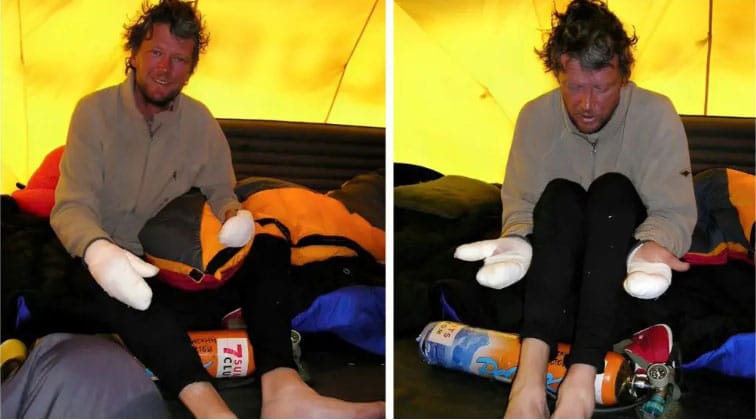
Hall was in a precarious physical state. His fingers had turned yellow and waxy, frozen nearly halfway to the tips. He wore only a thin fleece top over his exposed body, hallucinating from hypoxia, convinced at times that he was on a boat.
“He kept saying things like, ‘Strange boat ride we are on here, huh?’ and ‘Wow, you guys are on this boat ride too?’” Mazur recalled.
Despite his confused state, the rescuers moved quickly, helping Hall into harnesses, providing oxygen, and giving him water and Snickers bars to stabilize him.
The rescue was not without consequence. Mazur and his climbing team were forced to abandon their summit attempt due to the time and oxygen spent aiding Hall.
“The four hours we had lost made it risky to go on,” Mazur said, reflecting on the thin line between life and death at extreme altitudes.
Storms were always a looming threat, and every breath of supplemental oxygen was precious. Even with their own lives at stake, the team acted on a moral imperative that transcended ambition. “I feel humbled, very humbled, by the whole thing.
Sometimes you feel about an inch big. Just tiny. Like you are just a little pea,” Mazur admitted, conveying the overwhelming scale of Everest and the fragility of human life in such an environment.
Hall’s survival was nothing short of miraculous. After being stabilized by Mazur and the Sherpas, he was eventually transported back to base camp, where he received medical attention for frostbite and brain swelling caused by altitude sickness.
Hall’s condition was critical yet improving, and he would ultimately make a full recovery.
His story quickly captured global attention, a testament to both human resilience and the life-or-death decisions climbers must make in the “death zone,” where oxygen is scarce and temperatures plummet to life-threatening lows.
The events surrounding Hall’s near-death highlight the extreme risks associated with Everest, especially the “death zone” above 26,000 feet, where climbers often vanish without a trace.
In recent years, social media has amplified awareness of these dangers, with TikTok and other platforms showcasing both cautionary tales and awe-inspiring feats.
Hall’s experience underscores how quickly conditions can turn lethal, and how critical the presence of skilled and ethical guides can be when survival hangs in the balance.
Even in his hallucinatory state, Hall’s awareness of the rescue team’s presence marked a turning point. Mazur instructed him to put on gloves and a hat and zip up his coat, but Hall’s reactions were erratic, a mix of confusion and instinct.
The oxygen deprivation had left him vulnerable to hallucinations and misperceptions of his environment, yet he remained alive, a living testament to the unpredictability of survival at extreme altitudes.
Hall’s story is also a human narrative of compassion, courage, and moral choice. Climbers face impossible decisions: leave a presumed-dead colleague to continue their ascent, or risk their own safety to rescue someone clinging to life.
Mazur’s team chose the latter, demonstrating that in the most brutal and isolating places on Earth, acts of humanity can persist.
Their intervention not only saved Hall’s life but also ensured that his story would endure as an extraordinary example of survival against staggering odds.
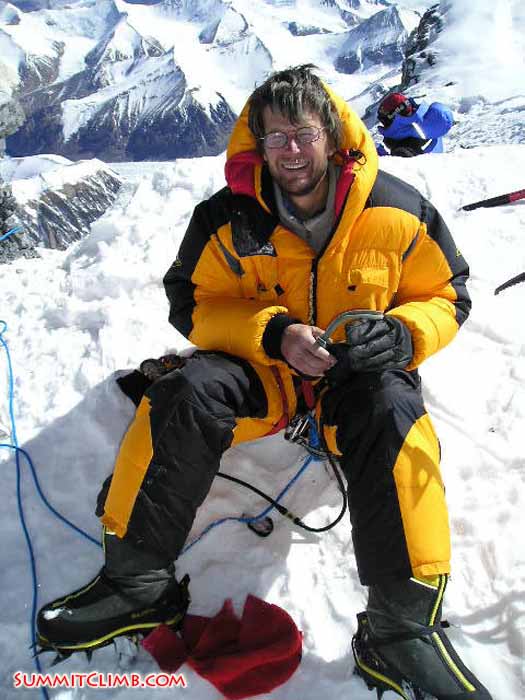
Reflecting on the experience, Mazur expressed deep respect for both Hall and the mountain itself. Everest is a place of sublime beauty but also relentless danger, where one misstep, a few lost seconds, or a misjudged breath can mean the difference between life and death.
Hall’s survival illustrates the fine balance between human fragility and resilience, as well as the profound impact that the decisions of others can have in moments of crisis.
Lincoln Hall went from being pronounced dead and left exposed to reclaiming life, health, and a story that would inspire adventurers and non-climbers alike.
The event serves as a stark reminder of the perilous nature of high-altitude climbing and the extraordinary courage of those willing to intervene against impossible odds.
His full recovery, coupled with the selflessness of Dan Mazur and the Sherpas, remains one of Everest’s most remarkable survival narratives.
Ultimately, Hall’s experience is more than a tale of extreme mountaineering; it is a story about survival, humanity, and the thin line between life and death.
In a place where oxygen is limited, temperatures are lethal, and the terrain is unforgiving, one man’s life hung in the balance, and the ethical choice of a few climbers ensured he returned to tell the story.
Lincoln Hall’s improbable rescue continues to captivate, a haunting and inspiring tale of courage, perseverance, and the miraculous endurance of the human spirit in the face of nature’s most extreme trials.
News
Doomsday From the Sky: The Shocking New Timeline of the Day the Dinosaurs Were Erased
A reconstructed scientific timeline details the minute-by-minute destruction unleashed when the Chicxulub asteroid struck Earth 65 million years ago. …

Descubrimiento de una Civilización Perdida Bajo Angkor Wat: Un Enigma Científico
A vast urban network buried beneath Angkor Wat has been revealed through LiDAR and radar imaging, uncovering roads, canals, reservoirs,…
Palace Denies Prince Harry Informed Them About Canada Trip, but His Team Says He Did
Prince Harry traveled to Canada for Remembrance Day events, surprising Buckingham Palace aides despite his team claiming they informed them….
Exiled and Exposed! Former Prince Andrew Spotted Riding Alone at Windsor as Royal Titles Erased and Falklands Honors Vanish!
Former Prince Andrew was spotted horseback riding at Windsor Castle for the first time since losing his royal titles and…

BBC Issues Rare Apology to Kate Middleton After Remembrance Broadcast Backlash
The network received criticism over the Princess of Wales’ titles after covering the royal family’s Remembrance tributes In…

Wall Street in ‘extreme fear’ as stocks plunge AGAIN amid fears world’s biggest company is a dud
Wall Street suffered another sharp sell-off as major indexes and Bitcoin extended their steep November declines. Investors are gripped by…
End of content
No more pages to load






