
Antarctica’s ice shelves could collapse by 2300, causing up to 32 feet of global sea-level rise. Coastal cities worldwide, including Miami, London, and Shanghai, face severe flooding and mass evacuations. Urgent action on greenhouse gas emissions is critical to prevent irreversible damage.

A chilling new study has delivered a stark warning for humanity’s future: more than half of Antarctica’s ice shelves could collapse by the year 2300, unleashing up to 32 feet of irreversible sea-level rise that would permanently reshape coastlines around the globe.
If current greenhouse gas emissions continue their relentless climb, millions of people in major cities could be forced to abandon their homes as oceans swallow their streets.
Scientists from Sorbonne University in Paris have modeled the fate of 64 Antarctic ice shelves, which act as critical “brakes” holding back the massive glaciers of the frozen continent.
These ice shelves, floating extensions of the Antarctic ice sheet, are essential for regulating the flow of ice into the oceans. Once they thin or break apart, the grounded ice behind them accelerates toward the sea, drastically increasing global sea levels.
Under a low-emission scenario, where global warming is limited to below 2°C by 2300, only one ice shelf is projected to become non-viable.
But under a high-emission scenario, in which global temperatures could climb a staggering 12°C by the end of the century, the outlook is apocalyptic: 38 ice shelves, or 59 percent, could collapse. This would contribute to a catastrophic 10-meter (32-foot) rise in sea level.

“The viability of ice shelves strongly depends on the emission scenario,” the researchers explained. “Only one ice shelf becomes likely or very likely non-viable by 2300 in the low-emission scenario compared with 59% in the high-emission scenario.”
In other words, the choices humanity makes today could dramatically affect whether Antarctic ice shelves survive for centuries—or vanish entirely.
While 2300 may seem distant, the impact would begin much sooner. The period between roughly 2085 and 2170 is expected to see the highest rate of ice shelf collapse, according to the study.
The researchers caution that their projections are conservative, meaning the melting and retreat of ice could happen even earlier, particularly due to processes such as rifting, hydrofracturing, or calving.
The consequences of such a dramatic rise in sea level are staggering. In the United States, entire stretches of Florida, Louisiana, and Texas could be permanently submerged.
Cities like Miami, New Orleans, and Houston would face mass evacuations as neighborhoods vanish beneath rising waters.
On the East Coast, tidal flooding is expected to dramatically increase, with mid-Atlantic locations such as Annapolis, Washington, D.C., and parts of New Jersey potentially experiencing hundreds of flooding events annually by 2030.
Even moderate sea-level rise could triple the number of annual tidal floods in some communities.

Across the Atlantic, the United Kingdom would see similarly devastating effects. Coastal cities including Hull, Portsmouth, Bristol, Southend-on-Sea, Middlesbrough, Blackpool, and Cardiff could be underwater.
London itself would not escape the crisis: areas along the Thames, from Hammersmith to Greenwich and Southwark to Westminster, face severe inundation.
By 2040, a rise of just 6.5 feet (2 meters) would see large parts of Kent almost completely submerged, with Cambridge, Peterborough, and towns along the Humber Estuary, including Hull, Scunthorpe, and Grimsby, at serious risk.
Other European coastal areas are not safe either. The coast stretching from Calais, France, to Ringkobing, Denmark, would disappear beneath rising seas, while iconic cities like Venice, Montpellier, Seville, and Lisbon would face devastating flooding.
In Asia, low-lying regions, particularly Bangladesh, could see massive displacement, while major cities like Shanghai, Ho Chi Minh City, and Karachi are also at severe risk.
The researchers emphasized that the collapse of Antarctic ice shelves would not just be a distant threat for future generations—it will have lasting, irreversible consequences for all humanity.
“Our results show that current choices to change emission pathways could significantly affect the likelihood of the long-term loss of most Antarctic ice shelves,” they said.
The study underscores the urgent need for global action to reduce greenhouse gas emissions if catastrophic sea-level rise is to be avoided.

Even individual glaciers in Antarctica, like the infamous Thwaites Glacier in West Antarctica, could have a dramatic effect on sea levels if they collapse.
Estimates suggest that the fall of this single glacier could raise global sea levels by as much as 10 feet (3 meters), threatening coastal cities worldwide—from New York and Sydney to low-lying nations like the Maldives.
A domino effect of glacier collapse could mean that what begins as incremental melting in the polar regions rapidly escalates into a global crisis.
The reality is that the world’s population is unprepared for such an event. Urban areas built along coasts, where millions live and billions in infrastructure exist, would be the first casualties of rising oceans.
Experts warn that tidal flooding, once a rare nuisance, could become an everyday emergency in many parts of the world. Communities already vulnerable to extreme weather and rising tides will see these threats compounded, further straining resources and infrastructure.
The study’s findings are a clarion call. Without drastic and immediate reductions in greenhouse gas emissions, humanity is on track to trigger a chain reaction of ice shelf collapses that will redraw the map of the planet.
Coastal cities, entire nations, and millions of lives hang in the balance. Scientists stress that while some of these changes may unfold over centuries, the trajectory we are on now makes it a certainty that global sea levels will rise significantly—and sooner than many expect.
For the U.S., the U.K., Europe, and Asia, the implications are clear: action—or inaction—today determines whether future generations inherit a world of submerged cities and displaced populations.
The clock is ticking, and the icy margins of Antarctica may hold the key to the survival of billions.

News
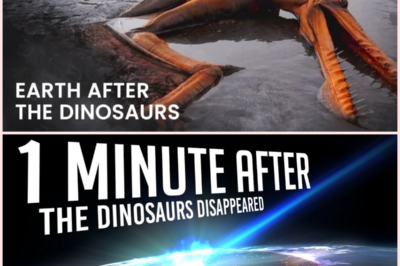
Doomsday From the Sky: The Shocking New Timeline of the Day the Dinosaurs Were Erased
A reconstructed scientific timeline details the minute-by-minute destruction unleashed when the Chicxulub asteroid struck Earth 65 million years ago. …

Descubrimiento de una Civilización Perdida Bajo Angkor Wat: Un Enigma Científico
A vast urban network buried beneath Angkor Wat has been revealed through LiDAR and radar imaging, uncovering roads, canals, reservoirs,…

Palace Denies Prince Harry Informed Them About Canada Trip, but His Team Says He Did
Prince Harry traveled to Canada for Remembrance Day events, surprising Buckingham Palace aides despite his team claiming they informed them….

Exiled and Exposed! Former Prince Andrew Spotted Riding Alone at Windsor as Royal Titles Erased and Falklands Honors Vanish!
Former Prince Andrew was spotted horseback riding at Windsor Castle for the first time since losing his royal titles and…

BBC Issues Rare Apology to Kate Middleton After Remembrance Broadcast Backlash
The network received criticism over the Princess of Wales’ titles after covering the royal family’s Remembrance tributes In…

Wall Street in ‘extreme fear’ as stocks plunge AGAIN amid fears world’s biggest company is a dud
Wall Street suffered another sharp sell-off as major indexes and Bitcoin extended their steep November declines. Investors are gripped by…
End of content
No more pages to load






