NASA’s Perseverance rover has detected unusual rock formations in Mars’ Jezero crater that contain organic compounds and minerals typically linked to microbial activity on Earth.

In a groundbreaking revelation that has sent shockwaves through the scientific community, NASA may have unearthed the first credible signs of life on Mars.
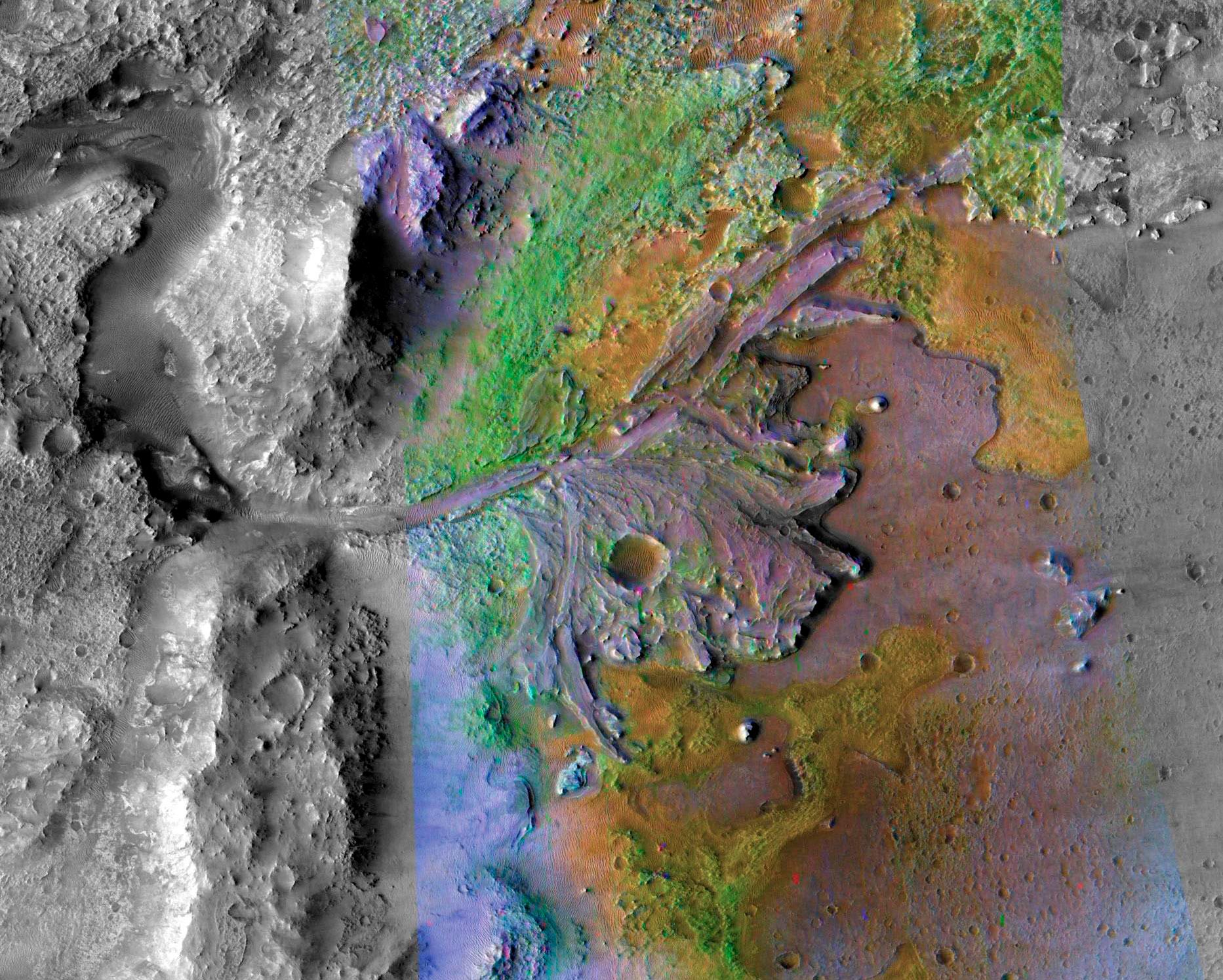
The Perseverance rover, affectionately known as “Percy,” has captured stunning images and data from the Jezero crater, an ancient lake bed
that once harbored water, where it stumbled upon peculiar rock formations that could hold the key to understanding whether we are alone in the universe.
This extraordinary find has ignited a firestorm of excitement and skepticism among astrobiologists, as the implications of this discovery could reshape our understanding of life beyond Earth.
Since its landing in February 2021, Perseverance has been on a mission to hunt for ancient microbial life. The Jezero crater, a site rich in clay minerals and sediment, is considered one of the best locations to search for these elusive signs of life.
Astrobiologists believe that ancient lakes like Jezero often contain perchlorate, a chemical that can be metabolized by microbes, making it a prime candidate for hosting life.
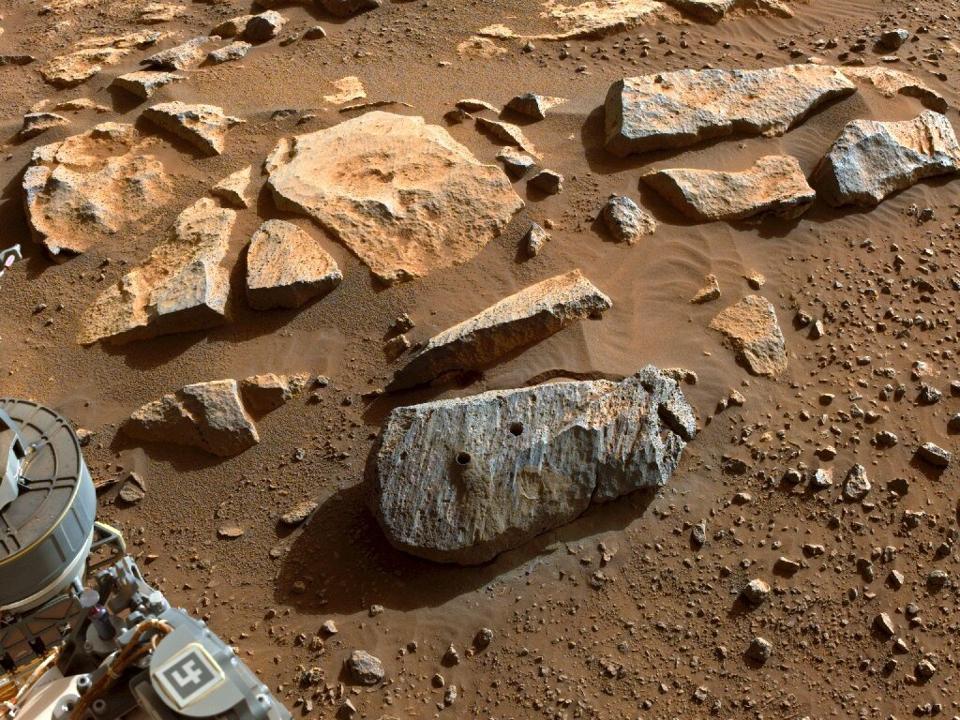
In July 2024, while exploring the edges of the ancient Neretva Vallis river channel, Percy’s cameras captured something astonishing: a rock formation from the Bright Angel formation, which exhibited unusual features.
Utilizing its advanced instruments, the rover detected sedimentary rocks composed of clay and silt—materials known to preserve microbial life on Earth.
Among these findings were two distinct formations, dubbed “Leopard Spots” and “Poppy Seeds,” which contained organic compounds such as carbon, phosphorus, and iron, arranged in intriguing patterns that span from 200 micrometers to 1 millimeter in diameter.
The implications of these findings are staggering. The light inner part of the Leopard Spot is chemically similar to its surrounding rock, while the dark outer rim is enriched with iron and phosphorus, indicating a potential biological process.
This combination of organics, water, and iron reduction is typically interpreted as evidence of microbial life on Earth, prompting scientists to wonder: could this mudstone rock be the first alien biosignature ever discovered?
At the heart of this investigation are two minerals: vivianite and greigite. Vivianite forms in environments where microbes metabolize iron, while greigite is created through the actions of sulfate-reducing microorganisms.
However, skeptics urge caution, suggesting that high temperatures or organic matter could also explain these reduction reactions.
Yet, the absence of evidence for volcanic activity or high temperatures in the area raises questions about these alternative explanations.
Adding to the intrigue, Percy unearthed a small rock of olivine, a mineral that challenges the acidic water hypothesis.
Olivine is known for its rapid weathering in acidic conditions, so its presence suggests that the Martian environment was not as acidic as previously thought, further complicating the narrative around the formation of these mysterious spots.
As excitement mounts, NASA remains cautious. The agency has a history of premature declarations regarding potential biosignatures on Mars. In 1976, the Viking Lander claimed to have found evidence of life, only for subsequent missions to debunk those findings.
Similarly, the discovery of the ALH 84001 meteorite in 1996, which appeared to contain fossilized bacteria, was later ruled non-biological.
With such a tumultuous history, NASA is treading carefully, emphasizing that while the findings are intriguing, they do not constitute definitive proof of life.
The next step in this thrilling saga is the Mars Sample Return mission, a complex endeavor that aims to bring samples from Mars back to Earth for further analysis.
This mission involves multiple spacecraft and has faced numerous delays and funding challenges, but the recent discoveries could reignite interest and support for its completion.
If successful, scientists will have the opportunity to conduct detailed experiments, looking for key indicators of life, such as chirality and carbon isotope ratios.
These tests could provide compelling evidence of biological activity and help clarify the origins of life on Earth and beyond.
The potential ramifications of this discovery are monumental. If the samples reveal signs of life, it would suggest that Mars was habitable far longer than previously believed, raising profound questions about the nature of life in the universe.
Did life on Earth and Mars share a common origin? Or did life arise independently on both planets?
The implications for our understanding of the Drake Equation, which estimates the number of extraterrestrial civilizations, could be transformative, suggesting that life is not as rare as once thought.
As we stand on the precipice of potentially answering one of humanity’s oldest questions—are we alone in the universe?—the excitement surrounding NASA’s findings continues to grow.
Whether these discoveries lead to confirmation of alien life or merely deepen our understanding of planetary conditions, they mark a significant milestone in our quest to explore the cosmos.
The journey to uncover the truth about life on Mars is just beginning, and the world watches with bated breath as we await the results of future missions and experiments.
The possibility of life beyond Earth is tantalizingly close, and the implications of what we might discover are bound to change everything we thought we knew about our place in the universe.
News

Descubrimiento de una Civilización Perdida Bajo Angkor Wat: Un Enigma Científico
A vast urban network buried beneath Angkor Wat has been revealed through LiDAR and radar imaging, uncovering roads, canals, reservoirs,…

Palace Denies Prince Harry Informed Them About Canada Trip, but His Team Says He Did
Prince Harry traveled to Canada for Remembrance Day events, surprising Buckingham Palace aides despite his team claiming they informed them….

Exiled and Exposed! Former Prince Andrew Spotted Riding Alone at Windsor as Royal Titles Erased and Falklands Honors Vanish!
Former Prince Andrew was spotted horseback riding at Windsor Castle for the first time since losing his royal titles and…

BBC Issues Rare Apology to Kate Middleton After Remembrance Broadcast Backlash
The network received criticism over the Princess of Wales’ titles after covering the royal family’s Remembrance tributes In…

Wall Street in ‘extreme fear’ as stocks plunge AGAIN amid fears world’s biggest company is a dud
Wall Street suffered another sharp sell-off as major indexes and Bitcoin extended their steep November declines. Investors are gripped by…

NASA’s Stunning Revelation: Interstellar Object 3I/ATLAS Faces Catastrophic CME Impact!
NASA announced that the interstellar object 3I/ATLAS is about to be struck by a solar coronal mass ejection, potentially triggering…
End of content
No more pages to load