
New drone footage reveals missing hatch clamps and critical structural flaws aboard the SS Edmund Fitzgerald, challenging decades-old theories about its sinking.

On a stormy November night in 1975, the SS Edmund Fitzgerald—a colossal freighter once deemed unsinkable—met a tragic fate on the unforgiving waters of Lake Superior.
This maritime disaster claimed the lives of all 29 crew members aboard, leaving behind a haunting mystery that has perplexed experts and enthusiasts for nearly half a century.
Now, groundbreaking new evidence from a state-of-the-art underwater drone has surfaced, challenging long-held beliefs about what truly happened on that fateful night and revealing shocking secrets that could change everything we thought we knew.
The SS Edmund Fitzgerald, launched in 1958, was a marvel of engineering. At 729 feet long and weighing over 13,000 tons when empty, she was the largest freshwater freighter ever built, earning nicknames like “the pride of the American side” and “the queen of the lakes.”
Her primary mission was to transport iron ore pellets from the mines of Minnesota to steel mills in Detroit, and for 17 years, she did so with unmatched speed and reliability.
Known for her prowess on the water, the Fitzgerald became more than just a vessel; she developed a personality, a sense of pride among her crew, many of whom dedicated their careers to her.
However, the Great Lakes are notorious for their treacherous conditions, particularly during the late fall.
The infamous “Witch of November” can unleash violent storms with hurricane-force winds and towering waves, and the Fitzgerald had weathered many of these tempests without incident.
But on November 9, 1975, as the ship set out loaded with over 26,000 tons of iron ore, the forecast predicted a brewing storm that would soon escalate into a maritime nightmare.

As the Fitzgerald and the nearby Arthur M. Anderson sailed across Lake Superior, they maintained radio contact, navigating through worsening conditions.
Captain Ernest McSorley, a seasoned veteran, assured the Anderson that they were “holding our own,” despite reporting a concerning list to the ship. Tragically, this would be the last communication received from the Fitzgerald.
Within minutes, the ship vanished from radar, and a frantic search yielded only lifeboats and debris—no survivors, no mayday calls, just silence.
The wreck of the Fitzgerald was discovered days later, lying in 530 feet of water, split into two large sections.
The official Coast Guard report attributed the sinking to flooding caused by ineffective hatch closures, suggesting that monstrous waves had breached the deck, allowing water to flood the cargo holds and ultimately break the ship apart.
However, this conclusion faced fierce backlash from the families of the crew, who believed it unjustly blamed them for a tragedy beyond their control.
For decades, the mystery deepened, with various theories surfacing to explain the Fitzgerald’s demise. Some speculated that the ship struck an uncharted shoal or was overwhelmed by a rogue wave.
Yet, the true cause remained elusive—until now. Nearly 50 years after the sinking, a high-tech expedition utilizing an underwater drone equipped with 4K cameras and advanced AI technology set out to investigate the wreck in unprecedented detail.
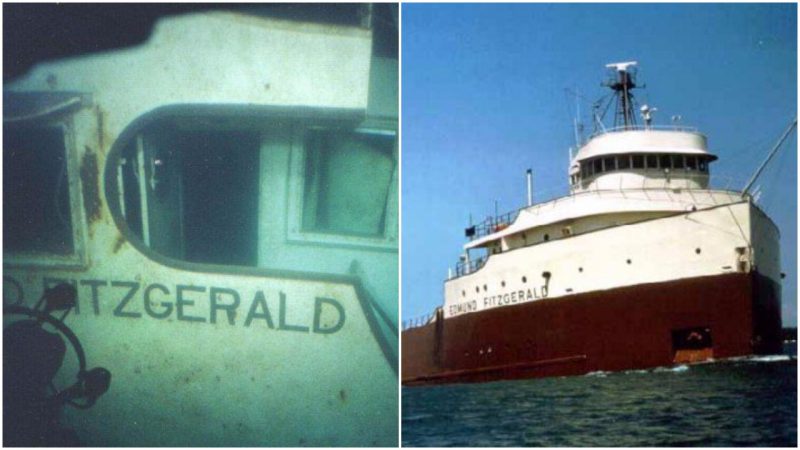
As the drone descended into the frigid depths of Lake Superior, it captured stunning footage of the Fitzgerald’s bow, revealing a hauntingly familiar sight—the ship’s name still faintly visible, but the structure twisted and damaged.
The mission’s focus was clear: to examine the cargo hatches, which had been the center of the longstanding debate.
As the drone scanned the hatches, investigators were shocked to discover missing clamps—critical components designed to secure the hatches against the relentless forces of nature.
What began as a single missing clamp quickly escalated into a pattern of alarming findings. Multiple hatches displayed missing or damaged clamps, suggesting a systematic failure of the ship’s defenses against the storm.
This evidence contradicted the original Coast Guard theory, shifting the blame away from the crew and onto the ship itself.
The Fitzgerald, it appeared, was not just a victim of nature but a vessel with fatal design flaws that had been compromised over years of service.
The drone’s investigation unearthed further chilling revelations. Among the debris, investigators found a gaping hole where an air vent pipe had once been—a catastrophic breach that would have allowed water to flood the cargo holds at an astonishing rate.
Simulations indicated that in the face of 35-foot waves, this breach, combined with the compromised hatch covers, would have led to an overwhelming influx of water, potentially thousands of gallons per minute.
This new evidence painted a grim picture: the Fitzgerald was likely flooding long before the crew even realized the severity of their situation.

As the ship’s bow sank lower, it acted like a scoop, forcing the vessel into a catastrophic nosedive as it met oncoming waves.
The drone footage confirmed that the ship did not simply break apart; it was torn asunder by the forces of physics, with the weight of the waterlogged bow causing a structural failure that had been building for years.
This new timeline of events absolved the crew of blame and pointed to a much more terrifying truth: the SS Edmund Fitzgerald was a ticking time bomb, doomed by design.
Despite this compelling evidence, speculation continues to swirl. Some marine theorists suggest the involvement of rogue waves—three massive waves that could have overwhelmed the Fitzgerald in seconds.
Others propose more esoteric possibilities, like harmonic resonance causing the ship’s steel to vibrate into failure, or even bizarre magnetic anomalies disrupting the vessel’s electronics.
These theories add layers of intrigue to an already tragic tale, suggesting that the storm’s fury may have been compounded by forces beyond human understanding.
As the secrets of the SS Edmund Fitzgerald are finally revealed, the question remains: does knowing the truth make the tragedy any less haunting?
The ship that once stood as a symbol of human ingenuity now serves as a stark reminder of nature’s power and the fragility of even the mightiest vessels.
The legend of the Fitzgerald lives on, but with it comes a deeper understanding of the forces that claimed her and the lives of those aboard.
What do you think happened that night? Share your thoughts below, and don’t forget to like and subscribe for more captivating stories from the depths of history.
News

Doomsday From the Sky: The Shocking New Timeline of the Day the Dinosaurs Were Erased
A reconstructed scientific timeline details the minute-by-minute destruction unleashed when the Chicxulub asteroid struck Earth 65 million years ago. …

Descubrimiento de una Civilización Perdida Bajo Angkor Wat: Un Enigma Científico
A vast urban network buried beneath Angkor Wat has been revealed through LiDAR and radar imaging, uncovering roads, canals, reservoirs,…

Palace Denies Prince Harry Informed Them About Canada Trip, but His Team Says He Did
Prince Harry traveled to Canada for Remembrance Day events, surprising Buckingham Palace aides despite his team claiming they informed them….
Exiled and Exposed! Former Prince Andrew Spotted Riding Alone at Windsor as Royal Titles Erased and Falklands Honors Vanish!
Former Prince Andrew was spotted horseback riding at Windsor Castle for the first time since losing his royal titles and…

BBC Issues Rare Apology to Kate Middleton After Remembrance Broadcast Backlash
The network received criticism over the Princess of Wales’ titles after covering the royal family’s Remembrance tributes In…

Wall Street in ‘extreme fear’ as stocks plunge AGAIN amid fears world’s biggest company is a dud
Wall Street suffered another sharp sell-off as major indexes and Bitcoin extended their steep November declines. Investors are gripped by…
End of content
No more pages to load






