
“Scientists STUN the World With New DNA Discovery: The Shocking Genetic Origins of the Early English Revealed 🇬🇧🧬”
Forget everything you thought you knew about British ancestry. The story of the “stiff upper lip,” the Sunday roast, and the Queen’s English just got a wild DNA twist — and let’s just say, it’s less tea and crumpets, more Viking helmets and Germanic swords.
After centuries of speculation, shouting matches in history departments, and at least a dozen BBC documentaries narrated by very serious men in tweed, scientists have finally cracked the code on what makes the English, well… English.
And according to their latest findings, the roots of England’s population are a tangled double helix of Celtic survivors, Germanic invaders, and DNA that refuses to stop bickering about land rights.
So buckle up, because this is the story of how modern England was literally built — strand by strand.
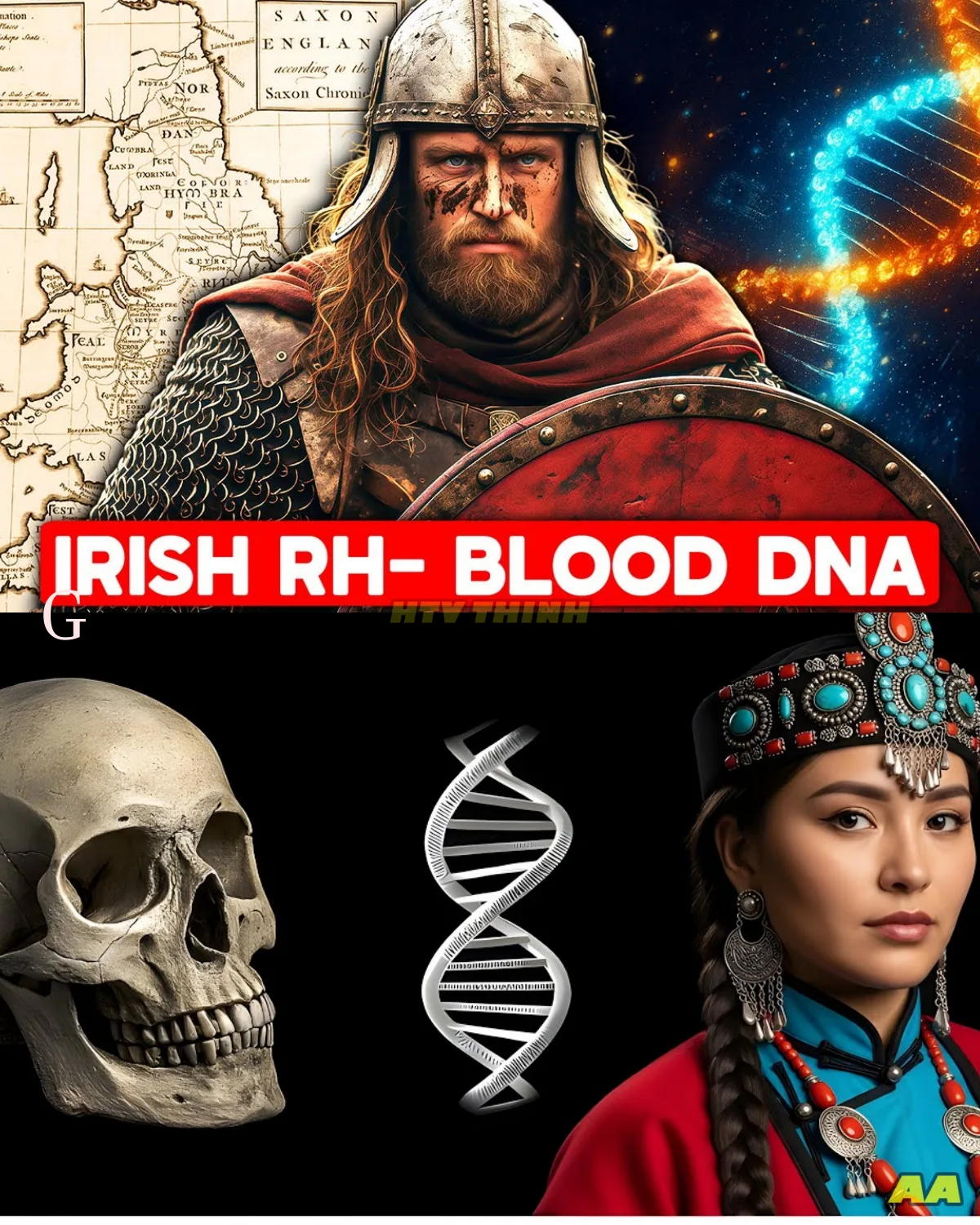
⚔️ THE GREAT MIGRATION THAT REWROTE HISTORY (AND EVERY FAMILY TREE IN ENGLAND)
For years, historians argued about the so-called “Anglo-Saxon invasion.” Was it a dramatic Game of Thrones–style takeover? Or just a bunch of northern Europeans showing up, saying “cheerio,” and introducing bad weather to southern Britain?
Now, thanks to a series of blockbuster studies in Nature and other scientific journals, we finally have an answer — and it’s juicier than a Tudor scandal.
According to researchers, when the Roman Empire crumbled around the 5th century CE, hordes of tribes from what’s now Germany, Denmark, and the Netherlands — the Angles, Saxons, Jutes, and Frisians — decided to cross the North Sea and settle in Britain.
Historians had long argued whether this migration was a trickle or a flood. But new DNA evidence says: forget the trickle. It was a tsunami.
🧬 “THE GENETIC EARTHQUAKE”: HOW 76% OF EARLY ENGLAND TURNED GERMANIC OVERNIGHT
In 2022, scientists analyzed the genomes of 460 ancient skeletons — and discovered that early medieval England wasn’t just influenced by the Anglo-Saxons. It was completely remade by them.
Up to 76% of the ancestry in eastern England came straight from northern Europe. In genetic terms, that’s basically a complete system reboot.
The remaining chunk of DNA came from the native Celtic Britons, descendants of Iron Age tribes who had already been conquered once by Rome and were about to get culturally steamrolled all over again.
“The Anglo-Saxon migration wasn’t just cultural,” said one researcher. “It was biological. Entire lineages moved in — and they brought their gods, their language, and their beer.”
Beer. Always beer.
🧠 THE GREAT GENE SWAP: CELTIC VS. SAXON
Before the Anglo-Saxons arrived, most men in Britain belonged to the R1B-L21 haplogroup — the genetic calling card of Celtic populations stretching from Ireland to France.
But post–Roman DNA samples tell a completely different story. Within a few centuries, this Celtic signature was dramatically replaced by northern European lineages like R1B-U106, I1-M253, and I2a1-L460.
Translation: England’s male gene pool got a total makeover. Goodbye, druid chic. Hello, Viking forearms.
Meanwhile, the Celts didn’t disappear completely. Their genes retreated westward into Wales, Scotland, and Ireland, where the old R1B-L21 haplogroup remains strong to this day — along with their cultural trademarks: whiskey, rebellion, and an undying hatred of London taxes.
💕 MARRYING THE ENEMY: THE ORIGINAL BREXIT COMPROMISE
But it wasn’t all bloodshed and conquest. DNA analysis of ancient burial sites shows that Anglo-Saxon settlers and Celtic Britons intermarried early and often — possibly out of love, but more likely out of the complete lack of Netflix or personal boundaries.
Female DNA samples reveal a smooth blend of European and British maternal haplogroups, like H1, K1, T2, and U5, proving that integration happened faster than historians expected.
“They didn’t just fight,” said one geneticist. “They flirted, farmed, and founded families together. The English were basically born from 300 years of awkward cultural exchange and questionable flirting.”
The result? A hybrid people — half Celtic heart, half Saxon steel — who would go on to conquer half the planet and still complain about the weather.
⚡ FRANKS, NORMANS, AND EVERYONE ELSE WHO TRIED (AND FAILED) TO REWRITE ENGLAND’S DNA
One shocking finding of the new studies is how little later invasions actually mattered genetically.
Take the Norman Conquest of 1066 — that event every schoolchild memorizes as the turning point of English history. Turns out, in DNA terms, it barely made a dent.
“The Normans left castles, not chromosomes,” quipped one historian.
Even the Franks from northern France, who mingled with the English in the post-Roman era, left only a faint trace — likely from small-scale trade or diplomatic visits, not mass migration.
So, while the French might have left their mark on English cuisine (bonjour, cheese and wine), their genetic impact was as fleeting as a Parisian apology.
🌾 HOW THE ANGLO-SAXONS BUILT ENGLAND — AND REWIRED ITS CULTURE
Genetics wasn’t the only thing that changed. The Anglo-Saxons didn’t just bring new blood — they brought a whole new blueprint for society.
They replaced the Roman villas and Celtic clans with “tuns” — small villages organized around kinship, loyalty, and the kind of community gossip that would make medieval England the birthplace of small-town drama.
Their society had three layers:
Thanes (nobility) — the influencers of the Dark Ages, basically.
Ceorls (free peasants) — your average taxpayers with livestock.
Thralls (slaves) — unlucky souls who probably didn’t enjoy the arrangement.
They worshipped Norse-style gods like Odin, Thor, and Tiw, whose names still echo in our weekdays. (Wednesday = Woden’s Day, Thursday = Thor’s Day, Tuesday = Tiw’s Day. You’re welcome for that useless pub trivia fact.)
Then Christianity arrived in the 7th century — and rather than burning the old temples, the English just… renamed them. Pagan feasts became church holidays. Woden turned into Saint Whoever. And nobody batted an eye.
That’s English pragmatism for you.
🏰 WHEN DNA MEETS DESTINY
Today, scientists estimate that modern English people carry between 10% and 40% Anglo-Saxon DNA, depending on geography. The East is still heavily Germanic, while the West clings proudly to its Celtic roots.
In other words: the farther you travel from London, the more likely you are to meet someone whose ancestors threw a spear at a Roman.
Modern haplogroup maps tell a similar story:
R1B-U106 — The Anglo-Saxon calling card, most common in central and eastern England.
R1B-L21 — The Celtic survivor, thriving in Scotland, Wales, and Ireland.
I1-M253 — The northern Scandinavian twist, courtesy of Vikings and their “raiding and chilling” lifestyle.
It’s a living map of conquest, marriage, and stubbornness — all embedded in the British genome.
🧪 THE SCIENCE BEHIND THE MYTH
How did scientists pull this off? Forget dusty scrolls — this is 21st-century detective work.
Researchers combined ancient genome sequencing with strontium isotope analysis (which can literally pinpoint where someone grew up by their teeth). The results confirmed that many early Anglo-Saxons were indeed immigrants from northern Germany and Denmark — precisely where medieval chroniclers had said they came from.
So yes, medieval monks were occasionally right. Who knew?
🇬🇧 THE REALITY OF “BEING ENGLISH”
So what does it mean to be English after all this? According to the science: everything and nothing.
England isn’t a single bloodline. It’s a genetic remix — Celtic rhythm, Saxon structure, Viking percussion, and a few French backing vocals.
It’s a nation forged by collision, cooperation, and centuries of accidental hybridization.
“There’s no such thing as pure English DNA,” one researcher concluded. “There’s only the ongoing experiment called England.”
And maybe that’s why the country works — most of the time.
It’s built from contradictions: pragmatic yet poetic, reserved yet rebellious, polite yet perpetually annoyed. A nation where Odin’s name lingers on a calendar, while the descendants of his worshippers queue politely for coffee.
🔬 FINAL THOUGHTS: THE DNA THAT BUILT A COUNTRY
The real shock isn’t that modern English people are part German, part Celtic. It’s that the fusion — the messy blend of genes, beliefs, and traditions — worked so well that it produced Shakespeare, Newton, Churchill, and The Beatles.
It turns out the English didn’t just inherit DNA. They inherited adaptability.
So next time someone insists on defining “true Englishness,” remind them: it’s not about bloodlines. It’s about surviving 1,500 years of invasion, famine, plague, and cultural chaos — and still having time for afternoon tea.
Because if there’s one thing the DNA proves beyond all doubt, it’s this:
News
Mind-Blowing Secrets of Cheech & Chong — The Untold Stories, Wild Moments & Hidden Truths Fans NEVER Knew About the Iconic Duo
There is a strange, almost painful truth buried beneath the laughter that Richard “Cheech” Marin and Tommy Chong gave the…
64 Years After His Death, Lou Costello’s Daughter Finally Reveals the Truth Behind Their Family’s Most Emotional Secret — Fans Are STUNNED
64 YEARS AFTER HIS DEATH, LOU COSTELLO’S DAUGHTER FINALLY REVEALS THE TRUTH — AND IT’S NOTHING LIKE WHAT YOU’VE HEARD…
Everyone Is Suddenly Talking About Farrah Fawcett Again — And You Won’t Believe the Stunning Reason Her Legacy Just Roared Back Into the Spotlight
Everyone Is Suddenly Talking About Farrah Fawcett Again — And the Real Reason Will Break You In 2025, Hollywood has…
At 81, Jimmy Page FINALLY Addresses His Complicated History With Eddie Van Halen — “People Have NO Idea What Really Went On…
Jimmy Page at 81: “Why I HATED Eddie Van Halen” — The Truth Behind the Guitar Gods’ Cold War Picture…
‘The View’ CLASHES With Stephen A. Smith — Hosts Push for an Apology, but His Response Turns the Studio UPSIDE DOWN
Stephen A. Smith SHUTS DOWN ‘The View’ On Live TV — Their Attempt to Corner Him Backfires Spectacularly It started…
Demi Moore FINALLY Speaks Out — Her Revealing Words About Ashton Kutcher Leave Hollywood GASPING: “This Is the Part I Never Told…
DEMI MOORE FINALLY SPEAKS: THE SHATTERING RECKONING BEHIND HER FAIRY-TALE DIVORCE — “I LOST MYSELF TO KEEP HIM” Demi Moore…
End of content
No more pages to load






