
The late afternoon light slanted through the high windows of the parlor, painting the floorboards in golden bars. Dust motes hung motionless in the still air, suspended as though time itself hesitated to intrude upon the solemn gathering below. The Langley family had assembled — six men in black coats, their polished boots aligned with military precision, and four young women kneeling before them, their dresses the muted gray of modest virtue.
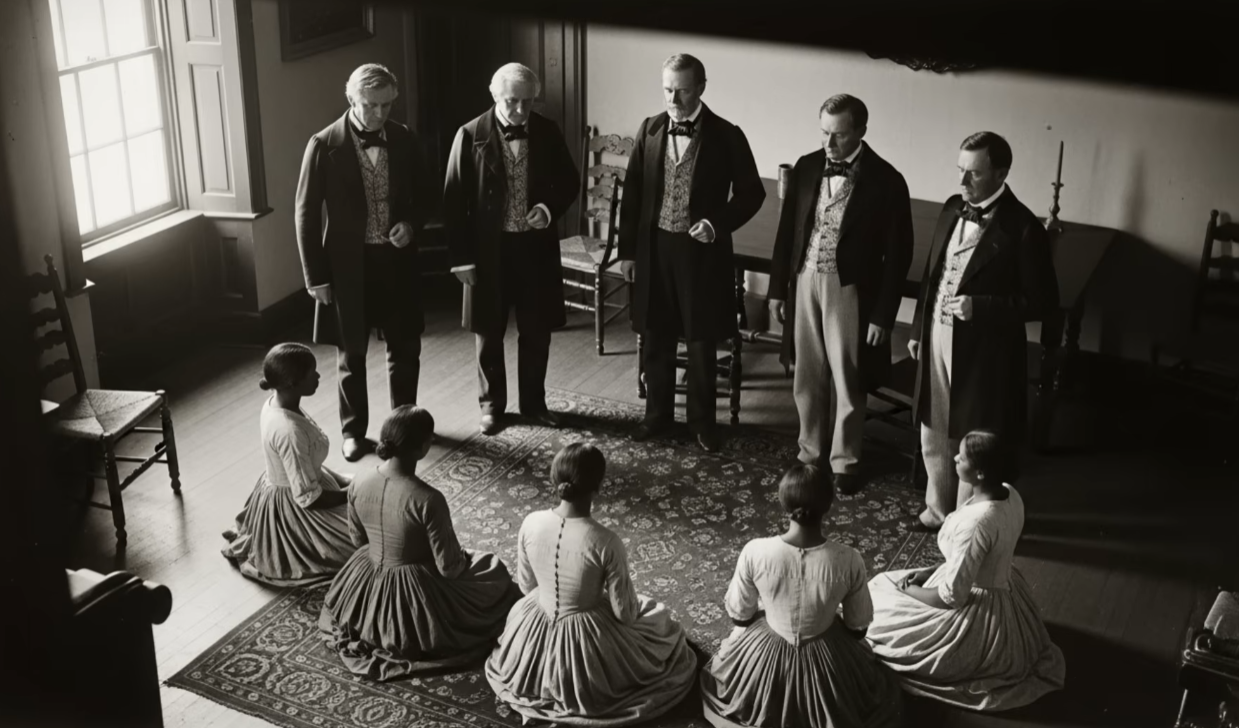
To an unknowing observer, it might have seemed a portrait of harmony, a tableau of domestic order preserved for posterity. Yet beneath the stillness, something darker pulsed — an undercurrent of fear too quiet to name.
It was the third Sunday of the month, the day the Langleys always convened for what they called the Recitation. The men stood in a semicircle, hands clasped behind their backs, their eyes trained on the women kneeling at their feet. The air was heavy with ritual — the slow creak of the wooden floor, the whisper of fabric as the girls shifted ever so slightly.
At the head of the semicircle stood Patriarch Edmund Langley, his silver hair gleaming beneath the lamplight. He was a man of impeccable manners and precise words, a judge in the city and a moral compass for those who lived under his roof.
“Begin,” he said softly.
The women spoke in unison, their voices fragile but measured, reciting passages from a book that lay open on the table behind the men — not the Bible, but a leather-bound volume embossed with an unfamiliar sigil: an ouroboros encircling a key.
Each word seemed to weigh more than the last, as though they were reciting not a prayer, but an incantation.
That afternoon, there was a guest in attendance — Jonathan Reeves, a young historian invited under the pretense of cataloguing the Langley archives. He stood near the back of the room, notebook in hand, his heart pounding as he watched the ceremony unfold.
He had been told that the Langleys were an old family, keepers of traditions dating back to the colonial era. But what he witnessed felt older still — something primal, a dance between power and submission masked as etiquette.
The women never raised their eyes. When the eldest stumbled on a line, Edmund’s gloved hand twitched, and a ripple of unease passed through the room. Jonathan felt the air shift — as if the walls themselves were holding their breath.
When the recitation ended, the women bowed their heads, waiting for permission to rise. Edmund gave a single nod, and only then did they stand.
“Thank you, Father,” they said in unison.
Father. Not father-in-law. Not uncle. Jonathan had been told these were nieces, daughters, perhaps wards. But the way they said it — the way their voices quavered with reverence and dread — made his stomach twist.
After dinner, Jonathan was invited into the study to see the family’s ancestral portraits. The walls were lined with sepia-toned photographs — stern men in frock coats, women with lace collars and distant eyes. Yet one photo drew his attention immediately.
It was almost identical to what he had witnessed that very afternoon: six men standing in a semicircle, four women kneeling before them on the same patterned rug. But the date in the corner read 1843.
The faces were eerily similar — as if time had not merely preserved the likeness, but repeated it.
Jonathan leaned closer. Beneath the glass, the image had faded, but one small detail stood out — the women’s necks. Around each one was a faint, dark mark, almost like a bruise.
He blinked, looked again. No — not bruises. Brands.
The House’s Secret
That night, long after the household had gone to bed, Jonathan wandered through the corridors of the Langley home.
The silence was oppressive, broken only by the soft ticking of a clock somewhere deep within the house.
He passed the locked doors of the daughters’ rooms — no sound from within. Only stillness.
At the end of the hall, he found a door left ajar. Inside was a small, windowless chamber lit by a single candle. On the wall hung a tapestry bearing the same ouroboros symbol. Beneath it, a wooden chest sat half-open, revealing old papers bound in twine.
He knelt and unfolded one — a record written in Edmund’s precise hand. “The lineage must remain pure. Each generation renews the covenant through obedience and sacrifice. The daughters must kneel before the patriarchs, as it was and shall be.”
Jonathan’s throat went dry. Another entry, dated only a few years prior, read: “The Recitation ensures remembrance. The blood must not be diluted. The ritual binds the soul to the house. Without it, we are unmoored.”
A noise behind him made him spin. One of the young women — the eldest, perhaps twenty — stood in the doorway. Her eyes were wide but calm.
“You shouldn’t be here,” she whispered.
“What is this?” Jonathan demanded. “What are they doing to you?”
She shook her head. “It isn’t what they do to us. It’s what they make us become.”
Before he could ask more, she vanished down the corridor, her footsteps silent on the wood.
The Truth Revealed
The next morning, Jonathan prepared to leave. Edmund greeted him with his usual, polished civility, insisting he take breakfast before departing. The family gathered once more, as though nothing unusual had occurred.
But as Jonathan sipped his coffee, his gaze fell upon the women — their sleeves rolled slightly back as they poured tea. And there it was again — that mark at the base of each wrist, faint but unmistakable.
Not a bruise. Not a tattoo.
A brand.
And when one of them glanced up, her eyes met his for the briefest moment. They were not pleading, nor frightened — but ancient, knowing. The eyes of someone who had seen generations pass through the same ceremony, the same walls, the same cycle.
Jonathan left that morning, but the image burned into his mind: the semicircle of men, the kneeling women, the quiet obedience.
He later wrote about the Langleys — but the manuscript was never published. Friends said he withdrew from society soon after, claiming to hear whispers in his sleep, the echo of voices reciting in unison.
And sometimes, when the afternoon light fell just right, he swore he saw them again — six men and four women — standing in his reflection, waiting for the next Recitation to begin.
Years later, when the Langley estate was finally sold, workers discovered a sealed room beneath the parlor. Inside were dozens of portraits, each identical to the last — six men standing, four women kneeling — stretching back more than a century.
And at the center of the floor, carved deep into the wood, was that same symbol: an ouroboros encircling a key.
It was just a formal family gathering, they said.
But one detail — the brands, the circle, the repetition — revealed a horrifying truth:
The Langleys had never been a family at all.
They were the keepers of something far older, and it was still waiting beneath the house.
News

🐹 At 62, Julian Lennon Admits “I Utterly Hated Her”
Julian Lennon was born into a world that already belonged to someone else — a world consumed by Beatlemania and…

🐹 Top 6 Actors Ron Howard Hated the Most – You Won’t Believe Who’s!
Hollywood has spent decades painting Ron Howard as the industry’s gentle soul — the calm director, the childhood icon, the…
🐹 Photo from 1961: A Maid Poses Behind the Family… But Her Fate Was Very Different
In the dusty boxes of an estate sale in Veracruz, a single photograph was discovered wedged between yellowed newspapers from…

🐹 What They Found In Gene Hackman’s Mansion Will Leave You Sh*cked
Police Photos Taken Inside Gene Hackman and Betsy Arakawa’s $4 Million Home Show It Filled With Clutter and Garbage. Santa…

🐹 The Top 7 Actors Harrison Ford Refused To Forgive
Hollywood loves its legends quiet, polished, and polite. But Harrison Ford was never built for that kind of performance. Behind…

🐹 US forces kill 3 narco-terrorists in Eastern Pacific lethal strike operation targeting drug networks
U.S. forces carried out a lethal strike Saturday on a narcotics vessel operated by a designated terrorist organization in the…
End of content
No more pages to load






