
The Photograph
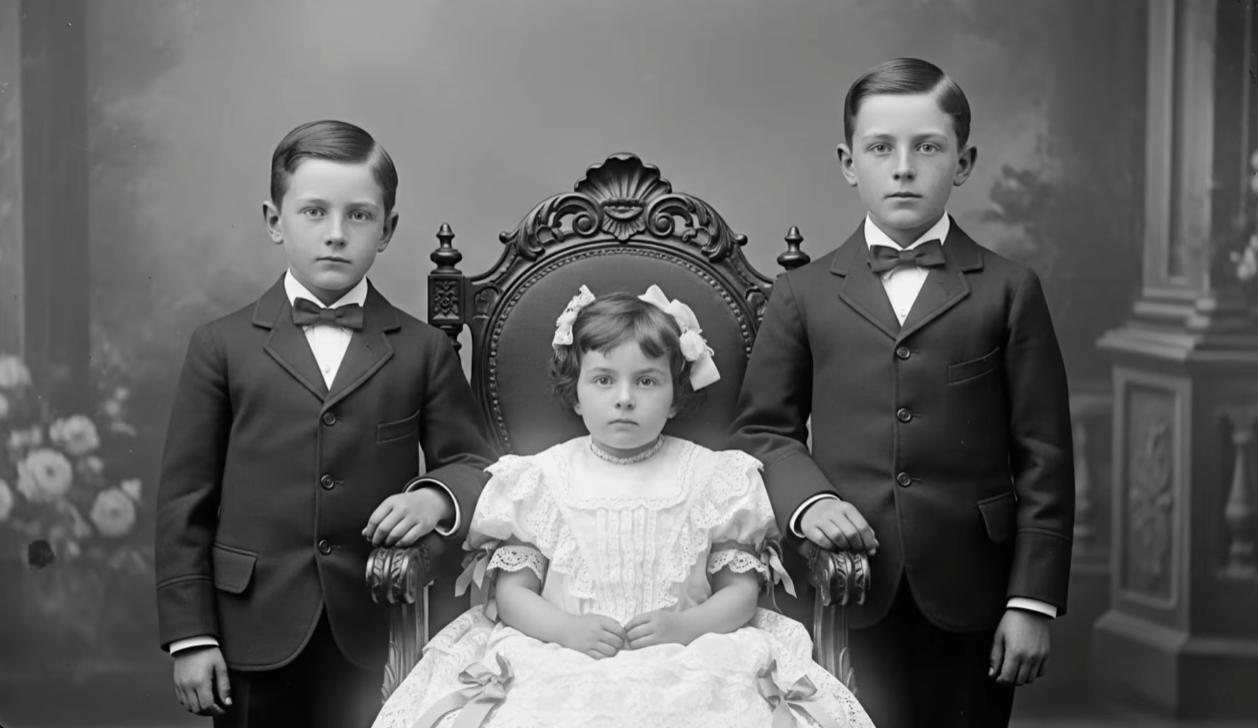
The photograph had hung for as long as anyone could remember in the parlor of the old Whitmore house — a grand but crumbling relic that overlooked the gray fields of northern Massachusetts. It was a formal portrait: three children dressed in their Sunday best. Two solemn boys in matching dark suits, their little sister seated between them, a lace ribbon tied carefully in her pale hair.
The frame was gilt, though age had dulled its shine, and the glass bore a thin crack running through the corner, like a wrinkle on an old face. When the light fell just so, it looked as though the photograph itself were wincing.
For years, visitors would pause before it. Something in the picture seemed to hold them there. Perhaps it was the way the girl’s eyes were painted — too bright, too sharp, as if she alone among the three were aware that she was being watched.
The Whitmore Children
The Whitmore children had once been the pride of the town.
Henry and James — identical twins — were strong, solemn boys, inseparable and eerily alike even in temperament. And Lily, their little sister, had been all laughter and motion — a pale wisp of a child who ran barefoot through the fields and sang nonsense songs to the wind.
Then came the fever.
It swept through the countryside one summer, taking children first. Within a week, Lily was gone. The doctor said it was mercifully quick, though their mother never believed in mercy again after that.
In her grief, Mrs. Whitmore insisted upon a final family portrait.
“She mustn’t be forgotten,” she whispered to the photographer. “She must be with them always.”
The man hesitated, as any decent man might, but the Whitmores were wealthy, and grief has a way of bending propriety. They brought Lily down from her room, dressed her in white, and placed her gently in the chair between her brothers. Her head tilted slightly to the side, her lips parted as if she might yet draw breath.
The photographer instructed the boys not to move, not to blink. The exposure would be long. The boys obeyed.
Lily, of course, did not.
Later, when the man developed the plate, he found her eyes had come out clouded and dull. He painted them over by hand, “to make them more lifelike,” he said.
He never took another photograph again.
The Years After
Time crept onward, as it does, and the Whitmore family withered like ivy on an old wall. Their father died in debt. Their mother in silence. The house grew cold and drafty, the walls yellowed with damp.
Henry and James, still boys but desperate to escape, left for Boston to find work. They rarely spoke of home, but when they packed their things, Henry insisted on taking the photograph. “It’s all that’s left of her,” he said. James didn’t argue — though he couldn’t quite bring himself to look at it.
In their boarding house, the photograph hung above the fireplace. At first, it seemed a comfort — a reminder of the past, of innocence. But after a while, Henry began waking in the night, certain he’d heard soft footsteps in the hall, the faint rustle of a dress brushing the floor.
James heard it too, though he said nothing. He only turned the picture face-down one evening and muttered, “It’s better this way.”
But in the morning, it was upright again.
The Following
Years passed.
The twins moved from one place to another — new towns, new rooms, new lives. Yet wherever they went, the photograph was always there.
Once, it appeared in a hotel room Henry swore he’d never brought it to. Another time, James found it waiting in the hallway of a rented flat, though he’d locked the door himself. They began to quarrel over it — each accusing the other of carrying it along.
“I don’t want it,” James would say, voice shaking. “I don’t even look at it anymore.”
And Henry, pale and tired, would whisper, “We can’t leave her behind. She won’t let us.”
Visitors noticed it too — how the eyes of the little girl seemed to follow them. Some said they heard a faint hum coming from the frame, like breath against glass. Others swore that in certain light, her lips looked softer, almost as if she were about to speak.
The Return
In their later years, the brothers returned to the old Whitmore house. It stood abandoned, windows shattered, ivy climbing through the cracks. They came not for nostalgia, but out of necessity — old, poor, and with nowhere else to go.
The photograph was already there, waiting on the parlor wall.
The house was quiet at night, except for the creak of the wind through the rafters. But sometimes — when the lamps flickered and the air grew heavy — they would hear her voice, faint and small, coming from the parlor.
“Don’t forget me.”
Henry would whisper, “We never have, Lily.”
James would close his eyes and pray.
The Fire
It was a lightning strike that did it, or so the neighbors said — a dry storm that rolled in from the hills. The old Whitmore house went up fast, its timber bones crackling like old paper. By the time the firemen reached it, the roof had fallen, and the twins were gone.
In the ashes, they found almost nothing recognizable. But the photograph — that impossible photograph — had survived.
The frame was blackened and warped, the glass cracked anew, but the image within was untouched.
The boys’ faces were dulled by soot, the shadows deep around their eyes.
But the girl — Lily — sat between them as she always had, her hands folded neatly in her lap.
Her eyes gleamed, bright and perfect.
As if she’d never closed them at all.
News

🐹 At 62, Julian Lennon Admits “I Utterly Hated Her”
Julian Lennon was born into a world that already belonged to someone else — a world consumed by Beatlemania and…

🐹 Top 6 Actors Ron Howard Hated the Most – You Won’t Believe Who’s!
Hollywood has spent decades painting Ron Howard as the industry’s gentle soul — the calm director, the childhood icon, the…
🐹 Photo from 1961: A Maid Poses Behind the Family… But Her Fate Was Very Different
In the dusty boxes of an estate sale in Veracruz, a single photograph was discovered wedged between yellowed newspapers from…

🐹 What They Found In Gene Hackman’s Mansion Will Leave You Sh*cked
Police Photos Taken Inside Gene Hackman and Betsy Arakawa’s $4 Million Home Show It Filled With Clutter and Garbage. Santa…

🐹 The Top 7 Actors Harrison Ford Refused To Forgive
Hollywood loves its legends quiet, polished, and polite. But Harrison Ford was never built for that kind of performance. Behind…

🐹 US forces kill 3 narco-terrorists in Eastern Pacific lethal strike operation targeting drug networks
U.S. forces carried out a lethal strike Saturday on a narcotics vessel operated by a designated terrorist organization in the…
End of content
No more pages to load






