
Falsam, Louisiana, was the kind of small town where everyone knew everyone — a place where the summer air was thick with the hum of cicadas, and the trees whispered secrets that only the wind could understand.
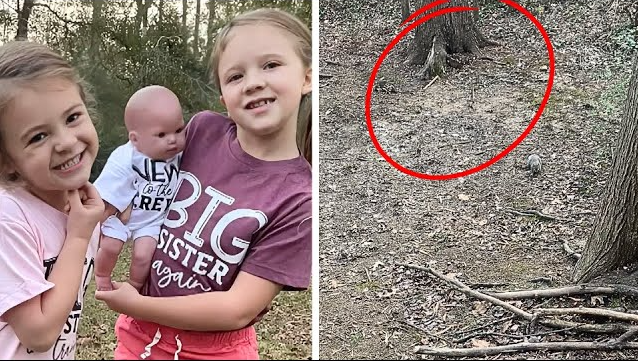
At the far end of a narrow country road stood the Borg family’s home — a white, timeworn farmhouse framed by sprawling oaks and a thick patch of forest behind it. That forest was beautiful, mysterious, and just a little bit wild.
It was where Abigail and Cecilia Borg, ages six and four, loved to play.
And it was where, one humid afternoon in late June, they disappeared.
It had started so ordinarily.
Their mother, Janet Borg, had been inside folding laundry, and their father, Mark, was fixing a broken fence post in the yard. The girls had been playing near the edge of the woods, their laughter floating through the air like music.
Janet remembered glancing out the window and smiling — seeing little Cecilia with her pink sunhat, and Abigail holding a stick like a magic wand, pretending to be a fairy.
It was only a few minutes — just a few minutes — when she turned away. When she looked back, they were gone.
At first, she thought they were hiding.
She called their names.
No answer.
“Abby! Cece! Time to come in for lemonade!”
Silence.
Then the panic set in.
Mark dropped his tools and ran into the woods. Janet’s voice broke into sobs as she shouted their names again and again.
By the time the sun began to dip, the Borg property was swarming with police, neighbors, and volunteers. Flashlights pierced the growing darkness. Dogs barked in the distance.
But there was still no sign of the girls.
Sheriff Tom Halpern stood at the edge of the woods, his weathered face grim. He’d seen missing persons cases before, but this — two small children lost in a dense, swampy forest with night approaching — made his stomach twist.
“Spread out in teams of three,” he instructed. “Check every ravine, every hollow. Watch for snake holes and low roots. We’ll grid this place until we find them.”
The searchers moved in — flashlights sweeping, voices calling.
“Abigail!”
“Cecilia!”
“This is Sheriff Halpern — you girls out there?”
But the woods gave no reply except for the rustle of leaves and the distant cry of a whip-poor-will.
Hours passed. The temperature dropped. The fireflies came out, flickering like lost stars among the branches.
And just as the first edge of hopelessness began to set in, a sound cut through the night.
A bark.
Sharp. Urgent.
Then another.
“Over there!” someone shouted. “That’s a dog!”
The search party pivoted toward the noise, flashlights trembling through the trees. The barking grew louder — closer — echoing off the trunks in a fierce rhythm.
“Hold on, we’re coming!”
They pushed through brush and vines, stumbling over roots and mud until suddenly, in a small clearing bathed in pale moonlight, they saw them.
Two little girls — barefoot, their dresses streaked with dirt, their faces streaked with tears — sitting close together beneath a fallen tree.
And standing over them, hackles raised, teeth bared, was Artemus.
Artemus was the family’s golden retriever — a large, gentle dog who’d been with the Borgs since before Abigail was born. Normally, he was as calm as sunshine. But not tonight.
When the rescuers stepped into the clearing, he growled low and deep, eyes glowing like embers in the flashlight beams. He stood between the girls and the world, every muscle tensed, ready to defend.
“Easy, boy,” Sheriff Halpern murmured, raising his hands. “It’s okay. We’re friends.”
But Artemus didn’t move. He kept circling the girls, pacing, his nose brushing their shoulders as if counting them — making sure both were still there.
Abigail sniffled. “He won’t let anyone touch us,” she whispered. “He’s been keeping the monsters away.”
Janet’s voice, carried through the radios, came trembling into the night: “Did you find them? Please tell me you found them!”
“We found them,” Halpern said, his throat tight. “They’re safe. And they’ve got a guardian angel with fur.”
It took time — slow, careful time — to earn Artemus’s trust.
A neighbor who knew him brought one of his favorite blankets from home. The scent made the dog’s tail twitch, just once, uncertainly. Then Janet herself arrived, barefoot and breathless, tears glistening in her eyes.
“Artemus,” she whispered. “It’s me, boy. It’s Mom.”
He froze — then the tension in his body melted. He whined softly, lowering his head as if finally recognizing that the danger was gone.
Only then did he step aside and let Janet scoop her daughters into her arms.
The moment was almost too much to bear. The rescuers turned away, eyes wet, pretending to adjust their flashlights.
As the group walked out of the forest, Artemus trotted beside them — quiet now, but still alert, occasionally glancing back into the shadows behind them as if to make sure nothing followed.
By dawn, word had spread through Falsam.
The missing girls were home, safe and sound — dehydrated, scratched, but unharmed. They’d wandered off chasing a butterfly, they said, and when they got lost, Artemus had found them.
He’d stayed with them the entire time. When it got dark, he’d nudged them beneath a fallen log for warmth. When they cried, he’d laid beside them. When they dozed, he kept watch — ears perked, body coiled, waiting for the first sign of help.
Doctors said they were lucky. The woods had coyotes. Snakes. Even the occasional wild boar.
But somehow, nothing had touched them.
That afternoon, Sheriff Halpern drove up to the Borg house. On the porch, Artemus lay sleeping, his fur still damp from the night dew, the two girls sitting beside him coloring pictures of trees and dogs and butterflies.
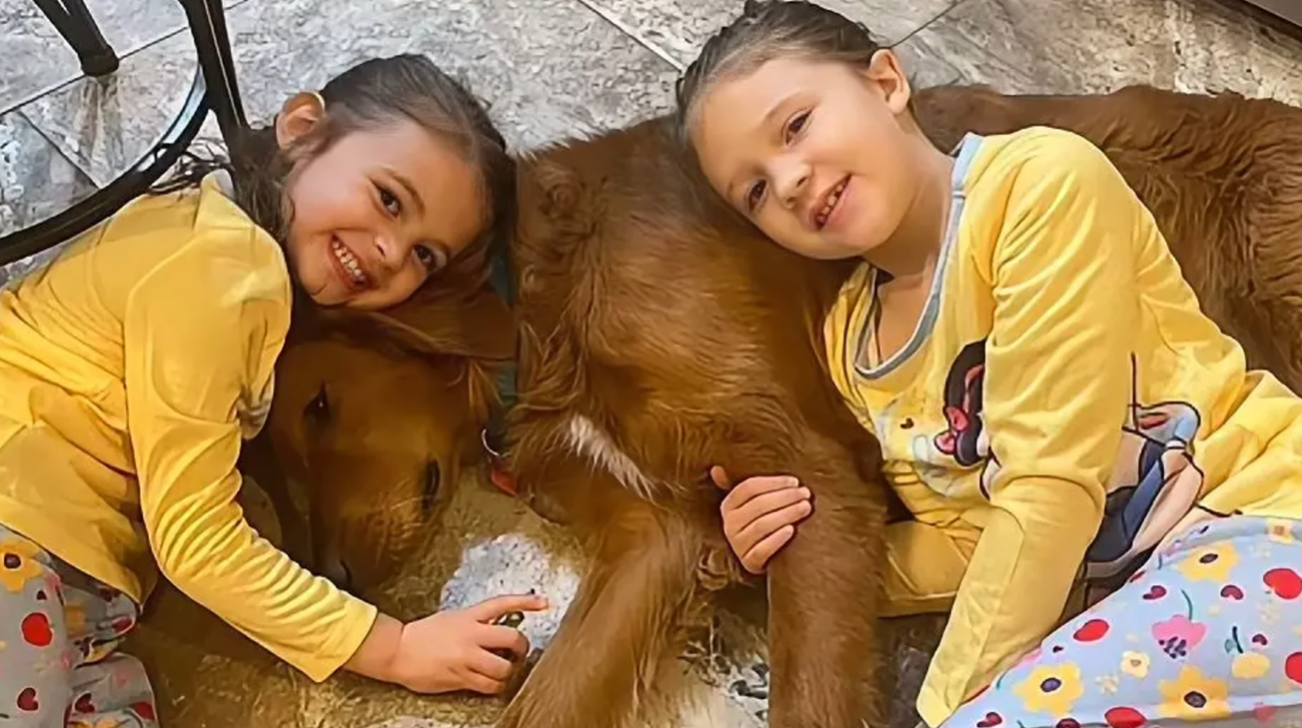
“Morning, boy,” the Sheriff said, crouching down. “Heard you earned yourself a medal.”
Mark laughed softly. “He doesn’t need one. He already knows.”
Halpern nodded. “Still, it’s something worth remembering. Not many heroes walk on four legs.”
The girls giggled. Cecilia tugged at the Sheriff’s sleeve. “He growled at you,” she said proudly. “He thought you were bad guys.”
Halpern smiled. “That’s alright, honey. Sometimes, that’s what a good protector does.”
As the sun dipped again that evening, the Borg family sat on the porch. The woods behind the house were quiet, peaceful — no longer frightening.
Abigail leaned her head on Artemus’s shoulder. “You were brave,” she whispered.
The dog’s tail thumped once.
Janet looked out toward the trees and shivered. “I don’t think I’ll ever stop thanking him.”
Mark nodded. “Some angels don’t have wings,” he said quietly. “They have paws.”
And in that golden hour light, as fireflies began to rise from the grass and the cicadas sang once more, Artemus lifted his head and looked toward the woods — still watchful, always ready.
He was no ordinary pet. He was their guardian. Their protector. Their silent promise that love, once given, never leaves your side.
Every year after that, on the anniversary of the day they were found, the Borg family would take a walk into the woods together — the same path where fear had once lived.
And at the front, leading them confidently through the trees, tail swaying like a golden banner, was Artemus — the dog who never stopped believing that his girls were worth guarding.
Sometimes heroes don’t wear uniforms or badges.
Sometimes, they walk quietly beside us every day — until the moment comes when their loyalty saves our world.
News

🐹 At 62, Julian Lennon Admits “I Utterly Hated Her”
Julian Lennon was born into a world that already belonged to someone else — a world consumed by Beatlemania and…

🐹 Top 6 Actors Ron Howard Hated the Most – You Won’t Believe Who’s!
Hollywood has spent decades painting Ron Howard as the industry’s gentle soul — the calm director, the childhood icon, the…
🐹 Photo from 1961: A Maid Poses Behind the Family… But Her Fate Was Very Different
In the dusty boxes of an estate sale in Veracruz, a single photograph was discovered wedged between yellowed newspapers from…

🐹 What They Found In Gene Hackman’s Mansion Will Leave You Sh*cked
Police Photos Taken Inside Gene Hackman and Betsy Arakawa’s $4 Million Home Show It Filled With Clutter and Garbage. Santa…

🐹 The Top 7 Actors Harrison Ford Refused To Forgive
Hollywood loves its legends quiet, polished, and polite. But Harrison Ford was never built for that kind of performance. Behind…

🐹 US forces kill 3 narco-terrorists in Eastern Pacific lethal strike operation targeting drug networks
U.S. forces carried out a lethal strike Saturday on a narcotics vessel operated by a designated terrorist organization in the…
End of content
No more pages to load






