
“Respect and humility are worth more than pride. No matter how far you go down the wrong path, there’s always a chance to make things right.”
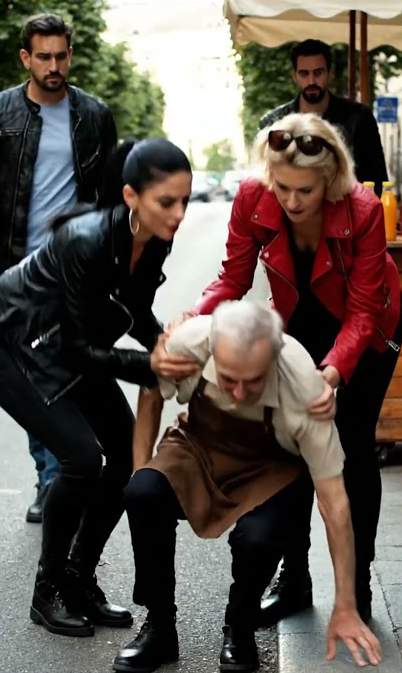
The afternoon sun baked the city streets of Santa Rosa, its heat shimmering off the pavement. People hurried past the small juice cart that sat quietly on the corner of Main and Willow — a humble setup with hand-painted signs that read “Fresh Orange Juice – $2 a cup.”
Behind the cart stood Mr. Ramírez, an old man in his seventies. His shirt was faded, his hands calloused, but his eyes were warm. Every morning, he juiced oranges by hand, greeting every customer with a nod and a smile.
He wasn’t rich, but he was proud of his work. And for years, he had built a quiet rhythm of kindness — offering discounts to children, free drinks to delivery workers, and small talk to anyone who needed it.
But not everyone respected his simplicity.
That afternoon, a sleek black car rolled up to the curb. Out stepped Dylan Price, twenty-four years old, stylish, cocky, and convinced the world revolved around him. He’d just landed a promotion at his father’s real estate firm and was out celebrating — or, more accurately, showing off.
Spotting the juice cart, he smirked. “You really sell that stuff out here? In this heat?”
Mr. Ramírez smiled patiently. “Sí, señor. It’s fresh. Cold. Would you like a cup?”
Dylan looked him up and down, scoffing. “How much can you even make doing this? You should retire or something.”
The old man just nodded. “Work keeps the heart strong.”
“Yeah?” Dylan said, pulling out a five-dollar bill. “Let’s see if your juice is even worth it.”
He took a sip — then exaggerated a grimace. “Tastes like sugar water. Guess I shouldn’t expect much from… this.” He waved at the cart dismissively.
People nearby turned their heads, frowning. But Mr. Ramírez didn’t argue. He just said quietly, “I’m sorry you don’t like it. I hope your day still goes well.”
Dylan laughed. “Yeah, sure. Enjoy your lemonade stand, old man.” Then he tossed the rest of the drink into the gutter, got into his car, and peeled away.
He didn’t notice the four motorcycles that had been parked a few yards down — or the men watching him with quiet disapproval.
A few blocks later, at a red light, Dylan heard the low rumble of engines behind him.
Four bikers in black leather jackets surrounded his car, their bikes forming a semicircle.
He frowned, lowering his window. “What’s your problem?”
One of them — a broad, middle-aged man with a scar across his cheek — leaned forward slightly. His vest patch read “Iron Wind MC.”
“You got a big mouth, kid,” he said. “Especially for someone who picks on old men just trying to work.”
Dylan blinked. “You talking about that juice guy? Come on, it was a joke.”
Another biker shook his head. “No, it wasn’t. It was arrogance.”
Dylan’s laugh faltered. “You’re seriously confronting me over some old street vendor?”
The leader revved his engine once — not threateningly, but enough to shake the air. “We know that man. He served this neighborhood for twenty years. He’s helped people you wouldn’t even look at twice. You humiliate him again, and we’ll make sure you remember respect the hard way.”
Dylan opened his mouth — then closed it.
The light turned green. The bikers didn’t move. The leader tilted his head. “Go make it right.”
Then, as if rehearsed, they rode off in four different directions, leaving Dylan sitting alone in stunned silence.
That night, Dylan couldn’t sleep.
The faces of the bikers kept replaying in his head — not angry, just disappointed. He remembered the look on Mr. Ramírez’s face: calm, kind, undeserving of ridicule.
His chest ached with something unfamiliar. Guilt.
By morning, he decided to go back.
When Dylan arrived at the corner the next day, Mr. Ramírez was already there, setting up his cart.
The old man looked up as Dylan approached. He hesitated, almost expecting anger. But instead, Mr. Ramírez smiled.
“Good morning,” he said softly. “Would you like some juice?”
Dylan swallowed. “I… I came to apologize. What I said yesterday — it was awful. You didn’t deserve that.”
The old man nodded slowly. “Thank you for coming back. Not everyone would.”
Dylan pulled out his wallet. “I want to pay for what I wasted. And maybe buy one for everyone here.”
Mr. Ramírez chuckled. “You don’t need to do that. What matters more is that you understand.”
He handed Dylan a cup of fresh juice — on the house.
Dylan looked at him, confused. “You’re… giving me one for free? After what I said?”
The old man nodded. “Yes. Because kindness doesn’t keep score.”
For a moment, Dylan couldn’t speak. He took a sip — and this time, it tasted different. Not just sweet, but pure.
Something inside him shifted.
From that day on, Dylan stopped at the juice cart every week. Sometimes he bought one drink, sometimes five for strangers passing by.
He began volunteering at a local community kitchen — the same one where Mr. Ramírez donated juice during summer months.
Over time, they became unlikely friends. The old man shared stories of his life in Mexico, of raising children, of losing his wife but never losing gratitude. Dylan listened — and learned.
Years later, when Mr. Ramírez passed away peacefully, Dylan helped pay for the funeral. He made sure the old man’s cart stayed on that same corner, now run by Mr. Ramírez’s grandson.
A small sign hangs on the front today: “Respect costs nothing — but means everything.” In memory of Mr. Ramírez.
In an interview years later, Dylan told the story to a local paper. “I used to think success made me better than people. But that man taught me that real wealth is measured by humility — not status.”
When asked what changed him most, he smiled. “The bikers scared me,” he said. “But the old man… he saved me.”
Moral of the Story
Arrogance blinds. Kindness opens eyes.
Sometimes, life teaches you through confrontation — and sometimes, it teaches through forgiveness.
No matter how far down the wrong path you go, there’s always a turn waiting — one that leads back to respect, humility, and humanity.
News

🐹 At 62, Julian Lennon Admits “I Utterly Hated Her”
Julian Lennon was born into a world that already belonged to someone else — a world consumed by Beatlemania and…
🐹 Top 6 Actors Ron Howard Hated the Most – You Won’t Believe Who’s!
Hollywood has spent decades painting Ron Howard as the industry’s gentle soul — the calm director, the childhood icon, the…
🐹 Photo from 1961: A Maid Poses Behind the Family… But Her Fate Was Very Different
In the dusty boxes of an estate sale in Veracruz, a single photograph was discovered wedged between yellowed newspapers from…

🐹 What They Found In Gene Hackman’s Mansion Will Leave You Sh*cked
Police Photos Taken Inside Gene Hackman and Betsy Arakawa’s $4 Million Home Show It Filled With Clutter and Garbage. Santa…

🐹 The Top 7 Actors Harrison Ford Refused To Forgive
Hollywood loves its legends quiet, polished, and polite. But Harrison Ford was never built for that kind of performance. Behind…

🐹 US forces kill 3 narco-terrorists in Eastern Pacific lethal strike operation targeting drug networks
U.S. forces carried out a lethal strike Saturday on a narcotics vessel operated by a designated terrorist organization in the…
End of content
No more pages to load






