
The Journey of Comet 3I/ATLAS: An Interstellar Visitor
Overview
Comet 3I/ATLAS is the third known object originating from outside our solar system to be observed passing through our celestial neighborhood.
Astronomers classify this object as interstellar due to the hyperbolic shape of its orbital path.
Unlike objects that follow a closed orbit around the Sun, 3I/ATLAS does not return, indicating its origin from beyond our solar system.
This comet poses no threat to Earth, remaining at a safe distance throughout its journey.
The closest approach to our planet will be approximately 1.8 astronomical units, or about 170 million miles, which is roughly 270 million kilometers.
On October 30, 2025, 3I/ATLAS will reach its closest point to the Sun, coming within about 1.4 astronomical units, or 130 million miles, which is around 210 million kilometers, just inside the orbit of Mars.
Astronomers worldwide are actively investigating the size and physical properties of this interstellar comet.
It is expected to remain visible to ground-based telescopes until September 2025.
After that, it will pass too close to the Sun for observation.
However, it will reappear on the other side of the Sun by early December 2025, allowing for renewed observations.

Discovery
The discovery of comet 3I/ATLAS was made by the NASA-funded ATLAS (Asteroid Terrestrial-impact Last Alert System) survey telescope located in Rio Hurtado, Chile.
On July 1, 2025, the telescope reported its observations to the Minor Planet Center.
Following this initial report, astronomers gathered data from the archives of three different ATLAS telescopes around the world, as well as from Caltech’s Zwicky Transient Facility at the Palomar Observatory in California.
These pre-discovery observations date back to June 14, 2025.
The naming of this comet follows a common convention where comets are named after their discoverers.
In this case, the ATLAS survey team is credited with its discovery.
The letter “I” signifies “interstellar,” indicating that this object has come from outside our solar system.
As the third known interstellar object, the name includes the number “3.”
NASA’s Observations of Comet 3I/ATLAS
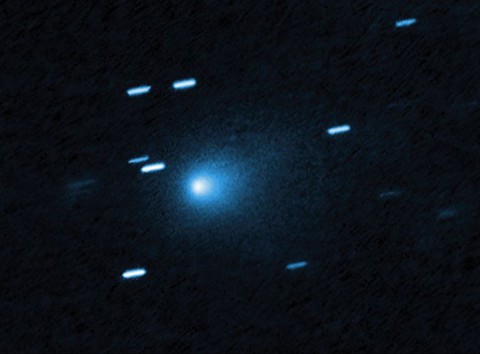
NASA’s Hubble Space Telescope captured an image of 3I/ATLAS on July 21, 2025, when the comet was 277 million miles away from Earth.
Hubble revealed a teardrop-shaped cocoon of dust emanating from the comet’s solid, icy nucleus.
Because Hubble tracked the comet along its hyperbolic trajectory, the background stars appeared streaked in the exposure.
Continuing observations from Hubble allow astronomers to estimate the size of the comet’s nucleus more accurately.
As of August 20, 2025, the estimated diameter of the nucleus is between 1,444 feet (440 meters) and 3.5 miles (5.6 kilometers).
NASA plans to utilize various assets to observe 3I/ATLAS, including Hubble, Webb, TESS, Swift, SPHEREx, the Perseverance Mars rover, the Mars Reconnaissance Orbiter, the Curiosity rover, Europa Clipper, Lucy, Psyche, Parker Solar Probe, PUNCH, and ESA/NASA’s SOHO and Juice missions.
Updates on observations and schedules will be provided as new information becomes available.

Latest Updates on Comet 3I/ATLAS
As of September 2025, NASA has been closely studying the icy visitor 3I/ATLAS using various space telescopes, including Hubble, Webb, and SPHEREx.
The comet is set to pass Mars on October 3, 2025, where multiple spacecraft might catch a glimpse of it.
After this close encounter, the comet will move behind the Sun in late October and will venture past Jupiter in March 2026 on its way out of our solar system.
Following Comet 3I/ATLAS
NASA offers an interactive app called Eyes on the Solar System, allowing users to follow the journey of comet 3I/ATLAS as it travels through our solar system.
This app provides real-time updates on the comet’s trajectory and future path.
Frequently Asked Questions
Where did this interstellar object come from?
Comet 3I/ATLAS formed in another star system and was ejected into interstellar space.
For millions or even billions of years, it has drifted through space until recently arriving in our solar system.
It approached from the direction of the constellation Sagittarius, which is near the center of the Milky Way galaxy.
At the time of its discovery, 3I/ATLAS was approximately 410 million miles (670 million kilometers) away from the Sun and within Jupiter’s orbit.
How was it determined that 3I/ATLAS did not originate in our solar system?
Astronomers determined that 3I/ATLAS did not originate in our solar system by studying its trajectory.
The comet is moving too fast to be captured by the Sun’s gravity and follows a hyperbolic trajectory.
This means it is simply passing through our solar system and will continue its journey into interstellar space, never to return.
How many interstellar objects have been discovered?
3I/ATLAS is the third known interstellar object observed passing through our solar system.
The first, 1I/ʻOumuamua, was discovered in 2017, followed by 2I/Borisov, which was discovered in 2019.
Is 3I/ATLAS an asteroid or a comet?
Observations indicate that 3I/ATLAS is active, featuring an icy nucleus and a coma, which is a bright cloud of gas and dust surrounding a comet as it approaches the Sun.
This activity is why astronomers classify it as a comet rather than an asteroid.
How big is 3I/ATLAS?
The exact size of 3I/ATLAS is still under investigation.
However, observations from the Hubble Space Telescope as of August 20, 2025, suggest that the diameter of its nucleus is between 1,444 feet (440 meters) and 3.5 miles (5.6 kilometers).
How fast is it moving?
3I/ATLAS is traveling at a remarkable speed.
When it was discovered, the comet was moving at approximately 137,000 miles per hour (221,000 kilometers per hour, or 61 kilometers per second).
Its speed will continue to increase as it approaches the Sun and moves through the solar system.
Conclusion
The journey of comet 3I/ATLAS is a significant event in the study of interstellar objects.
As astronomers continue to observe and analyze this remarkable comet, they hope to uncover valuable insights into its nature and origins.
The ongoing research surrounding 3I/ATLAS promises to enhance our understanding of comets and their role in the universe.
With its unique characteristics and fascinating history, 3I/ATLAS will undoubtedly remain a subject of interest for scientists and space enthusiasts alike.
News

At 56, The Tragedy Of Jennifer Aniston Is Beyond Heartbreaking
Behind the laughter, the fame, and the seemingly perfect Hollywood image of Jennifer Aniston lies a life marked by struggle,…

R. KELLY ATTACKED IN PRISON? Disturbing REPORTS and WHISPERS From Behind Bars Spark a Terrifying Question
R.Kelly’s collapse from global stardom did not end with a courtroom sentence. According to filings submitted by his legal team,…

What happened to Cesar Millan from Dog Whisperer? Is He Going to Jail?
The Truth Behind the Viral Claim About Cesar MillanWhy the Internet Suddenly Believed the Famous Dog Behaviorist Was Sentenced to…

Albert Lin Just Exposed What’s Hidden Beneath the Terracotta Army — And It’s Not What You Think
The world of television often appears polished and effortless, yet the truth behind the camera tells a very different story….

UK EXPLODES as King Charles DECLARES Divorce From Camilla After SHOCKING Betrayal
The Shocking Announcement of King Charles III’s Divorce from Queen Camilla In a dramatic turn of events, King Charles III…

After Locating Cleopatra’s Lost Tomb Archaeologists Found Terrifying Detail That Defies Explanation
For nearly two millennia, the final resting place of Cleopatra remained one of the greatest unsolved mysteries of the ancient…
End of content
No more pages to load






