
The Enigmatic Legacy of Genghis Khan: A Journey Through History, Power, and Mystery
In the vast expanses of Central Asia, a name resonates through the corridors of history with both awe and fear: Genghis Khan.
Born as Temüjin around 1162 in the harsh Mongolian steppes, he would rise to unite disparate tribes into a single Mongol confederation.
Through his extraordinary military genius, ruthless strategy, and relentless ambition, Genghis Khan transformed the Mongol people from scattered nomads into an unstoppable force.
By the time of his death in 1227, he had conquered vast territories, extending the reach of the Mongol Empire across much of Asia.
His empire spanned from the Pacific Ocean in the east to the Caspian Sea in the west, encompassing a diverse range of cultures, religions, and political structures.
While history celebrates his achievements in statecraft and military strategy, it also remembers the devastating human cost of his conquests.
Estimates suggest that his campaigns may have claimed the lives of tens of millions of people, reshaping entire civilizations and leaving cities in ruin.
Accounts from survivors and contemporary chroniclers recount scenes of destruction, with populations decimated and towns annihilated, all in the name of empire building.
In the Islamic world, Genghis Khan’s name is synonymous with terror, particularly due to the invasions of Central Asia and the Middle East, culminating in the catastrophic sack of cities.
His grandson, Hulagu Khan, continued the Mongol legacy in similar fashion, most notably during the siege of Baghdad in 1258, which marked a turning point in Islamic history.
Despite the terror he inflicted, Genghis Khan is revered among the Mongols as a national hero, a unifier who elevated the Mongolian identity and provided unprecedented political and cultural freedom.
He implemented reforms in governance, introduced a written script for the Mongolian language, and established trade networks that facilitated economic growth.

Under his rule, Mongolia saw the introduction of paper currency and a functioning postal system, innovations that symbolized administrative sophistication and connectivity.
His legacy is thus paradoxical: a figure of immense cruelty and destruction, yet also a visionary leader whose impact shaped the trajectory of Eurasian history.
Yet, despite centuries of scholarship, one mystery remains unresolved: the location of Genghis Khan’s tomb.
According to historical accounts, he made a peculiar and deliberate request regarding his burial.
Genghis Khan wished to be buried in a secret location, unmarked and unknown, ensuring that his final resting place would remain hidden from all but the heavens.
Following his death, his followers reportedly buried him in a location known only to a small group of loyal companions.
To prevent discovery, the mourners allegedly trampled the burial site with horses, leaving no visible trace behind, and possibly even killing witnesses to safeguard the secrecy.
This meticulous concealment has sparked centuries of speculation, folklore, and unyielding curiosity among historians, archaeologists, and treasure hunters.
Unlike the tombs of other emperors and rulers, which became sites of pilgrimage and historical preservation, Genghis Khan’s resting place is shrouded in enigma.
National Geographic and other institutions have undertaken high-tech searches, including satellite imagery and ground-penetrating radar scans, to locate potential burial sites.
These efforts, often termed projects like the “Valley of the Khans,” have scanned Mongolia’s vast and rugged terrain, but definitive evidence remains elusive.
Interestingly, local Mongolians have traditionally refrained from seeking out the tomb.
For them, the sanctity of the steppes and the memory of their revered leader outweigh the allure of discovery.
They regard any disturbance of sacred sites with great caution, adhering to cultural and spiritual beliefs that prioritize respect over exploration.
It is believed that Genghis Khan’s tomb, if ever found, would resemble other Mongol royal burials, often situated deep underground in elaborately constructed chambers.
These chambers were reportedly filled with treasures, ceremonial artifacts, and valuables accumulated during the ruler’s lifetime.
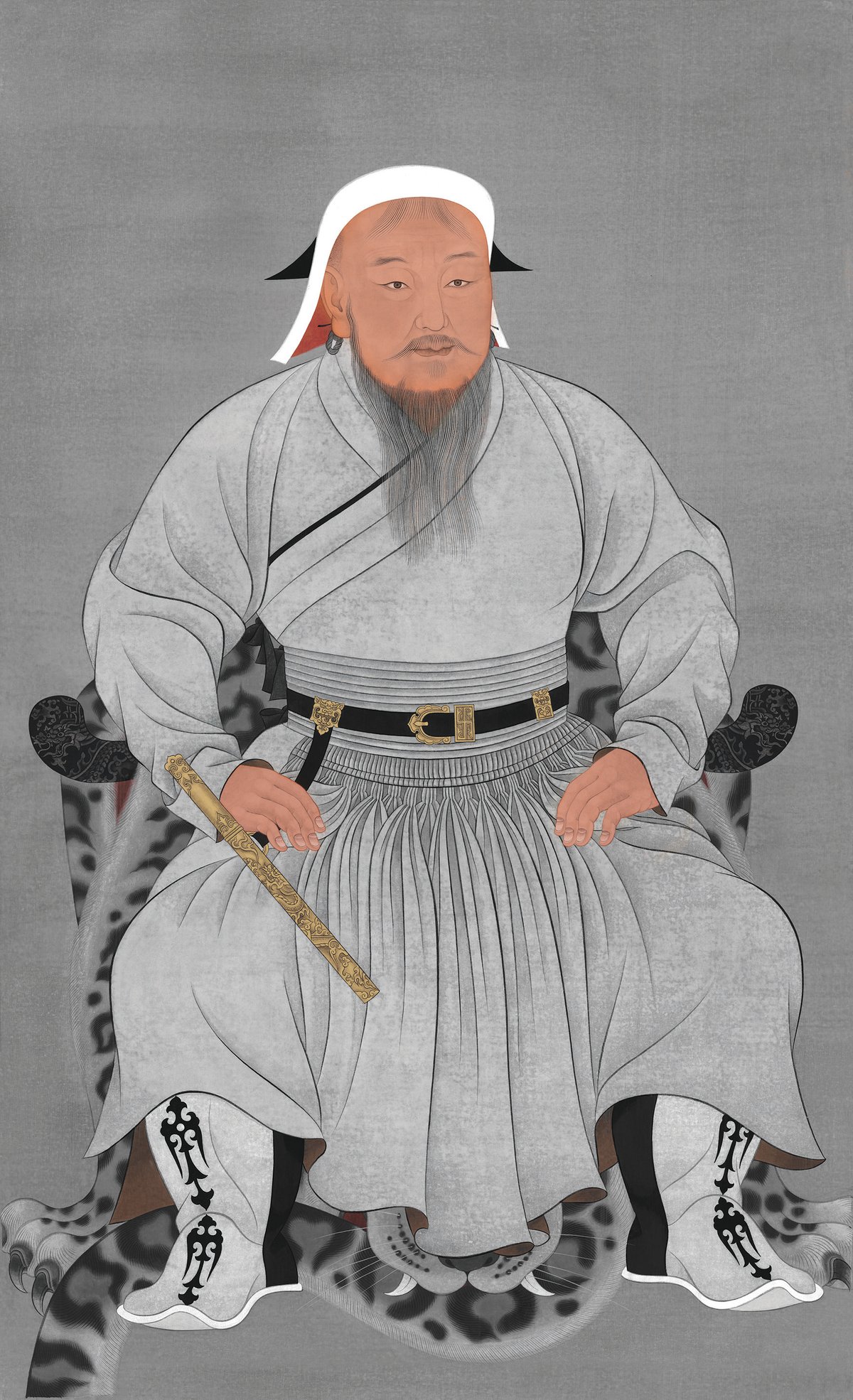
Yet, unlike treasures left for public display, Genghis Khan’s interment was designed to remain concealed, possibly reflecting his desire for humility or strategic secrecy.
Reports suggest that his final resting place might lie in the Khentii Mountains, a remote region with rugged terrain, dense forests, and little human settlement.
Folklore indicates that the burial site could be atop a peak known as Burkhan Khaldun, a sacred mountain that played a central role in Genghis Khan’s life and the Mongol cultural landscape.
The secrecy surrounding his burial has led to myths of elaborate traps, hidden chambers, and protective curses, intended to deter looters and outsiders.
Some accounts also claim that attendants, guards, or even family members were interred alongside him to serve him in the afterlife, a practice observed in other ancient civilizations.
Modern researchers face immense challenges in verifying these claims due to the sheer scale of Mongolia and the prohibitive nature of its terrain.
Unlike smaller nations with concentrated archaeological sites, Mongolia’s landscapes stretch over hundreds of thousands of square kilometers, making systematic searches akin to finding a needle in a haystack.
International interest in locating Genghis Khan’s tomb has often collided with local sensitivities, creating tension between scientific inquiry and cultural preservation.
In the early 2000s, a collaborative project with Japanese and Mongolian researchers sought to use satellite imaging to pinpoint potential burial mounds and anomalies in the terrain.
This project, codenamed the “Khorlo Khan Project,” focused on remote areas near historically significant sites tied to Genghis Khan’s life.
Despite extensive surveying, discoveries remained inconclusive, further enhancing the mystique surrounding his final resting place.
In addition to satellite analysis, ground-penetrating radar and other non-invasive archaeological methods have been employed to detect underground structures without disturbing sacred lands.
While these tools have identified potential burial mounds, confirmation of Genghis Khan’s presence remains speculative, and excavation is often forbidden by local authorities.
One reason for this caution is the cultural significance of Genghis Khan to the Mongolian identity.
Locals consider him a foundational figure whose legacy transcends mere historical curiosity, embodying the values, resilience, and heritage of the Mongol people.
Thus, even with modern technology, any attempt to unearth the tomb must balance scientific ambition with respect for tradition and spirituality.

Historical narratives also suggest that the burial was intentionally kept secret to prevent desecration or looting, a strategy consistent with Genghis Khan’s emphasis on security and control throughout his life.
Contemporary historians, while fascinated by the mystery, acknowledge that the secrecy surrounding his tomb may be as significant as any artifacts it contains.
This secrecy preserves not only the physical remains of Genghis Khan but also the symbolic power of his empire, which continues to influence cultural memory and national identity in Mongolia and beyond.
Moreover, the legend of the hidden tomb has become a cultural phenomenon, inspiring literature, documentaries, and countless theories about the location and contents of the burial site.
Some speculate that immense treasures, including gold, jewels, and valuable historical documents, lie within the burial chamber.
Others emphasize that the true value lies in the historical record preserved through artifacts, providing insight into Mongol society, warfare, and governance.
Interestingly, Genghis Khan’s life and death continue to serve as a lens through which historians examine the broader Eurasian world of the 12th and 13th centuries.
His campaigns connected distant regions, facilitated the exchange of ideas, and laid the foundation for trade routes such as the Silk Road, which flourished under Mongol protection.
The Mongol Empire’s impact on governance, law, and diplomacy resonates in historical scholarship, with Genghis Khan’s strategies studied in military academies and leadership programs worldwide.
Yet, the enigma of his tomb remains perhaps the most enduring aspect of his legacy.
The narrative of a ruler so powerful that his final resting place was deliberately concealed captures the imagination like few other historical figures.
It raises profound questions about mortality, memory, and the human desire to leave a mark on the world, even beyond death.
It also highlights the intersection of history, archaeology, and mythology, where empirical evidence and legend coexist in a delicate balance.
While technological advances continue to enhance our capacity for discovery, the tomb of Genghis Khan serves as a reminder of the limits of human knowledge.
It exemplifies how cultural respect, historical significance, and natural preservation intersect, dictating what can and cannot be uncovered.
For Mongolians, the sacredness of the steppes and mountains ensures that Genghis Khan’s legacy is honored without intrusion, reflecting a profound respect for heritage.
For historians and enthusiasts worldwide, the search for the tomb is a quest for understanding the man behind the myth—a figure whose life reshaped continents and whose death remains cloaked in secrecy.
As the centuries pass, the mystery persists, drawing new generations into debates, expeditions, and research initiatives.
Despite numerous claims of discovery, no conclusive evidence has yet surfaced, maintaining the tomb’s status as one of history’s greatest unsolved enigmas.
The story of Genghis Khan is thus twofold: it is a tale of conquest, strategy, and empire-building, and it is also a story of enduring mystery, secrecy, and cultural reverence.
In a world where the past is often excavated, cataloged, and displayed, the burial site of Genghis Khan reminds us that some secrets remain intentionally beyond reach.
Perhaps it is fitting that a man who commanded empires, instilled fear across continents, and united nomadic tribes would ensure that even in death, his final resting place would elude the world.
In the end, the search for Genghis Khan’s tomb is not merely a quest for historical artifacts or treasure; it is a pursuit of understanding, a meditation on power, mortality, and legacy.
The Mongolian steppes continue to whisper the story of the man born Temüjin, the ruler who became Genghis Khan, whose life reshaped nations and whose death remains one of history’s most profound mysteries.
.png)
Whether scholars ever unearth the tomb or it remains hidden for centuries to come, the legend of Genghis Khan endures, bridging past and present, myth and history, life and death.
It is a testament to the enduring impact of one individual, whose vision and ambition transcended his time and whose story continues to captivate the imagination of the world.
Genghis Khan’s tomb, shrouded in secrecy, is more than a physical site; it is a symbol of power, memory, and the enduring allure of the unknown.
As researchers, historians, and adventurers look to the Mongolian steppes, they are not only seeking the remains of a great leader but also confronting the deeper questions of history: what do we choose to uncover, and what do we allow to remain hidden?
The legacy of Genghis Khan teaches us that some of history’s greatest truths lie not in what is visible, but in the silence that surrounds them.
And so, the mystery continues, inviting each generation to ponder, to explore, and to respect the shadowed chapters of human history.
The story of Genghis Khan is a journey through brutality and brilliance, conquest and culture, secrecy and legacy.
In understanding him, we do not merely uncover the past; we engage with the profound complexities of leadership, power, and the human desire to leave a mark upon the world.
His tomb may be hidden, his treasures unknown, and his final resting place a mystery, but the influence of Genghis Khan is eternal.
Across the windswept steppes of Mongolia, in the echoes of history, and within the hearts of those who study him, Genghis Khan endures, a figure of awe, fear, and enduring fascination.
It is a legacy that challenges us to contemplate the extremes of human capability, the costs of ambition, and the enduring resonance of history.
Even in death, Genghis Khan’s shadow stretches across continents, reminding the world that some mysteries are meant not merely to be solved, but to be remembered.
News

At 56, The Tragedy Of Jennifer Aniston Is Beyond Heartbreaking
Behind the laughter, the fame, and the seemingly perfect Hollywood image of Jennifer Aniston lies a life marked by struggle,…

R. KELLY ATTACKED IN PRISON? Disturbing REPORTS and WHISPERS From Behind Bars Spark a Terrifying Question
R.Kelly’s collapse from global stardom did not end with a courtroom sentence. According to filings submitted by his legal team,…

What happened to Cesar Millan from Dog Whisperer? Is He Going to Jail?
The Truth Behind the Viral Claim About Cesar MillanWhy the Internet Suddenly Believed the Famous Dog Behaviorist Was Sentenced to…
Albert Lin Just Exposed What’s Hidden Beneath the Terracotta Army — And It’s Not What You Think
The world of television often appears polished and effortless, yet the truth behind the camera tells a very different story….

UK EXPLODES as King Charles DECLARES Divorce From Camilla After SHOCKING Betrayal
The Shocking Announcement of King Charles III’s Divorce from Queen Camilla In a dramatic turn of events, King Charles III…

After Locating Cleopatra’s Lost Tomb Archaeologists Found Terrifying Detail That Defies Explanation
For nearly two millennia, the final resting place of Cleopatra remained one of the greatest unsolved mysteries of the ancient…
End of content
No more pages to load






