
If one day the sky itself were to open and alien ships emerged from the void—vast, silent, and brimming with power—humanity would finally face the ultimate test of its existence.
Every culture, every nation, every scientific theory would collapse into a single terrifying question: Can we survive a war against beings from the stars? It is a question both thrilling and dreadful, one that has haunted humanity’s imagination for centuries.
Movies have dramatized it, philosophers have speculated about it, and generals have quietly considered the unthinkable.
But now, let us strip away fiction and emotion, and imagine the scenario as realistically as possible: what would happen if an advanced extraterrestrial civilization decided to attack humanity—and humanity, in desperation, responded with everything it had, including nuclear weapons?
To begin, we must consider the most basic imbalance of such a conflict: technological asymmetry.
Any civilization capable of interstellar travel would, by definition, be centuries—perhaps millennia—ahead of us in scientific development.
The laws of physics are universal, but the mastery of them is not.
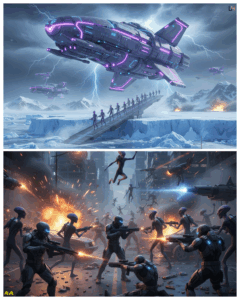
Humans have only just begun to leave their planetary cradle; our rockets crawl through space compared to the distances between stars.
An alien species that can cross those distances must have overcome energy limitations we can barely imagine.
They might harness quantum fields, manipulate gravity, or bend space-time itself.
Against such power, our nuclear weapons—devastating though they are to us—would be the equivalent of throwing spears at a lightning storm.
But technology alone does not determine victory.
History shows that asymmetric wars are rarely decided by power alone; they are decided by strategy, resilience, and unpredictability.
Humanity’s greatest weapon has always been its adaptability.
From the Stone Age to the Space Age, our species has survived ice ages, plagues, wars, and self-inflicted near-extinction.
We improvise.
We learn fast.
If aliens underestimated that—if they expected us to submit or collapse—they might find themselves facing a species more dangerous than it appears.
In a total war scenario, Earth itself would become our fortress, our weapon, and our grave if necessary.
Now imagine the first moments of the invasion.
The alien ships enter Earth’s orbit—immense, cold, glimmering with a light that doesn’t come from the Sun.
Communication attempts are made, but there is no response.
Satellites blink out one by one, cities lose power, and radar screens go blind.
Then, without warning, beams of energy begin to strike strategic targets—military bases, power grids, communication networks.
In a matter of hours, the infrastructure of modern civilization collapses.
Panic erupts.
Humanity is no longer divided by borders; it is united by fear.

For the first time in history, the entire planet faces a single enemy.
The world’s governments convene emergency councils.
The United Nations becomes a war room.
Nuclear powers—America, Russia, China, France, India, others—realize that diplomacy is meaningless.
Survival depends on resistance.
In a move unprecedented in human history, global nuclear arsenals are prepared for coordinated retaliation.
Humanity decides: if these invaders want war, they will taste our fire.
And then, the unimaginable happens.
As alien ships descend into the upper atmosphere, the order is given.
Hundreds of nuclear missiles are launched simultaneously, streaking into the sky like furious comets.
The world watches in silence as the heavens light up with human defiance.
For a moment, the entire species holds its breath.
Would it work? The answer depends on what the aliens are.
If they are made of flesh and metal like us, if their technology still obeys the physics we know, then perhaps—just perhaps—the detonation of hundreds of megatons of nuclear energy could harm them.
Radiation, electromagnetic pulses, shockwaves—these forces are universal.
Even advanced technology cannot completely ignore them.
A direct nuclear hit on a landing ship could cripple or destroy it.
The electromagnetic chaos that follows might disrupt their communication or sensors.
In that narrow window, humanity might strike back with everything else—fighter jets, railguns, directed energy weapons, even makeshift guerrilla tactics.
But the more likely outcome is sobering.
If they have traveled across light-years, they have surely mastered defensive shielding, perhaps using plasma fields or quantum deflection.
Nuclear blasts might look spectacular but do little more than irritate them.
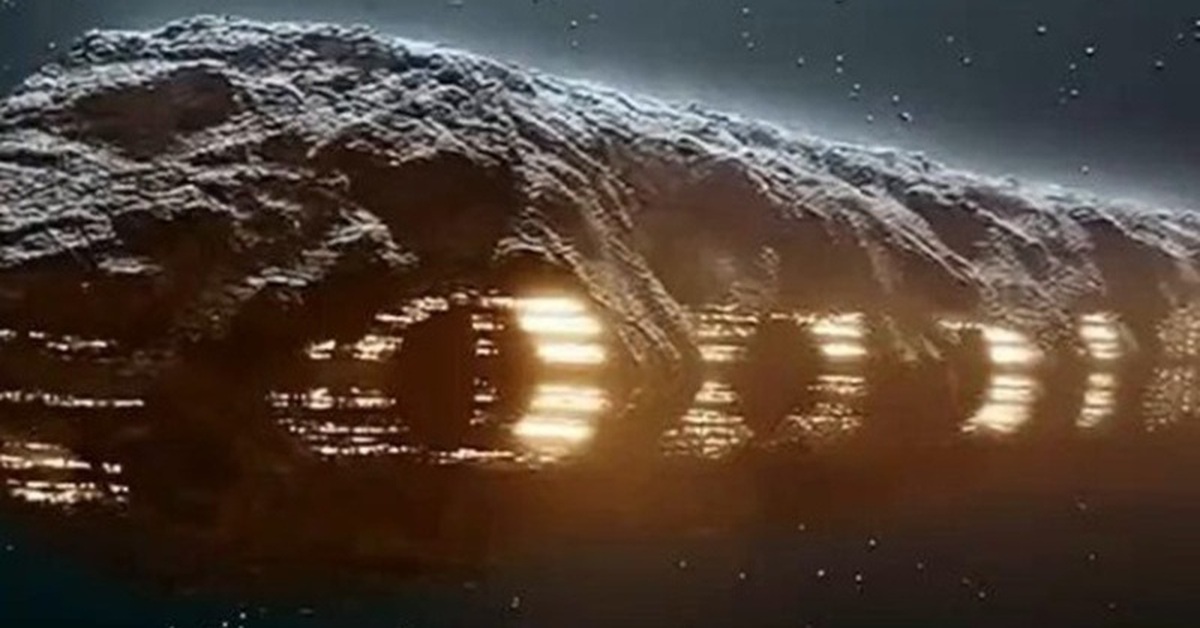
Worse, such explosions could devastate Earth’s own atmosphere, spreading radiation and triggering ecological collapse.
Humanity might fight bravely—but at the cost of destroying its own home in the process.
It is the ancient paradox of war amplified to a cosmic scale: in trying to defend the world, we might end up annihilating it.
Still, victory is not only measured in survival; it is measured in meaning.
Even if humanity were to fall, the very act of resistance could define us.
The aliens might possess superior weapons, but do they possess something like our spirit—the irrational courage to fight against impossible odds? History’s greatest revolutions were born from defiance, not strength.
In every human story, there comes a moment when reason says “give up,” and emotion says “no.
” That refusal to surrender might be the one thing the aliens could not understand—and therefore, could not predict.
Suppose the aliens’ objective is not extermination but conquest.
They might wish to harvest Earth’s resources or study humanity as a biological curiosity.
In that case, they would have to restrain themselves, using precision strikes instead of total annihilation.
That restraint could give humans time to adapt—to reverse-engineer their technology, to sabotage their systems, to fight in ways they don’t expect.
Earth’s terrain, atmosphere, and weather would become our allies.
We know this planet; they do not.
A species evolved under alien suns might struggle with our microbial life, our gravity, even our diseases.
Remember how smallpox and malaria once defeated empires? Perhaps Earth’s invisible ecosystems could do the same to invaders.
Yet, let us not deceive ourselves.
The aliens would have advantages far beyond our imagination.
Their intelligence systems might predict our every move.

Their machines could self-repair, self-replicate, even evolve faster than we can manufacture a single missile.
If they use artificial intelligence, their war strategies might shift instantaneously, leaving our human generals obsolete.
They could attack not just our cities but our minds, using frequencies or signals that disrupt human emotion and thought.
It would be a war not only of fire but of perception—one fought in cyberspace, in consciousness, in the very definition of what it means to be human.
And yet, amid all this despair, there is one possible equalizer: the unpredictability of life.
Intelligence, no matter how advanced, cannot fully simulate chaos.
Humans are irrational, emotional, prone to error—and sometimes, that is our greatest strength.
A desperate human act, seen as madness by a machine-like species, might succeed precisely because it defies logic.
History has shown that asymmetric forces—outnumbered, outgunned—can triumph through creativity and luck.
The question, then, is whether humanity’s collective chaos could outmaneuver an alien precision.
Could our messiness, our flaws, become our salvation?
In the deepest sense, the war would not only be physical but philosophical.
It would pit two different worldviews against each other: one shaped by survival and imperfection, the other by control and mastery.
The aliens, having long conquered their own nature, might view emotion as weakness.
Humans, on the other hand, fight precisely because of emotion—love, rage, fear, hope.
Those primal forces have driven our species to create art, build civilizations, and survive disasters.
If aliens fight without passion, and we fight with it, the battlefield becomes not just about who has stronger weapons, but whose will to live burns brighter.
In this context, nuclear weapons become symbols rather than solutions.
They represent humanity’s willingness to destroy everything rather than kneel.
The decision to launch them would be both heroic and tragic—the last declaration of independence from a species that refuses to be erased quietly.
Even if the blast clouds darkened the sky and poisoned the oceans, even if Earth became a wasteland, the message would echo through the universe: We fought.

Would that matter to the aliens? Perhaps.
If they are truly intelligent, they might realize that annihilating such a species would be a moral crime.
Perhaps they would stop, reconsider, or even respect us for our defiance.
If they are devoid of empathy, then they might wipe us out without hesitation.
But in either case, the outcome reveals something profound: that war between species is not simply about power, but about understanding.
It is a confrontation between two kinds of consciousness—one that sees the universe as a machine to be mastered, and another that sees it as a mystery to be endured.
There is, however, a third possibility—one often overlooked in the excitement of battle: that we are not worth attacking.
To a civilization millions of years ahead, humanity might appear as ants on a rock—primitive, loud, but irrelevant.
They could erase us easily, yet choose not to, just as we rarely declare war on bacteria.
Their “attack” might not even be intentional; it could be the side effect of cosmic-scale engineering, radiation bursts, or terraforming.
We might interpret natural phenomena as hostility when, in truth, they are indifferent.
In that sense, our nuclear retaliation would be like shouting at a storm—tragic, but also deeply human.
If such a day ever comes, the greatest question will not be who wins, but who remains.
Suppose the aliens withdraw after destroying half of humanity.
Civilization would collapse, but survivors would rebuild.
The war would become legend.
Future generations would grow up under a sky filled with scars—craters, wreckage, radioactive wastelands—but also with stories.
They would remember that their ancestors stood up against gods from the stars and refused to die quietly.
And that memory would shape them into something new—stronger, wiser, perhaps even ready for the next encounter.
In the long run, then, the war with aliens is not a question of victory or defeat; it is a question of evolution.
If we survive, we will no longer be the same species.
We will have learned to think beyond nations, to cooperate on a planetary scale, to build technologies that reach beyond Earth.
The aliens, by forcing us to the brink, might inadvertently make us worthy of standing beside them.
Conflict, as brutal as it is, has always been the catalyst of growth.
But if we perish—if humanity burns beneath the light of its own weapons—then perhaps that too has meaning.
The universe will have witnessed a brief, brilliant civilization that refused to go quietly into the dark.
And somewhere, among the stars, another species might find the ruins of our world, the echoes of our broadcasts, the radioactive fingerprints of our final stand.
They would know that once, on a small blue planet, there lived beings who loved fiercely, dreamed endlessly, and fought even when there was no hope.
So who would win? If we measure by power, the aliens would almost certainly triumph.
But if we measure by spirit—by the ability to endure, to defy, to leave a mark even in defeat—then humanity might win something greater than survival: immortality in memory.
The universe is vast, but courage is universal.
And in that cosmic equation, perhaps there are no true victors or losers—only stories, written in light and fire, of those who dared to fight.
News

At 56, The Tragedy Of Jennifer Aniston Is Beyond Heartbreaking
Behind the laughter, the fame, and the seemingly perfect Hollywood image of Jennifer Aniston lies a life marked by struggle,…

R. KELLY ATTACKED IN PRISON? Disturbing REPORTS and WHISPERS From Behind Bars Spark a Terrifying Question
R.Kelly’s collapse from global stardom did not end with a courtroom sentence. According to filings submitted by his legal team,…

What happened to Cesar Millan from Dog Whisperer? Is He Going to Jail?
The Truth Behind the Viral Claim About Cesar MillanWhy the Internet Suddenly Believed the Famous Dog Behaviorist Was Sentenced to…

Albert Lin Just Exposed What’s Hidden Beneath the Terracotta Army — And It’s Not What You Think
The world of television often appears polished and effortless, yet the truth behind the camera tells a very different story….

UK EXPLODES as King Charles DECLARES Divorce From Camilla After SHOCKING Betrayal
The Shocking Announcement of King Charles III’s Divorce from Queen Camilla In a dramatic turn of events, King Charles III…

After Locating Cleopatra’s Lost Tomb Archaeologists Found Terrifying Detail That Defies Explanation
For nearly two millennia, the final resting place of Cleopatra remained one of the greatest unsolved mysteries of the ancient…
End of content
No more pages to load






