
They used to call it a “five-minute life.
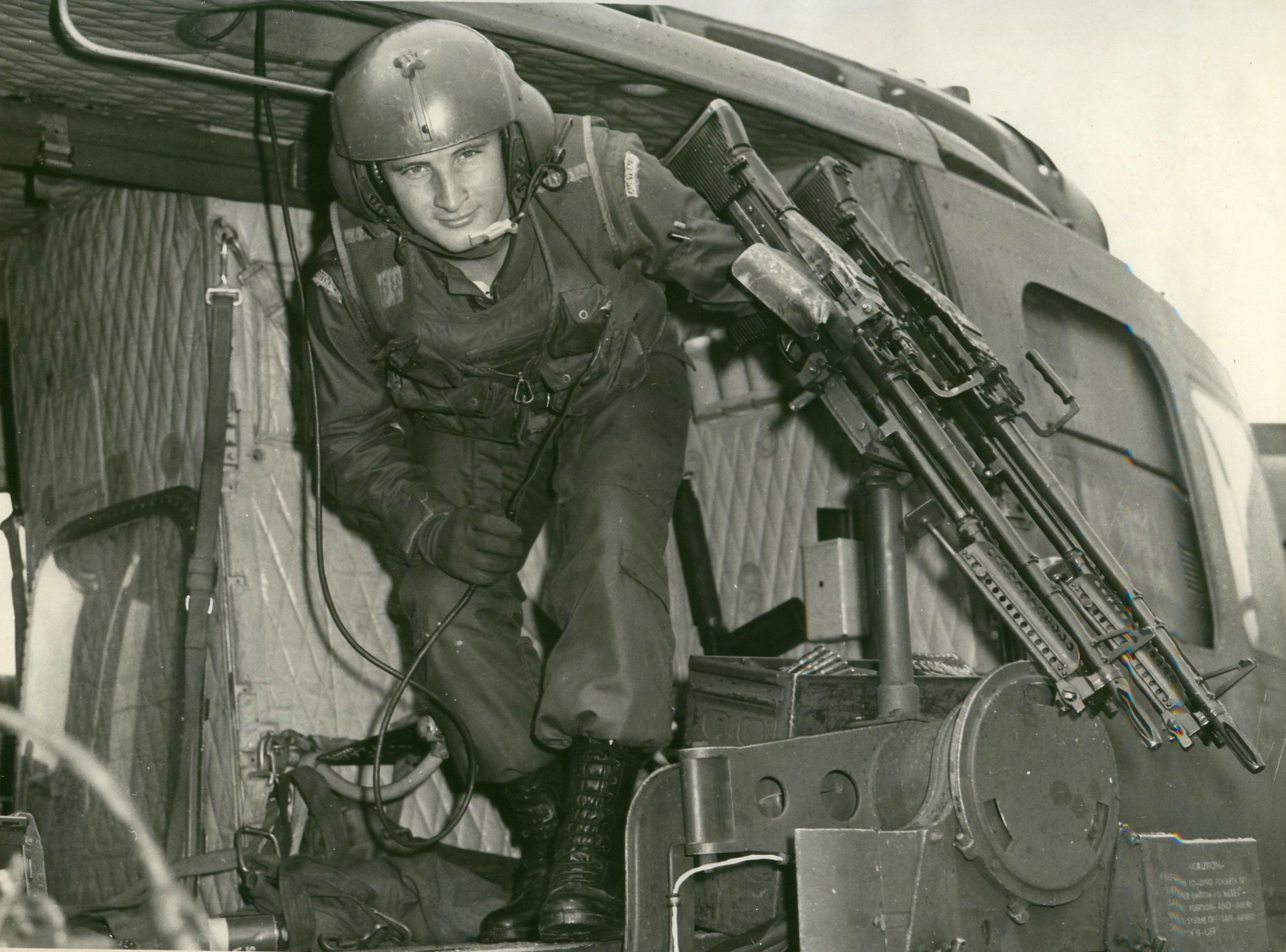
” A door gunner, strapped to a bungee-hung M60 on the edge of a Huey, stared into walls of tracer fire with nothing between him and the enemy except a harness and his own resolve.
For these men, courage wasn’t simply the willingness to face danger—it was becoming the shield that kept everyone else alive.
Yet a haunting question cuts through the history of that war: why did so many of them die even after heavier weapons and supposedly improved tactics appeared? The answer lies in the mission, the machine, and the system they flew within.
When the United States first committed helicopters to Vietnam, commanders clung to a perilous assumption: aircraft could survive the battlefield as long as they stayed high and fast enough.
The Bell UH-1 Iroquois—quickly christened the Huey—was imagined as a kind of airborne pickup truck, powered by a bright new turbine engine and ready to haul troops, ammunition, and rations wherever the jungle made roads useless.

Speed was expected to be its armor.
On paper, as long as the aircraft didn’t hover, enemy gunners would struggle to track it.
But the tidy logic of doctrine dissolved almost instantly once the Huey met the reality of Vietnam’s terrain.
Troops couldn’t jump from great heights, and supply bundles couldn’t be tossed blindly into the trees.
The Huey had to descend into tight clearings, flare, and hover for long seconds—sometimes half a minute or more—while soldiers leapt into grass flattened by the rotor wash.
Medevac birds, the lifelines of wounded men across the jungle, had to slow, settle, and sometimes touch down in spaces barely wider than their rotors.
Those moments of near-stillness gave the Viet Cong and North Vietnamese soldiers exactly what they needed: time.
Small-arms fire erupted from everywhere beneath the canopy.
The upward curve of AK-47 tracers was soon joined by the harsher thumping of RPD machine guns, then the terrifying punch of DShK heavy guns and radar-guided 37-millimeter cannons.
Flying too high meant losing sight of landing zones; flying low meant flying straight into fire.
The jungle eliminated the option of altitude, and every helicopter that slowed became a target.
Losses mounted with brutal speed.
Nearly 12,000 U.S.helicopters served in Southeast Asia; more than 5,600 were shot down or destroyed, and almost 2,700 of those were Hueys.
These weren’t the random casualties of a chaotic war—they were the predictable results of a machine used in ways it had never been designed for.
Hueys had minimal armor and broad, vulnerable silhouettes.
A single bullet in the rotor mast could turn a sortie into a spinning descent.
It didn’t take the enemy long to learn where to aim.
So survival began not with altitude or speed, but with fire from the open doors.
And from that necessity, the door gunner was born.
This role didn’t exist in manuals or training programs.
It emerged in the field when crew chiefs took cabin doors off their hinges, hung M60s on bungee cords, and leaned out to sweep the treeline with suppressive fire.

Soon a second gunner was added.
Volunteers flooded in from motor pools, supply rooms, and mess halls—anyone who wanted a taste of the fight or the thrill of trading the monotony of camp for the immediacy of combat.
They weren’t trained with simulations or optics.
They learned by gripping a rattling machine gun, bracing against the slipstream, and firing at fleeting shadows beneath them.
They carried thousands of rounds in long belts, rationing bursts by instinct.
Their protective gear was little more than flame-resistant fabric meant to stop shrapnel, not bullets.
The heavy ceramic plates that might have saved them slowed their movements, so many left them behind.
What kept them inside the helicopter wasn’t armor but a nylon tether clipped to the cabin frame.
They crouched on the skids with their boots in the wind, vulnerable to every abrupt turn and every enemy marksman waiting below.
Their legend grew in the barracks alongside a grim line of gallows humor: “A door gunner’s life expectancy is five minutes.
” No one took it literally, but everyone understood its meaning.
Gunners were the most exposed people in the sky.
When the Huey slowed, the enemy looked for the doors first.
Every burst they sent into the jungle called a dozen bullets back.
And so the casualty lists filled disproportionately with door gunners and crew chiefs—men whose station placed them in the deadliest arc of fire on the aircraft.
Stories like that of Specialist Gary Wetzel—who continued firing after a rocket-propelled grenade shattered his arm—captured the brutal essence of the job.
Wetzel crawled back to the skid, applied a makeshift tourniquet, and kept shooting until everyone else had escaped.
He survived and earned the Medal of Honor, but thousands of others did not.
Skill and bravery were never the issue; the physics of hovering machines and exposed positions governed their odds.
Faced with the obvious vulnerability of the Huey, commanders reached for the most immediate fix they could imagine: more guns.
They began turning transports into makeshift gunships—monstrous hybrids carrying miniguns, grenade launchers, and pods of folding-fin rockets.
These improvised gunships, nicknamed “hogs” and “frogs,” could saturate landing zones with terrifying firepower.
But the weight of all that ordnance crippled their ability to hover, especially in the hot, humid air of Vietnam.
The Huey remained what it had always been—large, slow to maneuver, and perilously fragile.
The door gunner, even on these Franken-Hueys, still stood exposed, still became the shield.
It took years before a real solution arrived.

Engineers at Bell Helicopter realized the Army didn’t need a transport that could fight—it needed a fighter that happened to fly.
The result was the AH-1 Cobra: narrow, fast, armored where it mattered, and bristling with weapons designed from the outset for combat.
First fielded in 1967, the Cobra immediately changed the war in the air.
For the first time, Huey slicks had an escort built for survival, and losses dropped as Cobras carved paths through the treeline with rockets and minigun fire.
The new tactics they enabled—like the hunter-killer teams pairing nimble OH-6 scouts with circling Cobras—shifted helicopters from prey to predator.
But even Cobras bled, and nowhere more savagely than during Operation Lam Son 719 in 1971.
Devised to test South Vietnam’s ability to operate independently, the mission barred American ground troops from entering Laos, forcing helicopters to carry the entire burden.
More than 600 aircraft filled the skies.
The North Vietnamese had spent months hauling heavy guns into the jungle, preparing kill zones along every predictable flight path.
When the first waves crossed into Laos, the air erupted in fire.
On February 13—“Black Monday”—over forty helicopters were hit or destroyed in a single attempt to resupply the besieged Ranger North outpost.
Pilots described the scene as wheels of flame rolling across the hillsides.
Heroism surfaced amid the carnage.
Specialist 5 Dennis Fujii, stranded after his medevac crashed, survived days under fire while calling danger-close airstrikes to protect wounded South Vietnamese soldiers around him.
The campaign lasted only weeks but accounted for one in ten of all helicopter-crew deaths in the entire war.
The men who survived rarely spoke of strategy; they remembered only the feeling of friends falling from the sky.
And from all of this emerges the dark truth about why door gunners died in such staggering numbers.
Their deaths were not random.
They were not the result of inexperience or recklessness.
They were the inevitable consequence of a system that demanded helicopters slow down, hover, and expose their weakest points in the heart of enemy fire.
The Huey was never designed for combat, yet for years it was forced into roles that required human beings to compensate for its vulnerabilities.
Doctrine celebrated rapid mobility, but mobility came at a price paid by the men in the open doors.
They were not unlucky—they were expendable by design.
Only with the arrival of purpose-built attack helicopters like the Cobra, and later the Apache, did technology finally provide the protection and firepower that might have spared them.
Those machines proved what had always been possible: armor, sensors, and weapons could do the job that once demanded the sacrifice of exposed young men perched on the skids of a Huey.
News

At 56, The Tragedy Of Jennifer Aniston Is Beyond Heartbreaking
Behind the laughter, the fame, and the seemingly perfect Hollywood image of Jennifer Aniston lies a life marked by struggle,…

R. KELLY ATTACKED IN PRISON? Disturbing REPORTS and WHISPERS From Behind Bars Spark a Terrifying Question
R.Kelly’s collapse from global stardom did not end with a courtroom sentence. According to filings submitted by his legal team,…

What happened to Cesar Millan from Dog Whisperer? Is He Going to Jail?
The Truth Behind the Viral Claim About Cesar MillanWhy the Internet Suddenly Believed the Famous Dog Behaviorist Was Sentenced to…

Albert Lin Just Exposed What’s Hidden Beneath the Terracotta Army — And It’s Not What You Think
The world of television often appears polished and effortless, yet the truth behind the camera tells a very different story….

UK EXPLODES as King Charles DECLARES Divorce From Camilla After SHOCKING Betrayal
The Shocking Announcement of King Charles III’s Divorce from Queen Camilla In a dramatic turn of events, King Charles III…

After Locating Cleopatra’s Lost Tomb Archaeologists Found Terrifying Detail That Defies Explanation
For nearly two millennia, the final resting place of Cleopatra remained one of the greatest unsolved mysteries of the ancient…
End of content
No more pages to load






