
If one night, the sky suddenly tore open with a streak of light so bright it outshone the stars, and every observatory on Earth sounded the alarm that 3I/ATLAS—the mysterious interstellar object that once baffled the world—was now on a direct collision course with our planet, what would happen? Would it mark the final chapter of human civilization, or the painful birth of something new?
This question—half science, half existential terror—is not only a thought experiment in physics, but also a meditation on human fragility and the indifferent vastness of the universe.
3I/ATLAS, as we know, is no ordinary wanderer.
It’s an interstellar object, an alien visitor that once entered our Solar System, accelerated near the Sun in ways gravity couldn’t explain, and emitted a faint OH radio signal at 1665 megahertz—the same spectral neighborhood as the famous 1977 “Wow!” signal.
Scientists have debated whether it was a comet, an asteroid, or something stranger—a relic of alien technology adrift among the stars.

Now, in this hypothetical scenario, imagine that after years of silence, it returns—and this time, its path crosses directly with Earth’s orbit.
To grasp the magnitude of this event, we must first look at the numbers.
If 3I/ATLAS were roughly 200 to 500 meters wide—comparable to a mid-sized asteroid—its impact speed, around 60–70 kilometers per second, would unleash an energy equal to tens of millions of megatons of TNT.
That’s thousands of times more powerful than every nuclear bomb on Earth combined.
The immediate result would be apocalyptic: an explosion of unimaginable heat, a crater spanning hundreds of kilometers, shockwaves tearing through the atmosphere, and global climate disruption that could last for years.
Yet the true terror of 3I/ATLAS isn’t just its kinetic energy—it’s its mystery.
If this object is not purely natural, if it’s in fact an artificial construct—a derelict probe, a long-lost artifact of some ancient civilization—then its impact would not simply be a natural disaster.
It would be contact.
A fatal one.
Let’s start from the scientific perspective.
In the early warning stage, when the object’s course begins to deviate toward Earth, telescopes such as Vera Rubin Observatory and Pan-STARRS would detect subtle anomalies in its motion.
Once the probability of collision exceeds even one percent, governments would scramble.
The world’s space agencies would convene emergency councils.
NASA, ESA, Roscosmos, and private firms like SpaceX would immediately draft impact-mitigation plans: kinetic impactors, nuclear deflection, gravity tractors—anything to shift its path by even a fraction of a degree.
But the problem is that 3I/ATLAS is not bound by the same physical rules as ordinary asteroids.
Its orbit is hyperbolic, meaning it is not captured by the Sun’s gravity—it’s merely passing through.
Past observations have shown it can accelerate, slow down, or change direction in ways that defy our models.
If it can adjust its trajectory intentionally, then all our plans to “deflect” it become meaningless.
The nightmare scenario is not that it might hit Earth, but that it chooses to.
As it approaches, radio observatories like MeerKAT and FAST would detect renewed activity—weak, rhythmic OH emissions repeating at precise intervals.
Some would dismiss them as chemical outgassing.
Others would hear a pattern—a heartbeat.
Spectroscopic data would show double tails, fluctuations in brightness, traces of rare metals like iridium and osmium, and carbon-based nanostructures never before seen in natural bodies.
Every new piece of data would blur the line between science and mythology.
And then, the unthinkable happens: impact becomes inevitable.
The countdown begins.
If 3I/ATLAS strikes the Pacific Ocean, the shockwave will vaporize billions of tons of water, blasting it into the stratosphere.
A tsunami more than 300 meters high would race across the ocean at nearly 800 km/h, devouring coastal cities from Japan to California.
If it strikes land, the explosion will generate temperatures hotter than the Sun’s surface.
Everything within a thousand kilometers will ignite instantly.
The sky will darken under a global shroud of dust and ash, blocking sunlight for months.
“Impact winter” begins.
Average temperatures will plummet.
Crops will fail.
Photosynthesis will halt.
Acid rain will poison the oceans.
The atmosphere, rich with sulfur dioxide and nitric compounds, will become a gray, suffocating veil.
Within weeks, ecosystems collapse.
Humanity—dependent on global agriculture, digital infrastructure, and fragile supply chains—will crumble with it.
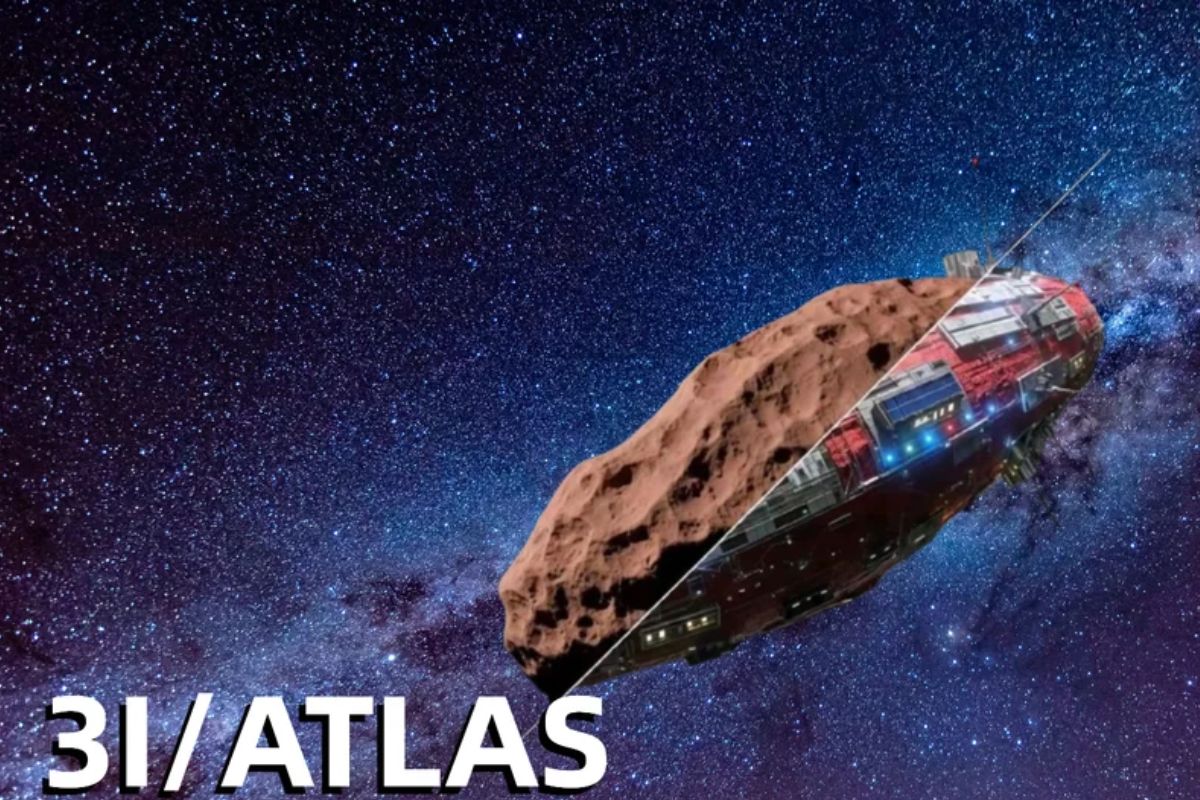
But what if, as some have speculated, 3I/ATLAS isn’t a natural rock at all?
What if, instead of disintegrating on impact, it activates?
Imagine the moment of contact: the impact doesn’t produce a crater but a silent shockwave of light.
Beneath the molten debris, a geometric structure reveals itself—metallic, hexagonal, glowing faintly blue.
Then a pulse: a signal not transmitted outward into space, but downward, into Earth’s crust.
Satellites fail.
GPS systems glitch.
Electromagnetic fields ripple across continents.
It’s as if something deep beneath our planet is being awakened—or perhaps, communicated with.
In this interpretation, 3I/ATLAS could be a “seed of intelligence,” a messenger dispatched across time and space to trigger or assess civilizations capable of recognizing it.
Its “impact” would not destroy Earth but reboot it.
In the ruins, survivors might discover crystalline structures within the object—filled with coded information, mathematical constants, and molecular blueprints.
These could become the Rosetta Stone of an entirely new cosmic language—a way for humanity to ascend to a higher understanding of the universe.
Yet, returning to physical reality, even a natural collision would alter Earth forever.
Scientists often compare such an event to the Chicxulub impact 66 million years ago, when a 10-kilometer asteroid wiped out 75% of all species, including the dinosaurs.
3I/ATLAS, though smaller, would arrive at much higher speed, releasing even greater energy per unit mass.
Could humanity stop it? Probably not.
Even the most advanced nuclear weapons would barely nudge an object traveling that fast.
At best, we could fragment it—only to turn one catastrophe into a thousand smaller ones.
The only hope would be early detection and coordination on a planetary scale, something we’ve never achieved.
As the hours tick down, the final broadcasts would go live.
Governments would collapse; faiths and philosophies would collide.
Some would pray, some would riot, others would simply watch the sky.
3I/ATLAS would appear larger each night—an artificial sun, dragging behind it a plasma tail that bleeds across the heavens.
The Sun itself would dim under its glare.
The world would hold its breath.
Then, silence.
A blinding flash.
A shockwave that ripples through the mantle of the planet.

Volcanoes awaken across the Pacific Ring of Fire, releasing centuries of trapped magma.
The ozone layer burns away.
The air fills with fine dust that dims the Earth into twilight.
For centuries afterward, the planet would be cloaked in shadow.
Only the deepest oceanic vents and underground refuges would harbor life.
Yet history tells us: life endures.
After Chicxulub, tiny mammals survived, eventually evolving into us.
Perhaps after 3I/ATLAS, new life forms—resilient, radiation-hardened, adapted to the new world—would rise.
The human species, if it survives at all, would become something else: not rulers of Earth, but witnesses of its rebirth.
From a philosophical lens, such an impact could be viewed as the cosmic test—a reminder that we are not the center of creation.
Our extinction, though tragic, might be part of a larger cosmic rhythm—the same rhythm that forges stars, births galaxies, and destroys worlds to create new ones.
3I/ATLAS, in this sense, becomes less an enemy than a messenger—one that forces us to confront a humbling truth: that intelligence, no matter how advanced, is fleeting in the vast theater of the universe.
But perhaps the most haunting aspect of this scenario isn’t the collision itself—it’s the anticipation.
In the months before impact, humanity would live under a single shadow.
Political borders would blur.
Wars would pause.
For the first time in recorded history, the entire species would share one fear, one fate.
In that unity—born not of hope, but of terror—we might finally see ourselves as one.

Ironically, it might take the end of the world to make humanity whole.
If we are fortunate, 3I/ATLAS would simply pass by—its plasma tail brushing Earth’s magnetosphere, lighting the sky with auroras never before seen.
The world would watch in awe, and then relief.
It would become a legend—a warning written across the stars, reminding us of how fragile life truly is.
But if not—if the impact comes, and Earth falls silent—then it will not be the end of the story.
For somewhere in the cold emptiness of space, the fragments of both 3I/ATLAS and Earth will drift together, orbiting the Sun—or perhaps leaving it behind entirely.
And maybe, just maybe, that union will seed another world, somewhere else, sometime in the far future.
Because that is how the universe writes its stories: not in permanence, but in cycles.
Every destruction births a beginning.
Every silence carries an echo.
And if the day comes when a strange object from the stars descends upon our world, our response—our courage, our curiosity, our understanding—will be the truest reflection of what it means to be human.
News

At 56, The Tragedy Of Jennifer Aniston Is Beyond Heartbreaking
Behind the laughter, the fame, and the seemingly perfect Hollywood image of Jennifer Aniston lies a life marked by struggle,…

R. KELLY ATTACKED IN PRISON? Disturbing REPORTS and WHISPERS From Behind Bars Spark a Terrifying Question
R.Kelly’s collapse from global stardom did not end with a courtroom sentence. According to filings submitted by his legal team,…

What happened to Cesar Millan from Dog Whisperer? Is He Going to Jail?
The Truth Behind the Viral Claim About Cesar MillanWhy the Internet Suddenly Believed the Famous Dog Behaviorist Was Sentenced to…

Albert Lin Just Exposed What’s Hidden Beneath the Terracotta Army — And It’s Not What You Think
The world of television often appears polished and effortless, yet the truth behind the camera tells a very different story….

UK EXPLODES as King Charles DECLARES Divorce From Camilla After SHOCKING Betrayal
The Shocking Announcement of King Charles III’s Divorce from Queen Camilla In a dramatic turn of events, King Charles III…
After Locating Cleopatra’s Lost Tomb Archaeologists Found Terrifying Detail That Defies Explanation
For nearly two millennia, the final resting place of Cleopatra remained one of the greatest unsolved mysteries of the ancient…
End of content
No more pages to load






