3I/ATLAS: The Comet That Defies Explanation—Is It a Cosmic Enigma or Just Misunderstood?
The latest observations of comet 3I/ATLAS have left astronomers scratching their heads in disbelief.
Initially thought to be breaking apart, recent images reveal that this enigmatic object remains intact, raising critical questions about its composition and behavior.
In this article, we will delve into the observations and theories surrounding 3I/ATLAS, exploring why this comet continues to baffle scientists and what it could mean for our understanding of these celestial wanderers.

When images of 3I/ATLAS were first captured on November 9, they displayed an astonishing tail stretching millions of kilometers.
This phenomenon led many to believe that the comet was fragmenting, as such extensive tails typically indicate a significant loss of material.
For comets, gas flows out at a relatively slow speed of about 1,500 kilometers per hour.
To produce tails that long, the comet would need to be expelling gas continuously for months.
The conundrum intensified when earlier images showed no tail at all, leading to a growing consensus that 3I/ATLAS was on the verge of disintegration.
Calculations indicated that for the tails to form as observed, the comet would require a surface area capable of absorbing sunlight equivalent to that of a sphere 23 kilometers in diameter.
However, measurements from the Hubble Space Telescope revealed that 3I/ATLAS is only about 5.6 kilometers across.
This discrepancy suggested that the comet was losing an unsustainable amount of material—estimated at around 50 billion tons per month—far exceeding its total mass of approximately 33 billion tons.
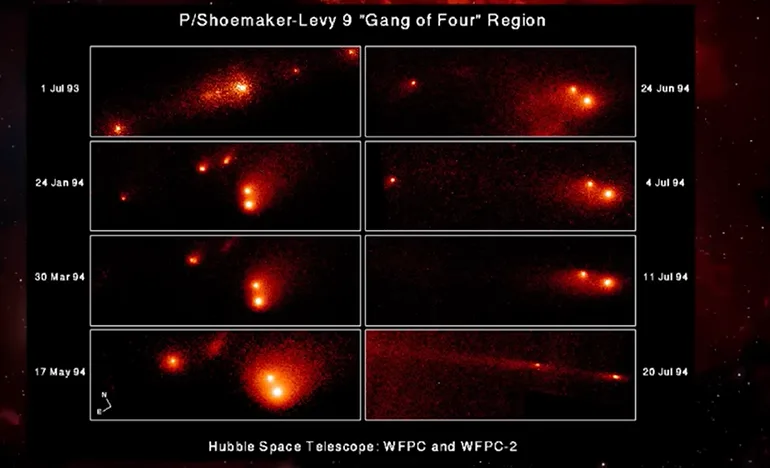
Despite the alarming predictions of fragmentation, a team of astronomers, David Jewitt and Jane Luu, conducted detailed observations of 3I/ATLAS on November 11.
Their findings were published with the straightforward title, “3I/ATLAS, Still Single.”
Contrary to expectations, they found no evidence of fragmentation.
Instead, they identified a single bright nucleus surrounded by an active coma—a glowing cloud of gas and dust.
The observations revealed two distinct tails: one directed almost directly toward the sun, known as an anti-tail, and another extending away from it.
The researchers meticulously analyzed a vast area around the comet, employing various imaging techniques to search for any signs of breakup.
Their conclusion was clear: 3I/ATLAS remained a single, intact object, despite having just passed through a period of intense solar heating.

The stability of 3I/ATLAS raises significant questions about the nature of comets and their behavior under extreme conditions.
Typically, one would expect a comet to fragment when subjected to the intense thermal stress of approaching the sun, especially after reaching perihelion on October 29.
Yet, two weeks later, 3I/ATLAS maintained its integrity while producing impressive jets of gas and dust.
If 3I/ATLAS is indeed a natural object, scientists must grapple with how it has managed to withstand such conditions.
Several theories have emerged to explain this anomaly.
One possibility is that 3I/ATLAS is billions of years old, potentially dating back to the early solar system.
Over that time, it may have been subjected to cosmic rays, which could have altered its surface chemistry and created a unique crust.
This crust might allow for sublimation processes that differ from typical comet behavior, possibly enhancing the effective surface area available for gas release.
Another theory suggests that the calculations regarding the comet’s mass loss may need reevaluation.
The figure of 50 billion tons per month was derived from the observed brightness and size of the tails, but if the tails are more effective at scattering sunlight than previously understood, the actual mass loss could be significantly lower—perhaps around 5 billion tons per month.
While this number is still substantial, it would be more feasible given the comet’s size.
The situation surrounding 3I/ATLAS illustrates the complexities of studying comets and the challenges of interpreting observational data.
As astronomers continue to analyze this comet, the implications of their findings could reshape our understanding of these celestial bodies.
The lack of fragmentation, despite the apparent loss of material, invites a reevaluation of how we perceive the dynamics of comets in our solar system.
The ongoing research into 3I/ATLAS highlights the necessity for continued observation and analysis.
As new data emerges, scientists will need to refine their models and theories to account for the unique characteristics displayed by this comet.
The mystery of 3I/ATLAS serves as a reminder of the wonders of space exploration and the ever-evolving nature of our understanding of the cosmos.
In conclusion, the case of 3I/ATLAS is a fascinating example of how celestial phenomena can challenge our existing knowledge and assumptions.
As astronomers work to unravel the mysteries of this comet, they are not only seeking to understand its behavior but also to gain insights into the broader processes that govern the dynamics of our solar system.
The journey of 3I/ATLAS is far from over, and as we continue to observe and study it, we may yet uncover revelations that change our perspective on these enigmatic travelers of the universe.
News

Ella Mai’s Shocking Confession: The Hidden Truth Behind Her Secret Baby and R&B Royalty!
Ella Mai’s Shocking Confession: The Hidden Truth Behind Her Secret Baby and R&B Royalty! Ella Mai, the voice behind the…

Nicole Kidman Breaks Her Silence: The Shocking Truth Behind Her Divorce from Keith Urban!
Nicole Kidman Breaks Her Silence: The Shocking Truth Behind Her Divorce from Keith Urban! After nearly two decades of a…

The Heartbreaking Reality of Tom Selleck: From Fame to Fear of Losing It All!
The Heartbreaking Reality of Tom Selleck: From Fame to Fear of Losing It All! Tom Selleck, the iconic actor known…
King Arthur’s Tomb Found: The Shocking Truth Behind the Legend That Changes Everything!
King Arthur’s Tomb Found: The Shocking Truth Behind the Legend That Changes Everything! The legend of King Arthur has captivated…

Keanu Reeves’ Heartbreaking Farewell: The Real Reason He May Never Return to Action Films!
Keanu Reeves’ Heartbreaking Farewell: The Real Reason He May Never Return to Action Films! Keanu Reeves, the beloved action star…

Jeremy Wade Breaks His Silence: The Shocking Truth Behind the Cancellation of River Monsters!
Jeremy Wade Breaks His Silence: The Shocking Truth Behind the Cancellation of River Monsters! After nearly a decade of captivating…
End of content
No more pages to load