
3I ATLAS: The Interstellar Comet That Shocked Scientists with Its Massive Ion Tail!
Something astonishing is happening far above us in the cosmos.
The interstellar comet known as 3I ATLAS, or C/2025 N1, is exhibiting unexpected behavior that has left scientists both amazed and intrigued.
As of November 11, 2025, astronomers have reported that its ion tail is not only growing but is also becoming significantly brighter, marking a remarkable chapter in the story of this mysterious visitor from beyond our solar system.
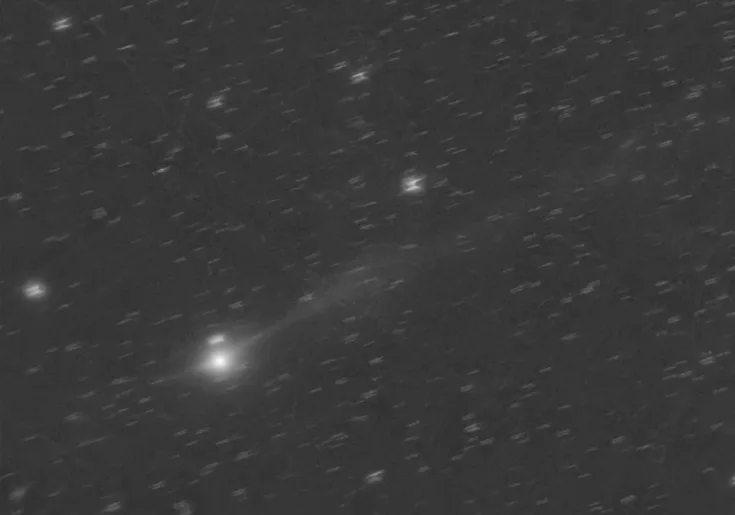
Imagine a glowing traveler moving silently through the blackness of space, carrying with it a long electric blue tail that stretches millions of kilometers into the void.
This tail, composed of charged gas glowing under the influence of sunlight and the solar wind, has suddenly extended even further than anticipated, making 3I ATLAS one of the most visually dramatic interstellar comets ever recorded.
Observations from various observatories in Europe and South Africa revealed that the comet’s ion tail had nearly doubled in length since the beginning of November, appearing to stretch across nearly half a degree of the sky—about the apparent width of the full moon when viewed from Earth.
But what does this rapid growth of the ion tail signify? Typically, when a comet’s ion tail expands, it indicates that the sun’s energy is exciting the gases in its coma or outer atmosphere.
As the comet approaches the sun, it absorbs more heat and radiation, causing frozen gases to vaporize and release ions and molecules that have lost electrons.
These ions are then swept backward by the solar wind, creating the characteristic tail.
However, in the case of 3I ATLAS, something unusual is occurring.
The comet’s ion tail is longer and brighter than scientists expected for an object of its size.
Astronomers monitoring the comet through spectrographs have detected strong emissions from carbon monoxide and cyanogen gas, both of which glow vividly when ionized by sunlight.
Additionally, faint traces of nitrogen compounds have been observed, potentially explaining the bluish tint seen in recent images.
What makes this discovery even more fascinating is that 3I ATLAS did not originate from our solar system; it came from deep interstellar space, carrying materials that may have formed around another star entirely.
This means the gases in its tail are not just beautiful to observe; they serve as scientific time capsules, preserving the chemistry of distant planetary systems.
The discovery of this new development was made on the evening of November 10th by observers at the Virtual Telescope Project in Italy, led by astrophysicist Gianluca Masi.
They captured fresh images of 3I ATLAS and noted that the faint bluish streak behind the comet’s nucleus had grown significantly longer compared to earlier images.
The following day, several observatories, including the British Astronomical Association’s Comet Section, confirmed the findings, leading to widespread excitement in the astronomy community.
The rapid growth of the ion tail can be attributed to a recent interaction with solar wind streams.
The solar wind, a constant outflow of charged particles from the sun, occasionally experiences bursts of activity, such as coronal mass ejections, which can intensify its effects on comets.
Astronomers suspect that a strong solar wind event around November 8th triggered a burst of ion activity in 3I ATLAS, causing its tail to elongate dramatically.
Early measurements suggest that the ion tail now extends over 20 million kilometers long.
Interstellar comets are rare, with only three confirmed in recorded history: 1I/‘Oumuamua in 2017, 2I/Borisov in 2019, and now 3I ATLAS.
Each of these visitors has behaved differently, providing valuable insights into the diversity of objects traveling between stars.
While ‘Oumuamua was notable for having no visible tail, 2I/Borisov resembled a textbook comet with a bright tail and typical gas emissions.
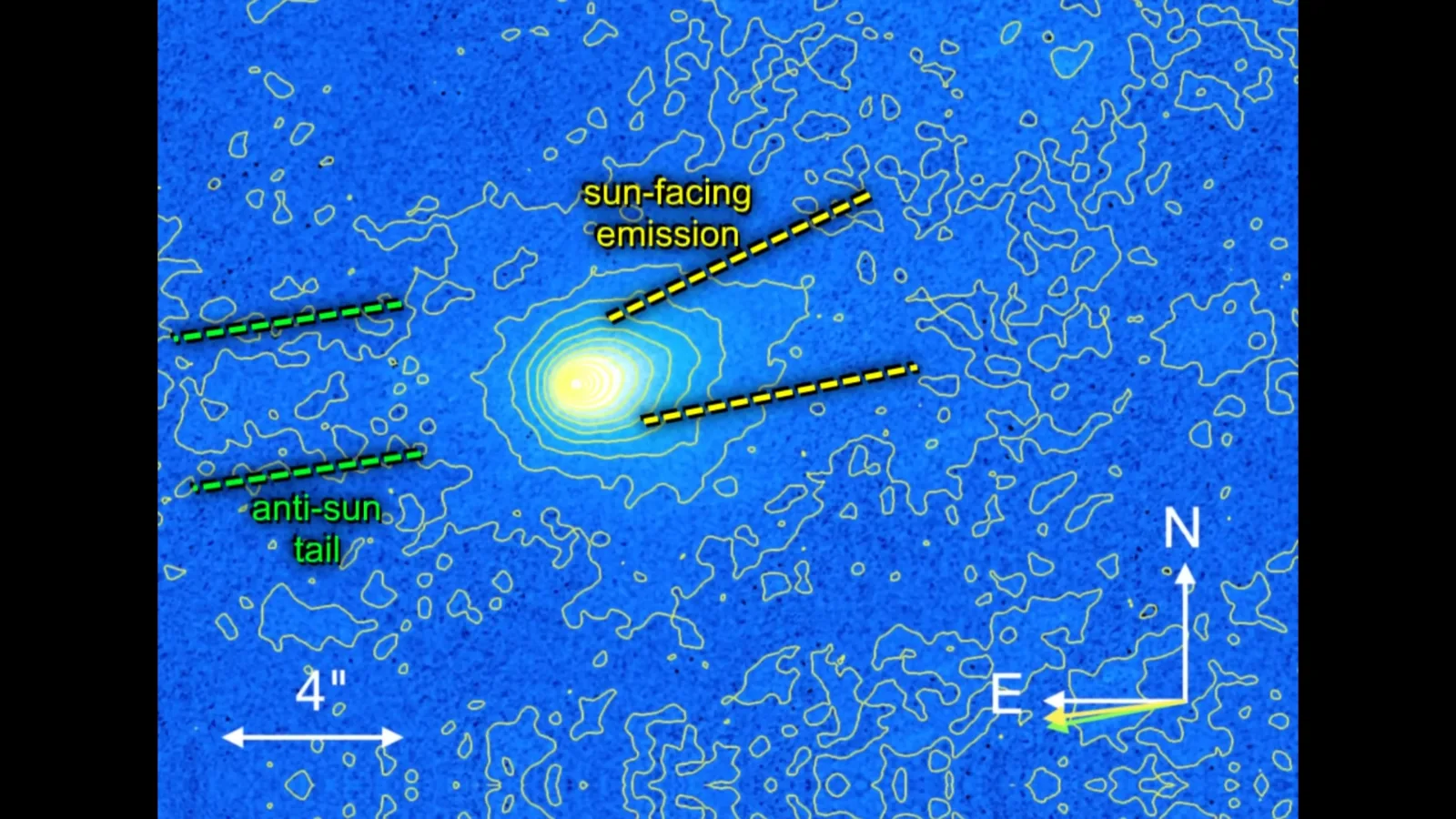
In contrast, 3I ATLAS combines characteristics of both, showcasing an active nature similar to Borisov while exhibiting unique features not previously seen, particularly its long, straight ionized tail and complex jet structures.
The growth of the ion tail also hints at new details about the comet’s composition.
The gas released contains high proportions of carbon-based molecules, which ionize more easily than water vapor.
This suggests that 3I ATLAS may have formed in a much colder region of its home system, where volatile ices like carbon monoxide and methane froze solid.
These ices would evaporate quickly when heated by sunlight, explaining the sudden increase in the tail’s brightness and length.
Scientists at the European Southern Observatory and NASA’s Jet Propulsion Laboratory are currently analyzing spectroscopic data to estimate how much gas the comet is releasing each second, with early results indicating that its activity has doubled in the past two weeks.
The physics behind the formation of a comet’s ion tail involves ultraviolet radiation from the sun stripping electrons from gas molecules near the comet’s nucleus.
The solar wind then carries these ions away, creating a narrow, straight tail that always points directly away from the sun.
This consistent behavior highlights the dynamic interaction between solar radiation and the comet’s material.
Interestingly, earlier images of 3I ATLAS displayed a separate gas jet expelled from an active vent on its surface, which combined with the expanding ion tail to create a spectacular cross-shaped structure.
Harvard astrophysicist Avi Loeb, who has been closely monitoring 3I ATLAS, suggests that the comet’s behavior could provide valuable data for testing theories about how interstellar objects react to solar heating.
If the comet’s acceleration or outgassing deviates from natural predictions, scientists may need to consider alternative explanations, including artificial propulsion.
However, current evidence aligns with the natural comet model, and further observations will be crucial in confirming this hypothesis.
What makes the growth of 3I ATLAS’s tail particularly intriguing is its timing.
The comet has already passed its closest approach to the sun, which occurred in late October.
Typically, a comet’s tail begins to fade after this point as it moves away from the sun and cools down.
Yet, in this case, the ion tail continues to lengthen, suggesting that powerful forces are still at play.
Possible explanations include magnetic fields within the solar wind or a delayed outburst from within the comet’s nucleus releasing trapped gases.
Amateur astronomers in Japan and Spain have also reported observing small kinks and waves forming along the tail, known as plasma disconnection events.
These dramatic ripples occur when magnetic field lines from the solar wind snap and reconnect, cutting off parts of the tail and demonstrating the lively interaction between the sun and the comet.
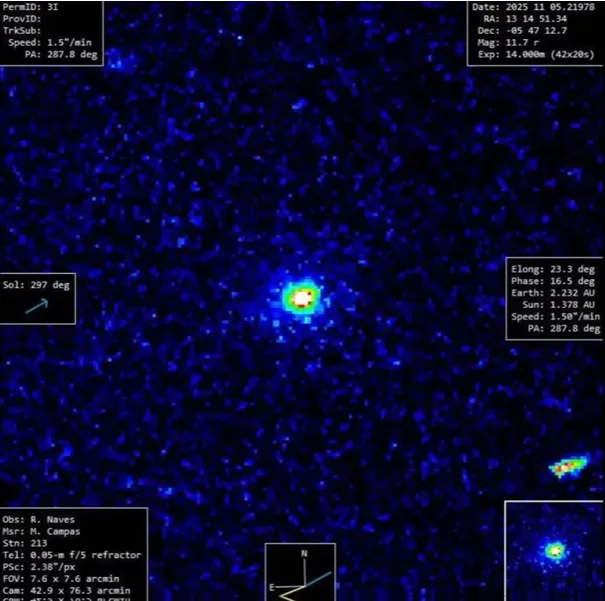
As of mid-November, 3I ATLAS remains visible to professional observatories and advanced amateur setups, with its magnitude slowly increasing, indicating it is getting brighter.
If this trend continues, the comet could become visible through binoculars by December.
For scientists, the coming weeks are crucial for collecting more data before the comet moves farther away.
By analyzing the light emitted from the ion tail, astronomers can identify the elements and molecules present, each leaving a unique fingerprint in the spectrum.
So far, strong lines for carbon monoxide and cyanogen have been detected, along with weaker signals for water and ammonia.
The dominance of these gases suggests that 3I ATLAS formed in a region much colder than our outer solar system, possibly near the edge of another star’s planetary disc.
Understanding its chemistry will help researchers compare how planetary systems form and provide insight into the prevalence of life-sustaining elements like carbon, nitrogen, and oxygen throughout the galaxy.
In December, 3I ATLAS will make its closest approach to Earth, passing at a safe distance but close enough for detailed study.
Astronomers will utilize radar and radio instruments to measure its motion and look for additional signs of outgassing.
Both the Hubble Space Telescope and the James Webb Space Telescope may take observations to measure thermal emissions and detect complex organic compounds.
This upcoming period presents a golden opportunity to learn from a true interstellar messenger.
As we conclude, envision once again that glowing traveler sailing through the solar system, its tail shimmering with blue light as it interacts with the solar wind.
3I ATLAS is a bridge between stars, carrying ancient material from another world.
Observing it is akin to peering through time, witnessing the raw materials of planetary systems drifting across the galaxy.
This growing ion tail is not merely a spectacle; it is a signal—a message written in light that tells us the universe is alive with movement and mystery.
News

Ella Mai’s Shocking Confession: The Hidden Truth Behind Her Secret Baby and R&B Royalty!
Ella Mai’s Shocking Confession: The Hidden Truth Behind Her Secret Baby and R&B Royalty! Ella Mai, the voice behind the…

Nicole Kidman Breaks Her Silence: The Shocking Truth Behind Her Divorce from Keith Urban!
Nicole Kidman Breaks Her Silence: The Shocking Truth Behind Her Divorce from Keith Urban! After nearly two decades of a…

The Heartbreaking Reality of Tom Selleck: From Fame to Fear of Losing It All!
The Heartbreaking Reality of Tom Selleck: From Fame to Fear of Losing It All! Tom Selleck, the iconic actor known…

King Arthur’s Tomb Found: The Shocking Truth Behind the Legend That Changes Everything!
King Arthur’s Tomb Found: The Shocking Truth Behind the Legend That Changes Everything! The legend of King Arthur has captivated…

Keanu Reeves’ Heartbreaking Farewell: The Real Reason He May Never Return to Action Films!
Keanu Reeves’ Heartbreaking Farewell: The Real Reason He May Never Return to Action Films! Keanu Reeves, the beloved action star…

Jeremy Wade Breaks His Silence: The Shocking Truth Behind the Cancellation of River Monsters!
Jeremy Wade Breaks His Silence: The Shocking Truth Behind the Cancellation of River Monsters! After nearly a decade of captivating…
End of content
No more pages to load






