
AI Unveils the Shocking Truth About Pompeii’s Victims: What Lies Beneath the Ashes?
The ancient city of Pompeii, frozen in time by the catastrophic eruption of Mount Vesuvius nearly 2,000 years ago, has long captivated historians and archaeologists alike.
Recent advancements in technology, particularly the use of artificial intelligence and CT scans, have allowed researchers to delve deeper into the lives—and deaths—of the people who perished in this tragic event.
What they’ve uncovered is not only revealing but also far more shocking than anyone could have imagined.
This article explores the stunning revelations about Pompeii’s victims, shedding light on their final moments and the realities of life in this Roman city.

On that fateful day in 79 AD, the residents of Pompeii were blissfully unaware of the impending doom.
As the sun rose over the Bay of Naples, a pale column of ash and gas erupted from Mount Vesuvius, reaching heights of over 20 miles.
This violent explosion unleashed a torrent of ash and pumice, burying the city under a thick blanket of debris within hours.
The eruption was not a slow lava flow; it was a catastrophic event that unleashed chaos, panic, and ultimately death.
Modern technology has allowed us to reconstruct the terrifying sequence of events that unfolded that day.
With the help of CT scans and AI, researchers can now analyze the remains of victims, revealing details that were previously hidden beneath layers of ash and plaster.
The findings have not only changed our understanding of how these individuals died but also provided insight into their lives before the disaster struck.
As the ash began to fall, the inhabitants of Pompeii faced unimaginable circumstances.
The first phase of the eruption lasted for 18 to 20 hours, during which time roofs collapsed under the weight of the accumulating ash, and streets became impassable.
Many tried to escape, covering their faces with cloth to shield themselves from the falling debris.
However, as night fell, the situation worsened.
The eruption transformed into a series of pyroclastic surges—fast-moving waves of ash and gas that swept through the city, reaching temperatures hot enough to kill instantly.
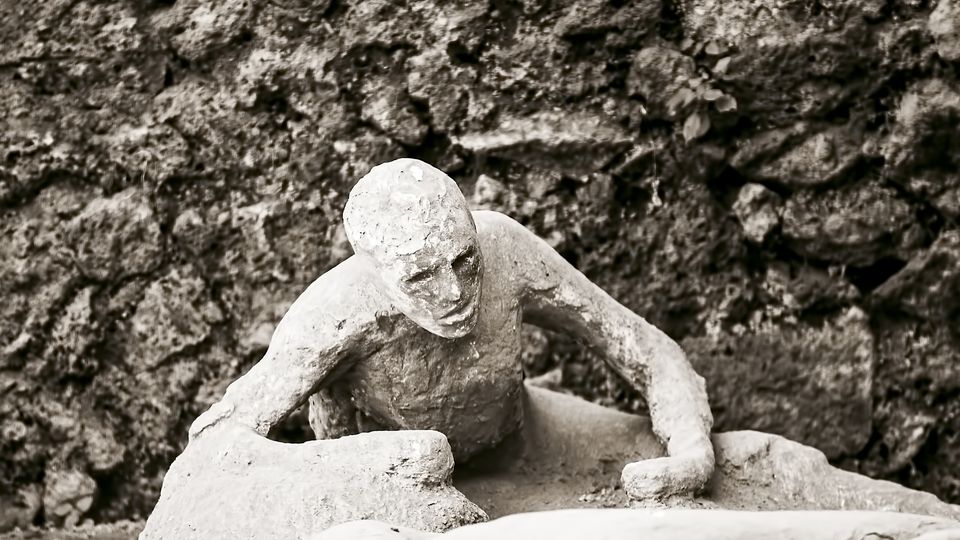
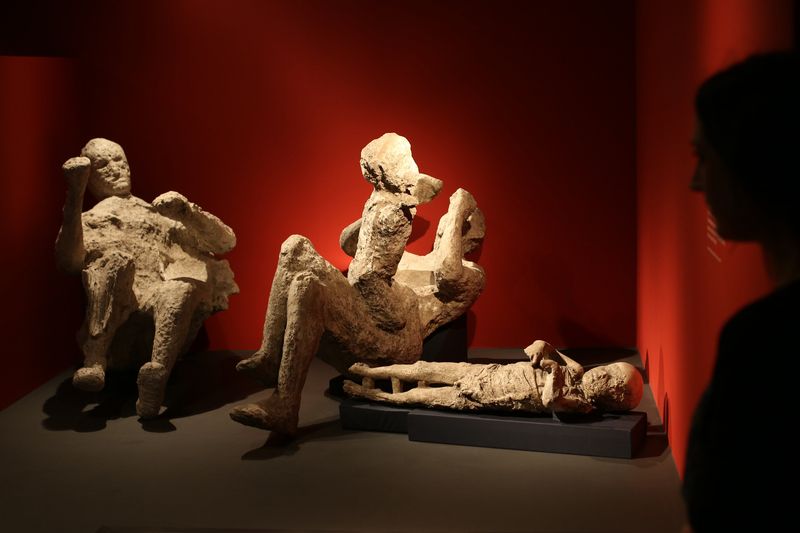
The aftermath of the eruption left many victims in lifelike poses, trapped in their final moments.
The layers of ash and debris that buried them were not just loose material; they compacted like cement, preserving the outlines of their bodies.
This preservation allowed archaeologists to create casts that depicted the victims as they fell, offering a haunting glimpse into their last seconds alive.
For centuries, the casts created from the voids left by decomposed bodies were the primary means of understanding Pompeii’s victims.
However, these casts only provided a limited view of who these individuals were.
Thanks to advancements in CT technology, researchers can now peer inside the plaster casts without damaging them.
This non-invasive method revealed that many casts contained complete skeletons, allowing scientists to conduct forensic analyses that were previously impossible.
The CT scans provided critical information about the victims’ ages, sexes, and even signs of past injuries.
The scans also revealed the true nature of the poses in which the bodies were found.
Previously thought to indicate a slow, painful death, these positions are now understood to be the result of “pugilistic attitude,” a physiological response to extreme heat that causes muscles to contract and limbs to curl.
Among the most disturbing findings from recent research is the discovery of a human brain that had been turned to glass.
A young man’s skull, found in the coastal town of Herculaneum, contained a shiny, brittle material that was determined to be vitrified brain tissue.
This phenomenon, caused by a sudden blast of heat exceeding 950°F, illustrates the brutal conditions faced by the victims of Vesuvius.
The rapid cooling of the brain tissue resulted in a glass-like substance, marking a horrifying testament to the eruption’s intensity.
Beyond the immediate horror of their deaths, modern science is uncovering the lives of Pompeii’s residents.
Researchers have successfully extracted DNA from the remains, revealing insights into the victims’ ancestry and health conditions.
For instance, one individual was found to have suffered from Pott’s disease, a form of tuberculosis that affects the spine.
This discovery suggests that health issues may have played a role in their inability to escape the disaster.
Additionally, stable isotope analysis of bones has provided a detailed picture of the diet of Pompeii’s inhabitants.
The findings indicate that their meals included a variety of grains, vegetables, and seafood, reflecting a diverse and rich diet.
The presence of certain isotopes also suggests that they had access to luxury goods and imported foods, further illustrating the complexity of life in this bustling Roman city.
The integration of artificial intelligence into archaeological research has revolutionized our understanding of historical events.
By analyzing the CT scans, AI can identify patterns and details that human researchers might overlook.
This technology has not only enhanced our knowledge of Pompeii but has also set a precedent for future archaeological studies.
As scientists continue to analyze the remains of Pompeii’s victims, they are piecing together a more comprehensive narrative of life in the ancient city.
This new approach to archaeology emphasizes the importance of understanding the human stories behind historical events, moving beyond mere statistics to explore the lives of those who lived and died in Pompeii.
The revelations about Pompeii’s victims, facilitated by modern technology and AI, have transformed our understanding of this ancient disaster.
The stories of these individuals—once lost to time—are being uncovered, providing a deeper connection to the past.
As we learn more about their lives, struggles, and the tragic circumstances of their deaths, we gain valuable insights into the resilience of the human spirit in the face of unimaginable adversity.
Pompeii serves as a powerful reminder of the fragility of life and the enduring impact of historical events.
The ongoing research not only honors the memory of those who perished but also enriches our understanding of the complexities of ancient Roman society.
As excavation and analysis continue, we can only anticipate what other shocking truths await discovery beneath the ash and rubble of this once-thriving city.
News

Ella Mai’s Shocking Confession: The Hidden Truth Behind Her Secret Baby and R&B Royalty!
Ella Mai’s Shocking Confession: The Hidden Truth Behind Her Secret Baby and R&B Royalty! Ella Mai, the voice behind the…

Nicole Kidman Breaks Her Silence: The Shocking Truth Behind Her Divorce from Keith Urban!
Nicole Kidman Breaks Her Silence: The Shocking Truth Behind Her Divorce from Keith Urban! After nearly two decades of a…

The Heartbreaking Reality of Tom Selleck: From Fame to Fear of Losing It All!
The Heartbreaking Reality of Tom Selleck: From Fame to Fear of Losing It All! Tom Selleck, the iconic actor known…

King Arthur’s Tomb Found: The Shocking Truth Behind the Legend That Changes Everything!
King Arthur’s Tomb Found: The Shocking Truth Behind the Legend That Changes Everything! The legend of King Arthur has captivated…

Keanu Reeves’ Heartbreaking Farewell: The Real Reason He May Never Return to Action Films!
Keanu Reeves’ Heartbreaking Farewell: The Real Reason He May Never Return to Action Films! Keanu Reeves, the beloved action star…

Jeremy Wade Breaks His Silence: The Shocking Truth Behind the Cancellation of River Monsters!
Jeremy Wade Breaks His Silence: The Shocking Truth Behind the Cancellation of River Monsters! After nearly a decade of captivating…
End of content
No more pages to load






