
Before the Big Bang: The Cosmic Mystery That Defies Time and Space!
What truly came before the Big Bang? This question has perplexed scientists and philosophers alike for centuries.
While traditional teachings suggest that the Big Bang marked the beginning of time and space, recent insights from physicists challenge this notion.
As we delve into the complexities of the universe’s origins, prepare to have your understanding of the cosmos turned upside down.
What if the Big Bang was not the beginning, but rather a pivotal moment in an ongoing cosmic saga?
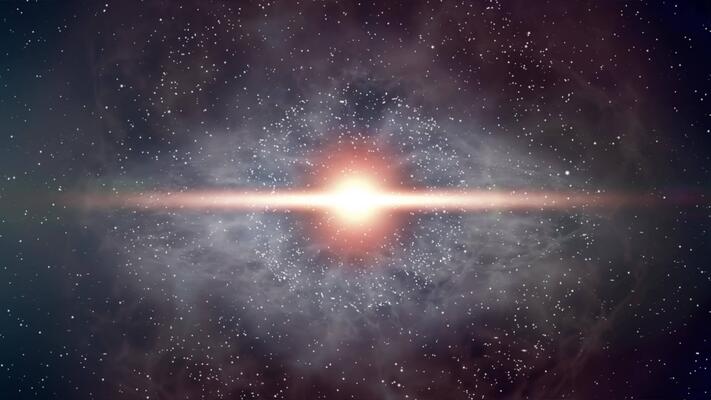
Long before modern science emerged, humanity gazed at the stars, crafting myriad myths and theories about the universe’s beginnings.
From ancient creation stories to the Greek atomists who envisioned an infinite universe, our understanding has evolved dramatically.
In 1687, Isaac Newton’s Principia laid the groundwork for classical physics, introducing the concept of gravity.
However, Newton’s static universe model faced scrutiny when the night sky revealed an unsettling truth: if the universe were truly infinite, we should see stars in every direction, not the vast emptiness we observe.
Fast forward over 200 years, and Albert Einstein’s theory of relativity revolutionized our understanding of gravity and the cosmos.
He proposed that gravity is not merely a force but the curvature of spacetime itself.
This groundbreaking insight paved the way for a deeper exploration of the universe, but it also introduced new questions about its stability.
Einstein’s modifications to his equations led to the introduction of the cosmological constant, a concept he later regretted, yet one that might hold key insights into the universe’s nature.
As astronomers turned their attention to the cosmos, they began to uncover the true nature of nebulae, now recognized as galaxies.
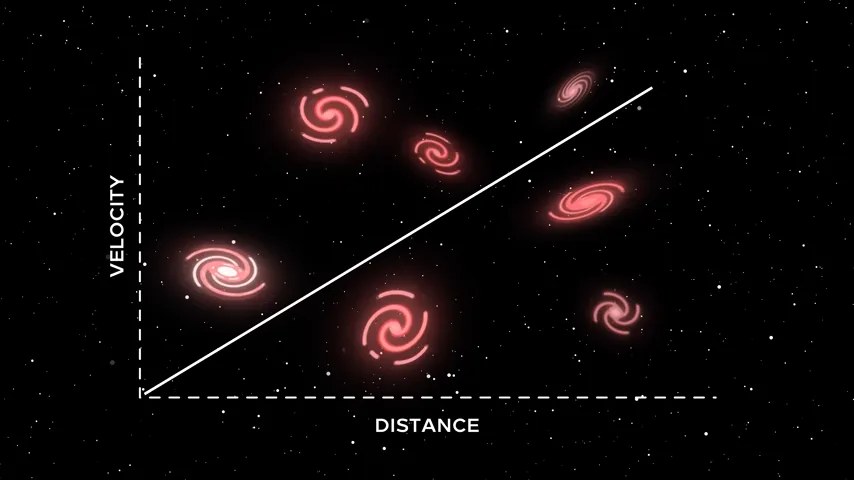
Edwin Hubble’s observations revealed that these galaxies were moving away from us, indicating that the universe was expanding.
This discovery shattered the static universe model, leading to the formulation of the Big Bang theory, which posited that the universe began from an extremely dense and hot state.
However, the Big Bang theory faced challenges, particularly regarding the age of the universe.
Early calculations suggested an age of only 1.
8 billion years, contradicting geological evidence of a much older Earth.
This discrepancy led to further investigations into the universe’s origins, with physicists like Georges Lemaître proposing the idea of a “primeval atom” from which the universe expanded.
As scientists explored the implications of the Big Bang, they predicted the existence of the cosmic microwave background radiation (CMB), a remnant of the early universe.
This radiation, a faint glow permeating the cosmos, was eventually detected by Arno Penzias and Robert Wilson in the 1960s, providing crucial evidence for the Big Bang theory.
The CMB’s uniformity across the sky suggested a hot, dense early universe, but it also raised new questions about the universe’s structure and expansion.
Three major problems emerged from the CMB observations: the horizon problem, the flatness problem, and the monopole problem.
The horizon problem questioned how regions of the universe, now vastly separated, could share the same temperature.
The flatness problem dealt with the universe’s curvature, while the monopole problem highlighted the absence of predicted magnetic monopoles in the universe.
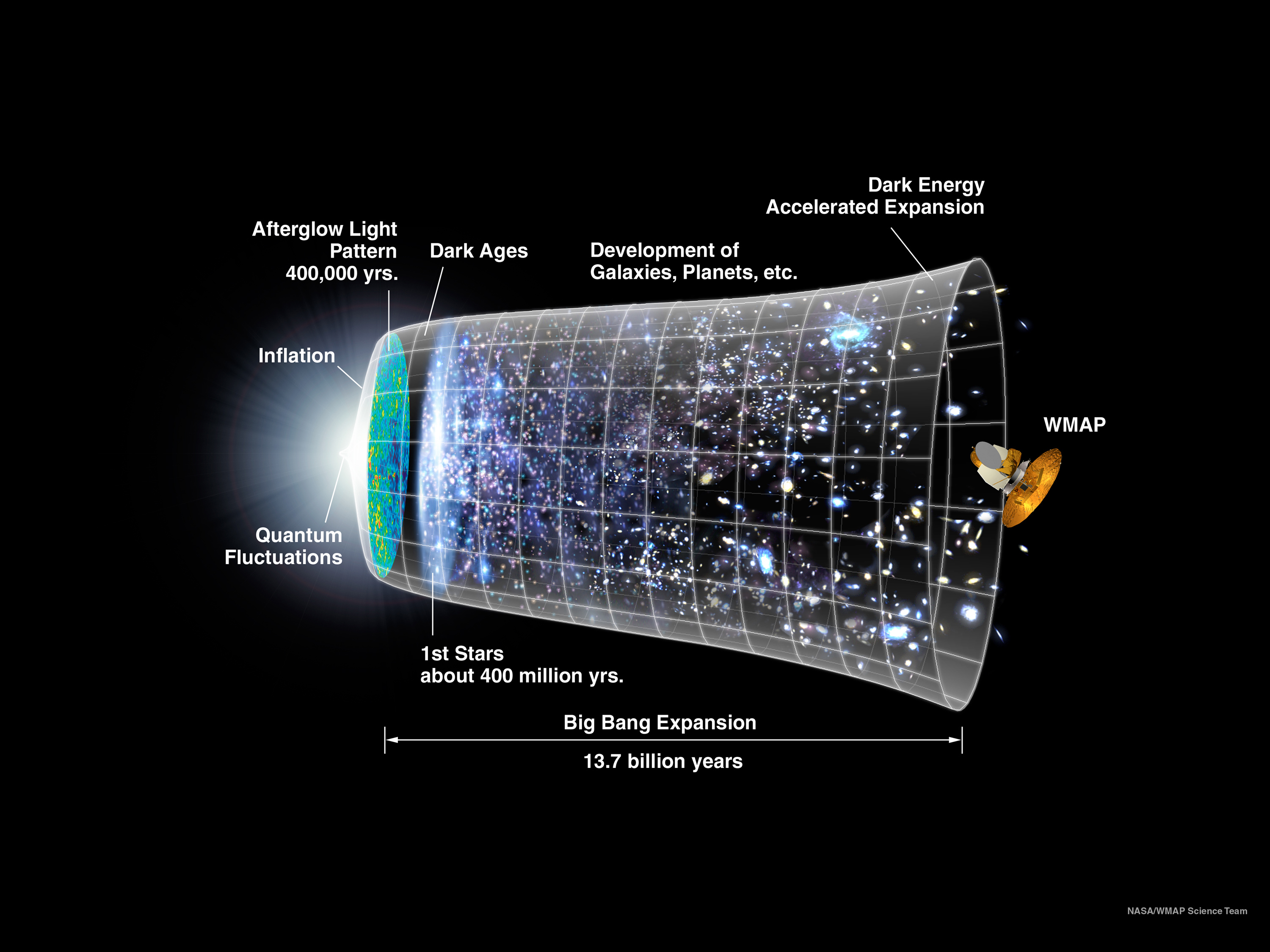
To address these challenges, physicist Alan Guth proposed the inflationary model, suggesting that the universe underwent a rapid expansion in its earliest moments.
This inflationary phase would explain the uniformity of the CMB and the flatness of the universe, solving the pressing problems that had arisen from the Big Bang theory.
According to Guth, the universe began as a minuscule patch of space filled with a quantum field that caused a rapid expansion, leading to the formation of matter and light as we know it.
This model not only addressed the issues posed by the CMB but also introduced the concept of a multiverse, where our universe is just one of many that may have emerged from this inflationary process.
This radical idea challenges traditional notions of a singular beginning and opens up new avenues for understanding the cosmos.
Despite the advances made through the inflationary model, questions remain.
Critics argue that inflation is too flexible and lacks testable predictions.
The relationship between general relativity and quantum mechanics continues to be a significant point of contention, leaving many aspects of the universe’s origins shrouded in mystery.
Furthermore, the idea that something can come from nothing is a profound philosophical and scientific challenge.
While modern physics suggests that the universe did not originate from a singularity, it raises deeper questions about the nature of existence itself.
What came before the Big Bang? Did time even exist in a meaningful way before this event?
The pursuit of knowledge about the universe’s origins is an ongoing journey filled with complexities and revelations.
While the inflationary model represents the best understanding we have today, the quest for answers continues.
As scientists explore the fabric of spacetime and the fundamental forces that govern our reality, we inch closer to unraveling the mysteries of the cosmos.
In this age of discovery, it’s essential to remain open-minded and curious.
The universe is vast and enigmatic, and our understanding of it is still evolving.
As we continue to investigate the origins of the universe, we may very well find that the questions we ask lead us to even more profound insights about existence itself.
What lies beyond the Big Bang? Perhaps the answer is just as mysterious as the cosmos itself.
News

Ella Mai’s Shocking Confession: The Hidden Truth Behind Her Secret Baby and R&B Royalty!
Ella Mai’s Shocking Confession: The Hidden Truth Behind Her Secret Baby and R&B Royalty! Ella Mai, the voice behind the…

Nicole Kidman Breaks Her Silence: The Shocking Truth Behind Her Divorce from Keith Urban!
Nicole Kidman Breaks Her Silence: The Shocking Truth Behind Her Divorce from Keith Urban! After nearly two decades of a…

The Heartbreaking Reality of Tom Selleck: From Fame to Fear of Losing It All!
The Heartbreaking Reality of Tom Selleck: From Fame to Fear of Losing It All! Tom Selleck, the iconic actor known…

King Arthur’s Tomb Found: The Shocking Truth Behind the Legend That Changes Everything!
King Arthur’s Tomb Found: The Shocking Truth Behind the Legend That Changes Everything! The legend of King Arthur has captivated…

Keanu Reeves’ Heartbreaking Farewell: The Real Reason He May Never Return to Action Films!
Keanu Reeves’ Heartbreaking Farewell: The Real Reason He May Never Return to Action Films! Keanu Reeves, the beloved action star…

Jeremy Wade Breaks His Silence: The Shocking Truth Behind the Cancellation of River Monsters!
Jeremy Wade Breaks His Silence: The Shocking Truth Behind the Cancellation of River Monsters! After nearly a decade of captivating…
End of content
No more pages to load






