
The house was asleep when Edward Kingsley returned. His driver’s headlights cut across the long, wet driveway, catching the white columns of the mansion that looked more like a monument than a home. It was nearly midnight. The only light left burning came from the second floor — the nursery.
He loosened his tie as he climbed the stairs, irritation rising with every step. Lucas, his four-year-old son, should have been asleep hours ago. Routine was the foundation of the Kingsley household — meals timed, lights out sharp, affection scheduled and brief.
But when he opened the nursery door, the scene waiting for him shattered the quiet perfection he demanded.
Maria, the young maid, lay asleep on the carpet beside Lucas’s small bed. She had no pillow, only a thin blanket wrapped around her shoulders. Lucas’s small hand rested on her arm, his breathing deep and even. The boy’s stuffed bear was tucked between them.
For a long moment, Edward simply stared. Then his composure broke into anger.
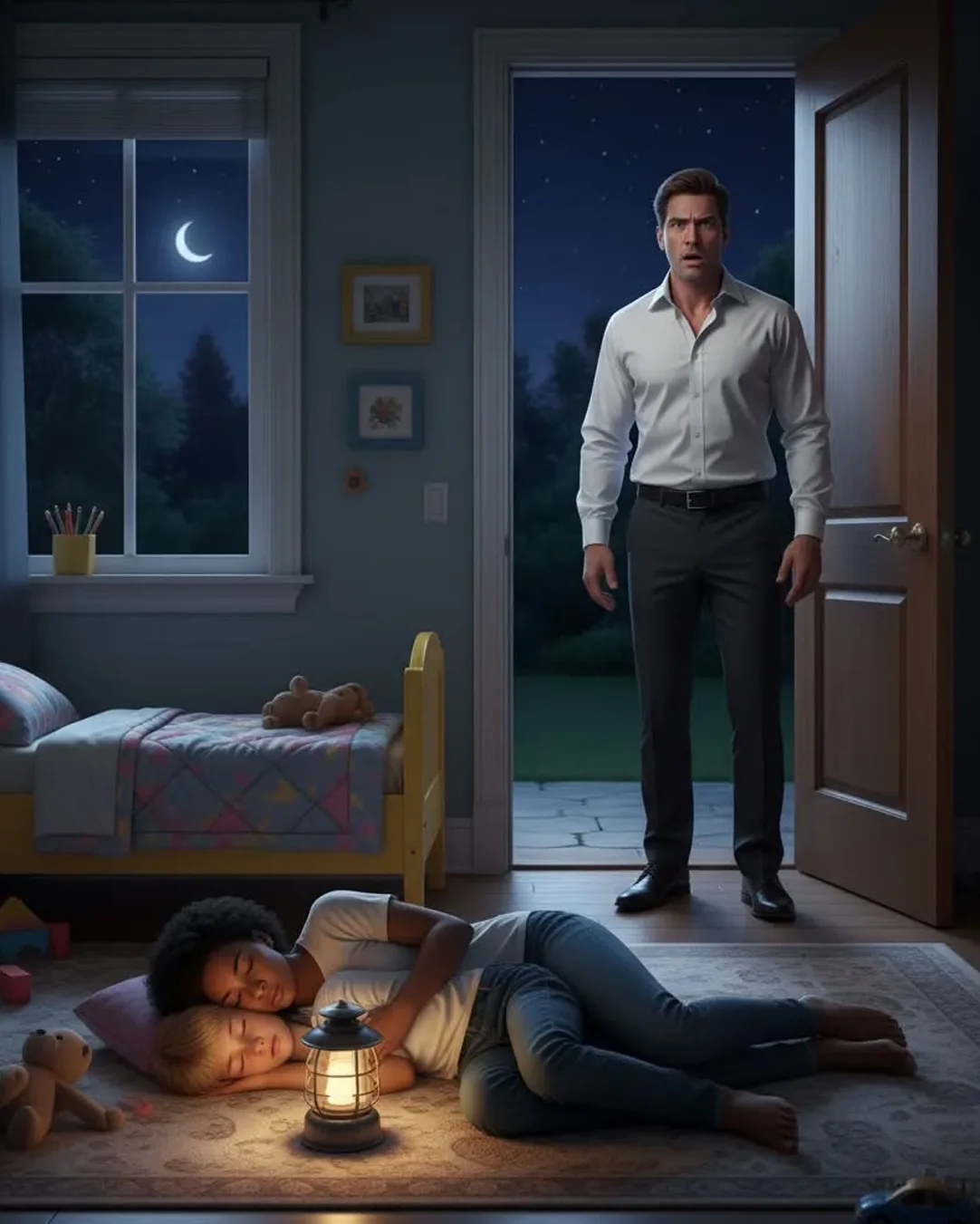
“Maria!” His voice cracked like a whip through the dim room. She jolted upright, eyes wide, the reflex of someone used to fear. Lucas stirred, whimpered, and began to cry.
“What are you doing sleeping here?” Edward snapped. “On the floor? With my son?”
Maria scrambled to her feet, stumbling over words. “I’m sorry, sir. He had a nightmare. He—he was shaking so badly, I didn’t want to leave him alone. I must’ve—”
“Enough,” Edward cut her off. “You’re paid to clean, not to cross boundaries.”
Lucas’s sobs grew louder. Edward turned toward him, gathering him in his arms, but the boy buried his face against his shoulder and whispered between hiccups, “Don’t be mad at Maria, Daddy. She makes the monsters go away.”
Something in Edward’s chest twisted, sharp and unfamiliar. For a heartbeat, he saw his son not as a reflection of legacy — but as a frightened child. Still, pride won. He muttered a curt goodnight and left the room.
But even as he walked down the corridor, guilt began its slow crawl under his ribs.
Sleep never came. Edward sat in his study, staring at the photo of his late wife. Elena’s smile — captured forever behind glass — glowed faintly in the lamplight. She’d been gone for two years now, taken too soon by an illness money couldn’t fix.
He remembered the day of her funeral: Lucas, barely two, clutching the edge of his suit jacket, confused by the black clothes and the absence of his mother’s laugh. Edward had promised himself he would be both parents — strong, steady, invincible. But work had devoured that promise piece by piece.
He built an empire instead of a home. Meetings replaced bedtime stories. Love was outsourced — to nannies, to schedules, to silence.
Maria had entered this world by accident — a temporary hire to help manage the house after a string of dismissals. She was quiet, careful, too humble for the marble grandeur around her. Edward had barely noticed her beyond her work. Until tonight.
Her face, pale with exhaustion, haunted him. Not because she had disobeyed — but because, in that small act of kindness, she had revealed what his wealth had erased: warmth.
At sunrise, Edward found her in the kitchen. The morning light fell softly across her face as she folded napkins with trembling hands.
“I’ll leave today, sir,” she said without looking up. Her voice was steady, but her eyes were red. “I never meant to disrespect your rules.”
Edward hesitated. The word good sat ready on his tongue — the familiar impulse to dismiss, replace, move on. But something stopped him. Lucas’s words from the night before echoed in his mind. She makes the monsters go away.
Finally, he said, “No. You’ll stay. At least until I decide what’s next.”
The days that followed were quiet. Yet Edward began to notice small things — laughter echoing from the nursery, soft songs hummed over the clatter of breakfast dishes, the faint scent of lavender that followed Maria wherever she went. Lucas ate more, smiled more, slept through the night.
One evening, Edward returned home early. From the hallway, he heard Maria reading Goodnight Moon in a calm, lilting voice. Lucas’s giggles interrupted her every few seconds.
Edward stood outside the door, listening. Something swelled inside him — shame, yes, but also longing. He hadn’t realized how long it had been since his house had sounded like a home.
Later that night, he approached her. “Maria,” he said, his voice softer than he intended, “I owe you an apology. I shouldn’t have yelled.”
She looked startled, then smiled faintly. “You were just protecting your son, sir. I understand.”
“No,” he said quietly, shaking his head. “You were.”
Time blurred after that. Winter gave way to spring, and with it came small, unspoken changes. Edward started joining Lucas for breakfast. He left the office earlier. The three of them began spending evenings together — Lucas building towers from wooden blocks, Maria laughing when they toppled, Edward learning to laugh too.
The mansion softened. What had once been a mausoleum of achievement now carried life again.
One Saturday morning, Lucas ran into Edward’s office holding a crayon drawing. “Look, Daddy! It’s us!”
Three stick figures stood under a sun — a tall one in a suit, a smaller one with curly hair, and a woman in a dress. All three held hands. Beneath them, Lucas had written: My Family.
Edward couldn’t speak for a long time.
That evening, he found Maria sitting on the porch, sipping tea, watching the horizon fade into gold. “You’ve done more for my son than I have in years,” he admitted. “You reminded me he doesn’t need a perfect father — just one who’s here.”
Maria looked up at him, eyes kind but firm. “You’re doing that now. That’s what he’ll remember.”
Months later, she told him she’d been accepted to nursing school. Edward offered to cover her tuition; she refused gently, insisting she’d saved enough.
On her last morning, Lucas wrapped his arms around her neck, refusing to let go. “Will you come back?” he whispered.
Maria smiled, pressing her forehead against his. “Always, in your heart.”
Edward watched from the doorway as she drove down the long, tree-lined road, the car shrinking into the horizon. He felt something ache — not just loss, but gratitude. She had walked into his house as an employee and left as the person who taught him how to love his own son.
That night, Edward tucked Lucas into bed. The boy yawned sleepily, clutching his bear. “Daddy,” he mumbled, “are you happy now?”
Edward brushed the hair from his forehead and smiled, a quiet smile that reached his eyes. “I think I finally am.”
He sat there for a while after Lucas fell asleep, watching the steady rhythm of his breathing, the peaceful rise and fall that no longer needed Maria’s lullabies to begin.
In the stillness, Edward thought of Elena — her laugh, her warmth — and understood, perhaps for the first time, what she had always tried to teach him: that love is not grand gestures or perfection, but presence.
The mansion outside was silent, the kind of silence that once felt empty. But tonight, it felt whole.
The light in the nursery glowed softly against the dark, and in that small room — once a symbol of loss — a father finally found his way home.
News

A Mafia Boss Threatened Dean Martin on Stage—Dean’s Reaction Was Pure Genius
A Mafia Boss Threatened Dean Martin on Stage—Dean’s Reaction Was Pure Genius Prologue: A Gun in the Spotlight Dean…

The Billionaire Had No Idea His Fiancée Was Poisoning His Son—Until the Maid Exposed Everything
The Billionaire Had No Idea His Fiancée Was Poisoning His Son—Until the Maid Exposed Everything Prologue: A Whisper That…

The Billionaire Catches Maid ‘Stealing’ Food… But When He Sees Who It’s For, He Breaks Down in Tears
The Billionaire Catches Maid ‘Stealing’ Food… But When He Sees Who It’s For, He Breaks Down in Tears Prologue:…

The Billionaire’s Fiancée Sets a Trap for the Maid — Until His Silent Daughter Exposed the Truth
The Billionaire’s Fiancée Sets a Trap for the Maid—Until His Silent Daughter Exposed the Truth Prologue: The Whisper That…

The Billionaire Went Undercover as a Gardener — Until the Maid Saved His Children from His Fiancée
Richard Whitmore’s hands trembled on the garden shears as he watched through the kitchen window. His new wife, Vanessa, stood…

Three Flight Attendants Vanished From a Vegas Hotel in 1996 — 28 Years Later a Hidden Wall Is Opened
.Every hotel, every casino, every neon-lit alley has a story, most of them ending in forgetfulness or denial. But some…
End of content
No more pages to load






