
The card lay on the marble like a dare—matte black, weighty as a secret. Ethan Royce watched his reflection ripple across it in the lobby’s glass and steel, a man more rumor than person, a billionaire whose calendar had been colonized by other people’s appetites. “Spend what you wish,” he said, placing three identical cards into three very different hands. Vanessa’s diamonded fingers curled like talons around hers. Chloe’s elegant nails tapped hers as if testing crystal. Maria’s—work-rough, clean—hesitated, then folded the card away as if it were a receipt she was safeguarding for someone else. The city outside hummed with Friday, taxis stitching yellow seams through dusk. Ethan smiled the way tired men smile when they’ve already decided not to be surprised. “Meet me here Sunday night,” he said, and dismissed them with a nod that felt too much like a verdict.
He’d met them in concentric circles of visibility. Vanessa first: a model who moved through restaurants as if spotlights trailed her, laughter pitched to carry to the right tables. She’d made a game of being seen with Ethan without ever quite seeing him. Chloe next: a curator of evenings and rooms, an event planner whose talent was arranging other people’s lives into photographs. Beauty, she said, was an asset class; her confidence wore silk and compound interest. And then Maria: the ghost of the house, arriving before dawn, leaving after dark, polite to the point of invisibility. Three years of steady presence—fresh lilies before breakfast meetings, sweaters returned to drawers folded in perfect thirds, a quiet “good night, sir” at the base of the stairs as he climbed back into emptiness. If the tabloids wrote him as a cipher—handsome, sharp—his loneliness was a private tense. He had grown allergic to the choreography of courtship, to the way affection bent toward zeros.
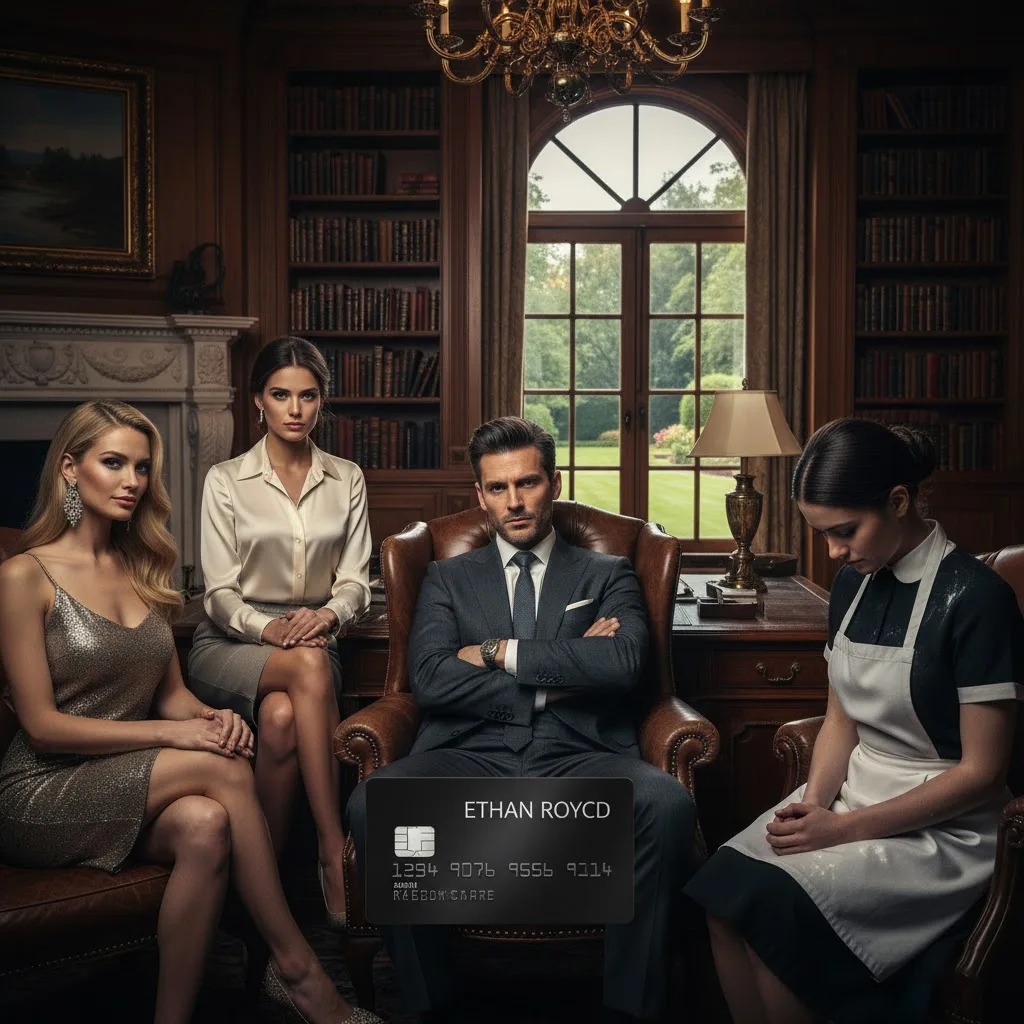
Saturday unspooled on his screens. Vanessa’s posts bloomed like tropical flowers: a watch in a velvet coffin of a box, a shopping bag procession so long it needed a caption with a wink—“A woman should know her worth.” Ethan chuckled into a glass of still water, not unkindly; it was an old joke in a new suit. Chloe sent a selfie in front of a Rothko, an orchid of a smile, then a photo of a pale abstraction with a red slash—“Investing in beauty,” she wrote. Impressive, maybe, and entirely legible: taste as thesis. Maria’s silence arrived like weather. No texts. No calls. No charges, according to the fraud alerts he’d muted. By evening, he found himself listening for a footstep that was not coming, irritated at his own restlessness. “Maybe she’s afraid to use it,” he told David. “Or maybe she sold it.” The possibility pricked him in a place pride couldn’t reach.
Sunday gathered them back under glass chandeliers, the city now a reflection on the lobby’s polished floor. Vanessa glowed with victory, setting the diamond watch on his desk with ceremony. “You’ll love it,” she purred, as if offering him a mirror he might finally admire. Chloe set down a folio of receipts—galleries, a sculpture, a rug with a provenance as long as a family tree. “Beauty and brains,” she said, soft and certain, already curating how he would remember this moment. Maria came last, hair pulled back, good blouse pressed to a shine, eyes cast down in a way that was humility and not shame. She handed him a plain envelope, edges softened by her grip. “I… I hope you’re not angry,” she said, and it was not performance but the voice of a person accustomed to bracing.
Inside: hospital receipts. Itemized, stamped, paid. Ethan’s mouth went dry. “Maria?” he said, slow and careful, as if the wrong tone might bruise her. “What is this?”
“For Mrs. Robinson,” she said, looking not at him but somewhere just left of his shoulder. “The gardener. Her son needed heart surgery.” She swallowed. “She couldn’t afford it.”
“You… gave away my money?” Vanessa’s horror was almost pure.
Maria flushed, then lifted her chin. “She brings me soup when I skip lunch,” she said, a sentence that contained both the world and its answer. “I used the card. I can work more hours to repay—”
“You didn’t buy anything for yourself?” Ethan asked.
“I have what I need,” she said simply.
The room reorganized around that line. The other women’s purchases turned into a kind of static, expensive but faint, while Maria’s silence formed a shape you could live inside. That night, he saw the hospital lit in blue like a ship at harbor and found Mrs. Robinson holding a small hand that wasn’t letting go. “An angel paid,” the nurse said, and he did not correct her. He stood at the window outside recovery and felt something shift—not conversion, not epiphany, just the soft click of a lock he’d forgotten he’d set from the inside.
On Monday, Vanessa arrived in a dress that fit like an argument. “So,” she said brightly, “who passed?” Chloe hovered with the poise of a final bid. Ethan looked toward the kitchen where a light burned late most nights for reasons he’d never bothered to ask. “You both showed me what money can buy,” he said gently. “Maria showed me why it matters.” Vanessa laughed in the key of insult. “She’s your maid,” she said, as if that answered anything. “No,” Ethan said, and the word landed. “She’s the only one who treated what I gave as more than a trophy.”
They left spinning their own narratives: wasted time, an odd man, a test no one had asked to take. The house settled into its usual hush. In the kitchen, Maria wiped the counter with small, precise circles, the way she always had, as if care were a discipline. “Come sit,” Ethan said. She froze—she had never been invited to sit at his table—and then obeyed with the awkwardness of crossing a boundary you didn’t draw. “I was testing people’s hearts,” he said, and the admission embarrassed him. “You reminded me money isn’t a language, it’s a tool. You spoke it fluently.”
“I just did what anyone would do,” she said.
“No,” he answered, smiling without triumph, “you did what only someone with a beautiful soul would do.”
He promoted her first—house manager, though the title felt too small for the steadiness she brought into rooms. She protested until he used the same line she had given him: you have what you need? Then let me give you what you deserve. He covered every remaining medical bill without turning it into a photo opportunity, and when he visited the garden that spring, Mrs. Robinson pressed his hand with a pressure that said more than thanks. The boy came by on wobbly legs, a postcard of recovery. Life continued to insist on itself in small ways—coffee left warming on the stove when he forgot, the pantry labeled in a hand that looked like patience.
Months later, he handed Maria a velvet box at the edge of the garden where rosemary lifted its clean breath. She opened it and found a bracelet—simple silver, the curve of it catching morning. On the inside, small letters: The richest hearts give most freely. Tears startled her. “I can’t accept this,” she said, shaking her head as if to refuse would keep the world understandable. “You can,” he said softly. “You already gave me something I didn’t know I’d lost.”
The gossip pages began to write him as an absence. No parties, fewer panels, a face in fewer rooms. He learned his own house again—morning light in the east windows, the way floorboards voice their age at dusk. They walked sometimes after dinner, a billionaire and his house manager in the quiet democracy of a neighborhood where sprinklers ticked and dogs insisted on greetings. When he finally asked her to marry him, it was not spectacle. It was a kitchen evening, the radio low, onion and thyme in the air, his voice steady. She touched the counter with her fingertips as if to be sure it was all still there. They kept the bracelet. They kept the job titles as jokes. They kept, most of all, the habit of choosing usefulness over display.
Years later, a reporter asked how he fell in love with a woman no one had heard of. He said, “She loved the part of me money couldn’t fix.” It sounded more polished than the truth, which was simpler: she had taken a card and turned it into a life. On Sundays they sometimes drove past the hospital. Maria would look out the window and exhale something that wasn’t quite a prayer and wasn’t quite a memory. Hope, like wealth, is only real in circulation.
He had thought he was running an experiment on three women; he had been measuring his own poverty. Vanessa bought time in a world that eats it. Chloe bought beauty that appreciated like stock. Maria bought a heartbeat. In a city calibrated to acquire, she spent to restore. Love, it turned out, was not abstaining from the card or returning it untouched; it was using it as if other people’s pain were an emergency and not a headline. The test didn’t expose greed so much as it revealed allegiance. Two women purchased mirrors. One bought a door and held it open.
There is a way of living that confuses value with price and mistakes possession for proof. The correction is not asceticism; it is attention. Wealth is not the number of things you can collect, but the number of burdens you can lift without keeping a ledger. Ethan learned to recognize the sound of a generous act—the quiet thud of an envelope that changes a family’s future, the soft click of a bracelet that remembers a moment without trying to own it. If money is a language, love is the grammar that keeps it honest. In the end, the only fortune that mattered was the one he could not deposit: a house where kindness was policy, a marriage built not on the spectacle of plenty but on the daily practice of “enough” shared widely.
News
A Mafia Boss Threatened Dean Martin on Stage—Dean’s Reaction Was Pure Genius
A Mafia Boss Threatened Dean Martin on Stage—Dean’s Reaction Was Pure Genius Prologue: A Gun in the Spotlight Dean…
The Billionaire Had No Idea His Fiancée Was Poisoning His Son—Until the Maid Exposed Everything
The Billionaire Had No Idea His Fiancée Was Poisoning His Son—Until the Maid Exposed Everything Prologue: A Whisper That…

The Billionaire Catches Maid ‘Stealing’ Food… But When He Sees Who It’s For, He Breaks Down in Tears
The Billionaire Catches Maid ‘Stealing’ Food… But When He Sees Who It’s For, He Breaks Down in Tears Prologue:…

The Billionaire’s Fiancée Sets a Trap for the Maid — Until His Silent Daughter Exposed the Truth
The Billionaire’s Fiancée Sets a Trap for the Maid—Until His Silent Daughter Exposed the Truth Prologue: The Whisper That…
The Billionaire Went Undercover as a Gardener — Until the Maid Saved His Children from His Fiancée
Richard Whitmore’s hands trembled on the garden shears as he watched through the kitchen window. His new wife, Vanessa, stood…
Three Flight Attendants Vanished From a Vegas Hotel in 1996 — 28 Years Later a Hidden Wall Is Opened
.Every hotel, every casino, every neon-lit alley has a story, most of them ending in forgetfulness or denial. But some…
End of content
No more pages to load






