
Morning spilled across the Grant estate like warm milk, softening the hard edges of imported stone and steel. In the kitchen, Sophie stood under a cone of light, rolling ginger between her palms, steam from a simmering broth fogging the window that looked out over clipped hedges and a sky the color of pearl. In the adjoining room, Liam watched her reflection waver in the glass—calm, patient, impossible. He’d heard her just hours earlier, kneeling beside a maid who had shattered a vase, voice low and sure: “It’s just glass. People matter more than things.” The sentence had nested in him like a bird intent on staying. By dinner he’d inched his chair closer to hers without thinking, surprised to find the air lighter there. “Why are you always so… calm?” he asked, unpracticed in gentleness. “Because anger doesn’t pay bills, Mr. Grant,” she said, smiling, and something inside him clicked loose—the first sound of a locked room opening.
The weeks that followed softened like butter left out on the counter. Sophie cooked when a fever took him down—ginger broth and toast with a scorch mark shaped like a crescent moon. She labeled leftovers with a tidy hand, lined the shelves with jars that turned the pantry into a palette: lentils like polished coins, rice like snow. She spoke to the staff by name. She spoke to Liam as if he were more than a portfolio in a suit. He tried, awkwardly at first, to match her cadence. He ate breakfast at the big table instead of over emails. He learned how to stir risotto without scalding it, how to stand in the blue hour before sunrise and let quiet pour through him like medicine. Cameras were not invited to their evening walks. Neither were phones. For the first time since he could remember, his life did not feel like a carefully managed product.
One afternoon he slipped away to a hospital ward that smelled of lemon disinfectant and the faint, metallic edge of fear. He stood at the end of a bed where Sophie’s brother slept, face waxy with exhaustion, and signed a form that would make the surgery possible. He left before the anesthesiologist arrived. When Sophie found out, she came at him with eyes bright from crying, mouth set like a blade. “Why did you do that?” she demanded in his office, where glass and money had always bent the room to his will. “I didn’t ask for your pity.” “It wasn’t pity,” he said, voice gone soft at the edges. “You’ve done more for me than you know.” It landed between them like a bridge no one had expected to find.
Their orbit shifted after that. He learned her laugh by temperature: cool for a joke, warm for surprise, bright as a match when he burned the garlic and she teased him for days. She taught him the pedestrian holiness of a cheap park bench. He taught her how to make perfect omelets and failed half the time, thrilled anyway. Simple things grew tall: a grocery list on a crumpled receipt, shoes left by the door, rain that made them late for nothing.
The illusion held until an afternoon that smelled like cut grass and trouble. Eric breezed in without knocking, suit loud, grin louder, eyes scanning the room like a thief who couldn’t help himself. He waved a document the way people wave flags when they want to win a war before it starts. “Six months are almost up, Grant,” he sang, the kind of friend who sharpened your worst instincts and called it loyalty. “You’ve proven your point. Time to collect your fifty million.” The sentence cracked the air.
Sophie’s face emptied of color so quickly it looked like a trick. “What is he talking about?” she asked, each word wrapped in the kind of calm that keeps porcelain from shattering. Liam’s mouth opened, then closed. Eric smiled—he’d always liked an audience. “Didn’t he tell you? You were part of a fifty-million-dollar bet.” Silence fell like heavy snow. The room shrank to the sound of the contract rustling and the soft choke of Sophie’s breath.
She turned to Liam then, her eyes searching his face for the person she’d cooked soup for, the man who’d said anger didn’t pay bills and meant it. “Is that true?” she asked, voice barely above a whisper—the voice people use when they understand the truth and beg to be wrong anyway. He couldn’t answer. That, more than the bet itself, delivered the blow.
Something closed inside her, a door on oiled hinges. She moved quickly, the efficiency of someone who had learned not to linger where she wasn’t safe. The suitcase was not dramatic; it was quiet, practiced—people who’ve had to leave in a hurry learn to fold a life without wasting motion. Liam stood useless in the doorframe of his own choices. Eric, suddenly unsure of the joke, faded to the perimeter like smoke losing heat.
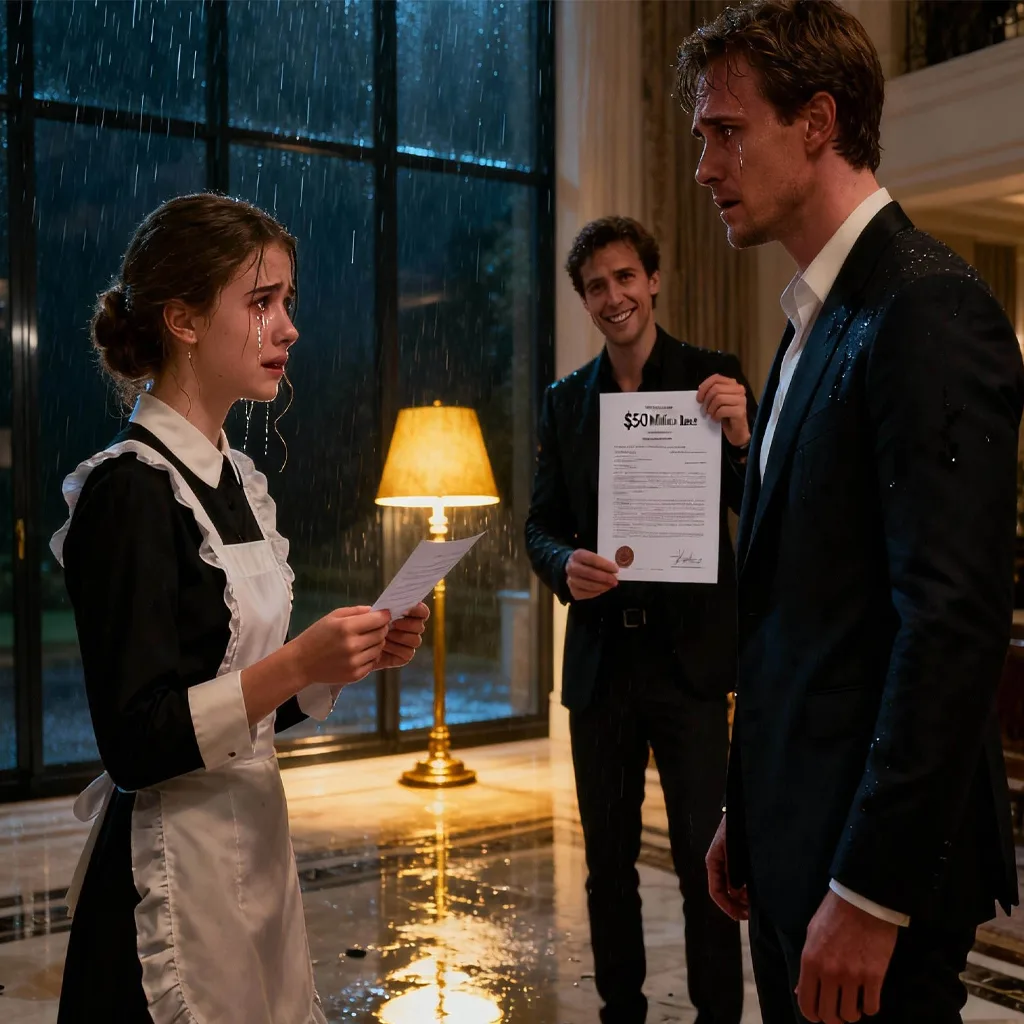
She left before the rain came, a small figure on the gravel, spine straight, hair lifted by a wind that had turned. He followed to the edge of the steps because his legs remembered how to move even when the rest of him didn’t. “Sophie,” he tried, the name in his mouth like a coin he’d finally realized had value. She didn’t look back. The gate opened on its rails with a clean mechanical sigh. Then she was gone, and the estate swallowed the sound of her footsteps as if it had never learned to echo anything but wealth.
He went back inside, where the house had already begun to rearrange itself into absence. The kitchen clock ticked like an accusation. The ginger on the counter looked like a word he couldn’t pronounce. In the pantry, labels in her tidy script faced forward with a loyal neatness that felt like cruelty. He stood there, palms on the cool marble, and thought about the day he’d signed a contract with a man who never lifted his eyes from the prize. He thought about the first time she’d set a bowl in front of him and told him to eat, the way care can be an order that saves your life. He sat at the table they had learned to share and tried to speak out loud the one sentence he’d never had to say: I was wrong.
Calls went unanswered. Messages came back unread. He sent flowers and then stopped because flowers are a theater of apology when the apology required is structural. Days folded. The staff spoke in the low register people use when a home is in mourning. Anger came—at Eric, at himself, at the dumb, rich boy he had been—and then left, because anger didn’t pay anything. Not this bill. He slept badly. He ate worse. He walked through rooms that had looked like success and now looked like an expensive kind of loneliness.
A week later, he took the contract to the fire pit and fed it page by page to the flames. It burned bright and fast, the way bad ideas do when you finally let them go. The heat climbed his forearms; ash rose like ruined snow. He watched until every clause had surrendered, until the last black curl of stipulation gave up its stubborn shape. The word “collect” dissolved into nothing. The word “win” did too.
He understood, finally, what he had lost. Not a woman who cooked soup. Not the ethics he’d rented for a season. He had lost the one currency no ledger could hold: trust. It does not splinter like glass; it thins like light, then vanishes, and when it goes, rooms change temperature. He could see, with the painful clarity regret brings, the way wealth had trained him to believe every door turned on a hinge he could buy. Sophie had been the first to hand him a door that opened only for honesty.
He wrote letters he didn’t send. He visited the hospital quietly and left receipts only the billing department would notice. He canceled dinners where men toasted wins that tasted like ash. He let silence teach him where words had once done all the work. In the evenings he walked to the park alone, sat on the bench where they had once let the world pass without asking it for anything, and learned to be ordinary without her there to translate. A sparrow hop-skipped across his shoe and tilted its head at him as if to say: be smaller. He tried.
If there was a future here, it would not be a grand gesture standing on a lawn under lights. It would be a man willing to return to the beginning and stay there, proving with quiet repetition what his mouth had broken in a single omission. Trust is not an IOU; it is a garden—the kind that dies the season you neglect it and returns only if you lay down your pride and start again with soil and patience.
He didn’t know if Sophie would ever come back, and for once, he didn’t make a plan to force the world to deliver what he wanted. He made dinner. He washed the pot. He apologized to the maid who overfilled the vase with peonies because the water ring would stain the table Sophie had scrubbed with lemon oil. He sat under a cone of light and ate slowly, tasting each bite like a person who hopes to deserve a second chance someday.
Some truths arrive like fire. Some arrive like a soft sentence spoken to a frightened girl in a kitchen: it’s just glass; people matter more than things. In the end, Liam understood the only arithmetic worth learning. Money multiplies what you are. If what you are is careless, it buys you better alibis. If what you are is finally, painstakingly true, it buys you time to practice being worthy of the trust you once treated like a wager. The rest of the story would wait. He would, too—emptied of certainty, full of the difficult, steady work of becoming the kind of man whose apology didn’t need flowers to make it bloom.
News
A Mafia Boss Threatened Dean Martin on Stage—Dean’s Reaction Was Pure Genius
A Mafia Boss Threatened Dean Martin on Stage—Dean’s Reaction Was Pure Genius Prologue: A Gun in the Spotlight Dean…

The Billionaire Had No Idea His Fiancée Was Poisoning His Son—Until the Maid Exposed Everything
The Billionaire Had No Idea His Fiancée Was Poisoning His Son—Until the Maid Exposed Everything Prologue: A Whisper That…

The Billionaire Catches Maid ‘Stealing’ Food… But When He Sees Who It’s For, He Breaks Down in Tears
The Billionaire Catches Maid ‘Stealing’ Food… But When He Sees Who It’s For, He Breaks Down in Tears Prologue:…

The Billionaire’s Fiancée Sets a Trap for the Maid — Until His Silent Daughter Exposed the Truth
The Billionaire’s Fiancée Sets a Trap for the Maid—Until His Silent Daughter Exposed the Truth Prologue: The Whisper That…
The Billionaire Went Undercover as a Gardener — Until the Maid Saved His Children from His Fiancée
Richard Whitmore’s hands trembled on the garden shears as he watched through the kitchen window. His new wife, Vanessa, stood…
Three Flight Attendants Vanished From a Vegas Hotel in 1996 — 28 Years Later a Hidden Wall Is Opened
.Every hotel, every casino, every neon-lit alley has a story, most of them ending in forgetfulness or denial. But some…
End of content
No more pages to load






