
The corridor of the Morera mansion was a cathedral of silence — polished marble floors reflecting chandeliers that glittered like frozen stars. Ethan Morera stood before the fireplace, a glass of untouched wine trembling in his hand. The portrait above the mantel — a young boy, no more than six, painted in soft, amber tones — stared back at him with eyes too familiar to be coincidence.
Behind him, the sound of hesitant footsteps broke the stillness. It was Amara, the new maid, her uniform neatly pressed though her hands betrayed a tremor. She had paused in the doorway, her gaze locked on the portrait. When she finally spoke, her voice barely rose above a whisper.
“Sir,” she said, breath catching in her throat, “that boy… he lived with me in the orphanage.”
The words seemed to splinter the air. Ethan turned sharply, his composure fracturing for the first time in years. “What did you just say?”
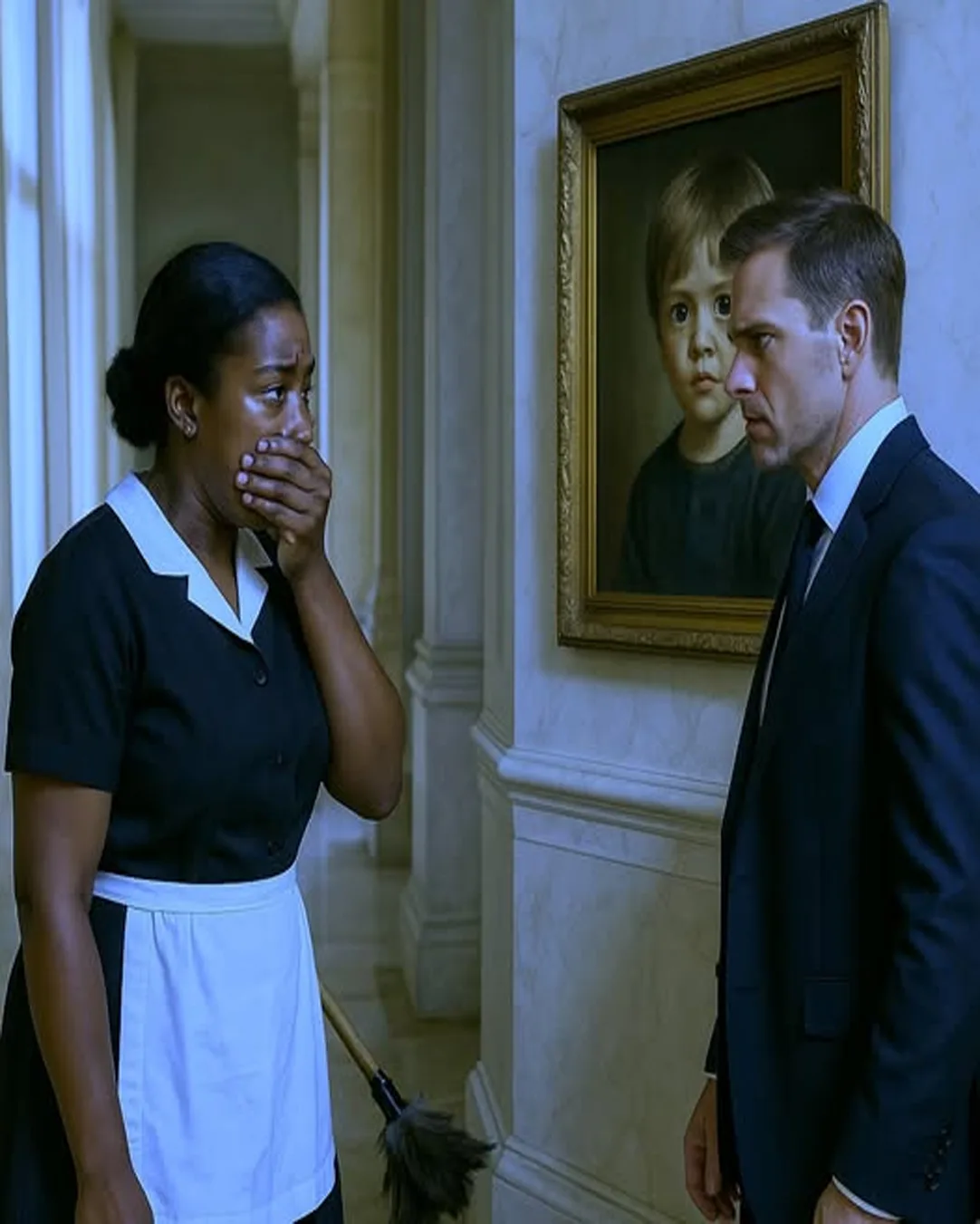
Amara’s eyes glistened with something beyond fear — recognition. “We called him Daniel,” she said. “He never spoke much. But he used to say he had a brother — one who called him My Little Champion.”
Ethan’s hand tightened around the wine glass until it cracked. That name — those three words — cut through decades like a key turning in a long-locked door.
The portrait’s painted eyes seemed to follow him, pleading and alive. For thirty years, Ethan had looked at that same expression in his own reflection — haunted by a promise he had failed to keep.
When Ethan Morera was eight, the world ended on a Sunday morning. He could still hear the wind that day, carrying the laughter of his little brother Leo across the park. He could still see the red balloon tied around Leo’s wrist, floating above his head like a tiny sun. And then — in a blink — both were gone.
His mother’s scream had torn through the air like glass. His father’s voice, sharp with commands and desperation, drowned in the sound of sirens. Reporters came, searchlights swept the park, neighbors whispered theories. Days turned to weeks. Weeks to months.
Then silence.
Leo had vanished without a trace.
Their family fractured under the weight of it. His mother stopped playing piano. His father, once a man of law and principle, turned hollow, drinking his grief in the study until dawn. Ethan, left to grow up in a house where every sound felt like a reminder, learned the only way to survive was to bury the past under achievement.
By forty, he had built an empire. The Morera name was known from Wall Street to Geneva — a symbol of wealth, efficiency, and precision. But inside, he carried a void shaped like a boy’s laughter.
He’d tried to convince himself that success was its own absolution. Yet even amid the perfection of his mansion, there were nights when the echoes returned — a small voice calling from the park, a whisper he couldn’t unhear: “Big brother, wait for me.”
Now, standing beside the trembling maid, Ethan felt that voice again — closer than ever.
“Tell me everything you remember,” he said, the words clipped but desperate.
Amara hesitated. “He arrived at the Sao Vicente orphanage when he was six,” she began softly. “They said his parents had died in an accident. But he told me otherwise. Said his family was rich. Said he had a brother who promised to find him.”
Her eyes darted back to the portrait. “He used to draw this house — over and over. The white columns. The piano by the window. Nobody believed him. They said it was a dream to make the loneliness hurt less.”
Ethan’s voice dropped to a whisper. “But you did.”
Amara nodded, tears spilling now. “He called me his sister. I believed him because he never lied, not about anything. But one day, he got into a fight with another boy. Then he was gone. Ran away in the night. We never saw him again.”
Ethan gripped the edge of the fireplace to steady himself. His pulse roared in his ears. All those years searching the wrong places, chasing false leads, while his brother had been there — living, waiting, forgotten by everyone but a maid who had nothing to gain from remembering.
“Why didn’t anyone find him?” Ethan whispered.
Amara’s answer came softly. “Because nobody was looking anymore.”
The sentence landed like a confession, and Ethan felt something in his chest fracture beyond repair.
He turned to the portrait again, tracing the painted curve of a smile he once knew. Leo. Daniel. The names fused in his mind until they were one.
That night, Ethan didn’t sleep. The mansion felt alive — not with comfort, but with ghosts. He wandered from room to room, his reflection trailing through the glass like an accusation. Every sound — the faint ticking of the grandfather clock, the sigh of wind through the curtains — felt like Leo calling from the other side of time.
When dawn finally broke, Ethan was already dressed, his coat buttoned, his eyes raw from sleeplessness.
Amara entered the foyer to find him waiting by the grand staircase. “Sir?” she asked, startled.
He met her gaze with a quiet resolve. “We’re going to Sao Vicente,” he said.
The drive south cut through fields of frost and fog, silence filling the car between them. Amara clutched a worn cross around her neck; Ethan clutched an old photograph, creased from being carried too long.
Hours later, the orphanage came into view — a crumbling building with fading paint and barred windows. Children played in the courtyard, their laughter carrying faintly in the cold air.
Inside, the head nun greeted them, her expression wary. “Sao Vicente doesn’t see many visitors,” she said.
Ethan handed her the photograph. “Do you remember this boy?”
The nun adjusted her glasses, her lips parting in recognition. “Daniel,” she murmured. “Yes, I remember him. Quiet child. Always drawing. He left one day — said he had to find his brother.”
Ethan’s breath caught. “Did he ever come back?”
She shook her head. “No. But there was a letter, years later. He sent money to the orphanage every Christmas. Never signed his full name — just ‘D.M.’ We thought it was kindness from a stranger.”
Ethan turned to Amara, his voice trembling. “He was alive. He was trying to give back.”
In that moment, the years collapsed. Leo hadn’t vanished — he had simply found his own way to live, quietly, far from the noise of a world that forgot him.
For the first time since childhood, Ethan felt the weight of his brother’s absence lift just enough for him to breathe again.
When Ethan returned home, the portrait no longer haunted him. He had it restored — not as a monument to grief, but as a remembrance of love that survived even silence.
He established a foundation in his brother’s name — The Little Champion Trust — funding orphanages across the country. Sao Vicente was the first.
Sometimes, late at night, he would sit in the piano room — his mother’s old piano — and let his hands rest on the keys. He didn’t play. He just listened, eyes closed, to the echo of a memory that had finally come home.
Amara still worked in the mansion, though her role had changed. Ethan insisted she oversee the foundation, saying she understood what others had forgotten: that compassion, not money, builds the truest legacy.
Once, she asked him quietly, “Do you think he forgave you, sir?”
Ethan looked up at the portrait, at those wide, forgiving eyes, and smiled faintly. “He never needed to,” he said. “He was my little champion. He always forgave first.”
The house fell silent again, but this time, it wasn’t empty. It was full — of memory, of music, of love that had been lost and, somehow, found again.
And in that silence, Ethan finally understood: some promises are not broken by time. They simply wait — patient as the heart that made them — for the moment they can be kept.
News
A Mafia Boss Threatened Dean Martin on Stage—Dean’s Reaction Was Pure Genius
A Mafia Boss Threatened Dean Martin on Stage—Dean’s Reaction Was Pure Genius Prologue: A Gun in the Spotlight Dean…

The Billionaire Had No Idea His Fiancée Was Poisoning His Son—Until the Maid Exposed Everything
The Billionaire Had No Idea His Fiancée Was Poisoning His Son—Until the Maid Exposed Everything Prologue: A Whisper That…

The Billionaire Catches Maid ‘Stealing’ Food… But When He Sees Who It’s For, He Breaks Down in Tears
The Billionaire Catches Maid ‘Stealing’ Food… But When He Sees Who It’s For, He Breaks Down in Tears Prologue:…

The Billionaire’s Fiancée Sets a Trap for the Maid — Until His Silent Daughter Exposed the Truth
The Billionaire’s Fiancée Sets a Trap for the Maid—Until His Silent Daughter Exposed the Truth Prologue: The Whisper That…

The Billionaire Went Undercover as a Gardener — Until the Maid Saved His Children from His Fiancée
Richard Whitmore’s hands trembled on the garden shears as he watched through the kitchen window. His new wife, Vanessa, stood…
Three Flight Attendants Vanished From a Vegas Hotel in 1996 — 28 Years Later a Hidden Wall Is Opened
.Every hotel, every casino, every neon-lit alley has a story, most of them ending in forgetfulness or denial. But some…
End of content
No more pages to load






