
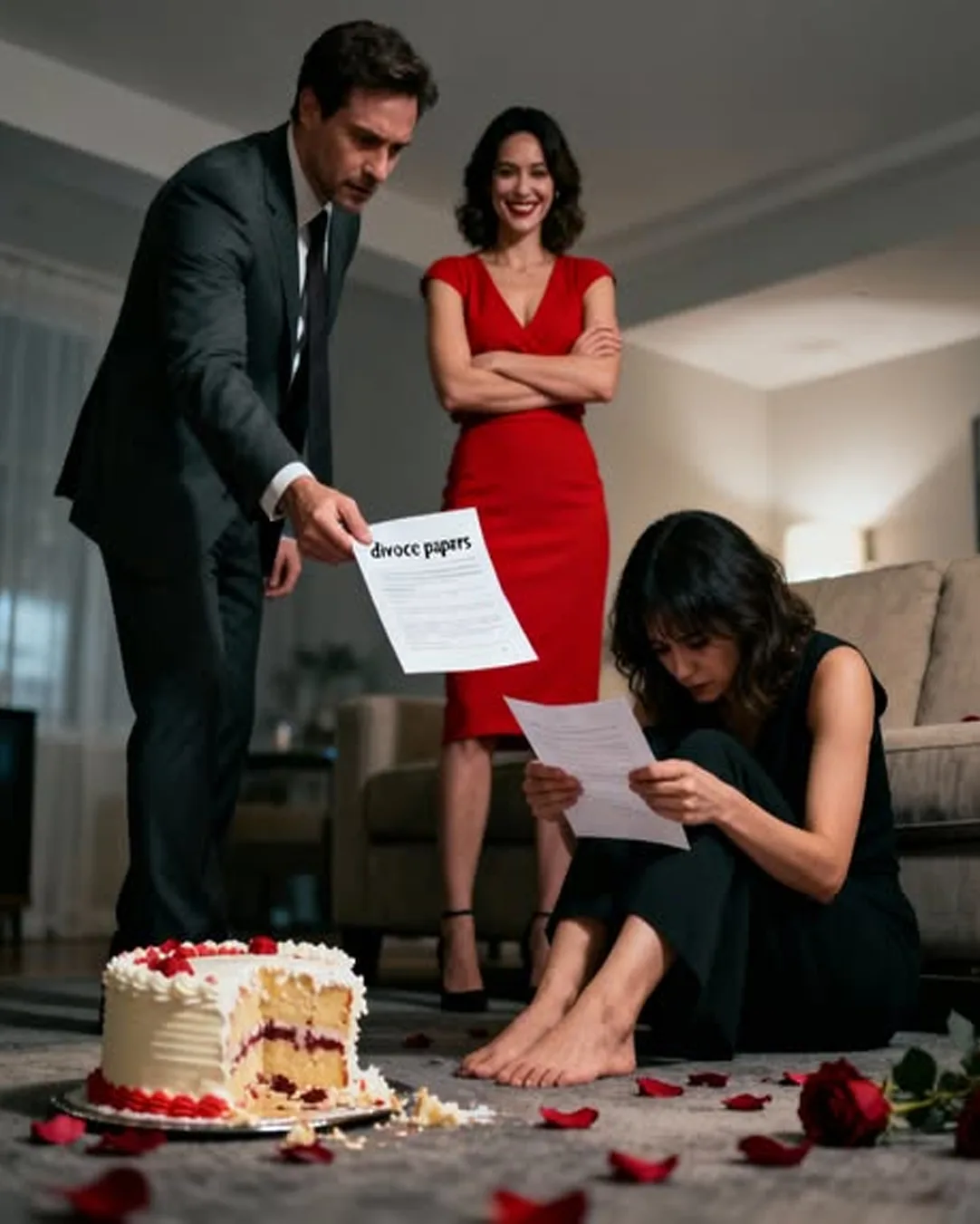
The city glittered like a lie beyond the glass, a necklace of cold lights draped over Manhattan. In our penthouse kitchen, steam curled from a perfect plate of braised fish, the kind that takes an afternoon and a particular kind of hope. The front door clicked—heavy oak, expensive silence—and my heart did its old trick of leaping before it learned. “Happy anniversary,” I said to the air, smoothing an apron I suddenly hated. Felix didn’t look at the table. He walked past, loosening his tie with the bored finesse of a man signing autographs, not promises. “After Grandma’s birthday banquet,” he said, dropping a manila folder on marble, “we’ll get a divorce.” The folder slid, whispering finality. The room smelled like celebration and something rotten. I heard the glass in my voice when I said, “Because of her?” He didn’t flinch. Mina Su. A card clattered beside the file—black, weightless, unlimited. “Sign,” he said. I picked up a pen like it was a blade, and for the first time in three years, wrote my own name: Jenna Jiang.For seven years I’d loved Felix Feng; for three, I’d been his wife; for all of them, I’d been a shadow cast by his schedule. I poured myself into the invisible labor that makes rich men look inevitable—coffees the way he liked them, rooms the temperature he preferred, my own ambitions wrapped in linen and put away like summer clothes. I thought devotion was a currency that would compound if I waited. But devotion doesn’t accrue interest; it empties you at cost. The night he asked me to sign, something small and sharp inside me snapped clean. I threw the anniversary dinner in the trash and walked out with his card, not as a trophy, but as a key. I spent like a woman prying open a locked life—heels, blazers, a car because it was loud, another because it was quiet. Then I made the only purchase that mattered: an appointment with the part of myself I’d mothballed. Before marriage, I’d been the designer companies fought to recruit. There is a particular joy in remembering you were good before you were good for someone else. When I said I’d aim for WY Group—the top—people laughed with the indulgence reserved for exiles and fools. I chose something pettier and sharper: I walked through the glass doors of Feng Group to take the design director seat they’d offered, and introduced myself in the lobby where my almost-ex-husband stood with his executives. “Our new Director,” someone beamed. Felix turned. His face lost color. “How do you know President Feng?” a VP asked. “He’s my ex-husband,” I said, smiling like a new moon.
Work sharpened me. The office sharpened against me. Rumor is a language people speak when they can’t bear the truth: that a woman can leave, return, and be better than before. He tried to make me quit with a poisoned assignment—an infamous client who treated contracts like bait and women like sport. My assistant begged me to refuse; I didn’t. In a smoke-thick KTV room, he grabbed my wrist; the bottle connected with his forehead; rage bloomed like a bruise. The door burst open. Felix. He moved with a violence I had never seen in him—cold, surgical, decisive. The contract was signed because fear compels signatures where respect should, and the man was delivered to the police with evidence Felix’s team already had. Outside, rain stitched the city into a single sheet. “You saved your company’s face,” I said, shaking. “Don’t mistake that for saving me.” He said nothing, which was almost human. The company party arrived like a dare. A circle, a bottle, a command to kiss. I drank whiskey instead of obedience. When the bottle chose him, he crossed the room and kissed me anyway—angry, unasked, the kind of kiss that steals and calls it romance. My mouth tasted like good bourbon and worse timing. By the time the night was done, I’d thrown up on his suit, slept in his bed without meaning to, and woken to his grandmother scolding him in the lobby like a boy who’d forgotten his manners and his wife. She took my hand and called me family. It was the first time the building felt warm.
Mina entered the office like perfume—sweet, cloying, hard to scrub off. She called me “sister” with an audience and placed herself as the fiancée in a sentence designed to draw blood. She sabotaged my launch, then smiled through a lie about leaked designs. The security cameras had been “down”; mine hadn’t. I played the footage in a meeting room so quiet I could hear the electricity, and watched her face go from porcelain to paper. Felix fired her. Shock rippled the floor like a small earthquake. That night, she tried one last theater—an office, a drug, a loosening shirt. I walked in on the performance and dragged him out, cursing myself for caring and him for being easy to care about. We kissed in the wrong moment for the right reasons, then pretended we hadn’t. His phone rang him back to crisis. Mine rang me to the hospital, where a truth rewrote years: Mina’s “brother” was my brother—Suhan—comatose since the accident in which he’d saved Felix’s life. Mina had worn my grief like a costume, accepted Felix’s protection as payment on a promise he’d made to the wrong sister. When Suhan woke, Mina tried to weaponize him—luring him into traffic, a scalpel at his throat, a window as leverage. Felix tackled her as security swarmed, and the room spun with sirens. That night’s quiet tasted like iron and understanding. “I treated her well,” he said at last, “because I thought she was yours.” The floor tilted; the past rearranged itself into something almost forgivable.Some stories sprint to forgiveness; ours limped. I filed my resignation on his desk the next morning because leaving felt like the only honest move. He tore it in half because honesty, it turns out, can make room for stubbornness. We circled each other like two people who’d finally learned each other’s weight. I told him I wouldn’t stay married to a man who loves a ghost. He told me he’d never loved her—only a debt. We were still arguing about it on the sidewalk outside the hospital when headlights became a verdict. He shoved me out of the path of the car like it was the most obvious thing in the world, and the sound of metal on bone cut the sentence clean. Surgery. Bleach. The steady metronome of machines that don’t care who you were before you were a patient. I prayed to no one in particular: if he lives, I won’t make my pride our tombstone. He lived. He opened his eyes and asked, “Who are you?” It was almost funny, if cruelty can be comedic: selective amnesia, the doctor said—a mind protecting itself with erasures. He remembered my brother, not me. He remembered duty, not marriage. Suhan caught the lie first; siblings do. “He’s faking,” he said, delighted, like a kid exposing a magic trick. Felix flushed, a man caught practicing survival. “I thought you’d make me sign the divorce papers before the anesthesia wore off,” he muttered. I hit his arm, which is its own kind of vow.
Here is what I learned in the long, slow after: love is not the same thing as erasure. The quiet wife who curated a life around a man’s preferences had to die for the woman who designs to live again. Money can build a life, but character furnishes it. The powerful can protect you; only you can return yourself to yourself. I kept my job, then earned the one beyond it. We kept the marriage, then remade it—contract first, kiss second. Felix apologized not with flowers but with changes I could measure: policies that protected women from men like our former client; credit where it was due; listening that looked like new habits, not new promises. When his grandmother asked if we were happy, I told her the truth: we were learning. She called it happiness anyway. At night, the city still glittered like a lie, but the rooms we moved through felt honest—a little messy, a little loud, ours. Sometimes he’ll look at me across a meeting table, all angles and arrogance, and I’ll remember the kiss I refuse to make mythic. Sometimes I’ll wake to the sound of my brother snoring in the guest room, alive because a man I once mistook for a stranger drove a car into a bad ending and turned it into a beginning. On our next anniversary, I cooked nothing. We ordered takeout and ate on the floor, barefoot, paperwork piled beside us like the evidence of two people building a life without pretending it’s easy. He raised a carton of noodles in a quiet toast. I raised water, the truest drink I know. We didn’t say the words. We didn’t need to. In the dark window, our reflection looked less like a portrait and more like a story still writing itself—and for the first time in years, I was holding the pen.
News

A Mafia Boss Threatened Dean Martin on Stage—Dean’s Reaction Was Pure Genius
A Mafia Boss Threatened Dean Martin on Stage—Dean’s Reaction Was Pure Genius Prologue: A Gun in the Spotlight Dean…

The Billionaire Had No Idea His Fiancée Was Poisoning His Son—Until the Maid Exposed Everything
The Billionaire Had No Idea His Fiancée Was Poisoning His Son—Until the Maid Exposed Everything Prologue: A Whisper That…

The Billionaire Catches Maid ‘Stealing’ Food… But When He Sees Who It’s For, He Breaks Down in Tears
The Billionaire Catches Maid ‘Stealing’ Food… But When He Sees Who It’s For, He Breaks Down in Tears Prologue:…

The Billionaire’s Fiancée Sets a Trap for the Maid — Until His Silent Daughter Exposed the Truth
The Billionaire’s Fiancée Sets a Trap for the Maid—Until His Silent Daughter Exposed the Truth Prologue: The Whisper That…

The Billionaire Went Undercover as a Gardener — Until the Maid Saved His Children from His Fiancée
Richard Whitmore’s hands trembled on the garden shears as he watched through the kitchen window. His new wife, Vanessa, stood…

Three Flight Attendants Vanished From a Vegas Hotel in 1996 — 28 Years Later a Hidden Wall Is Opened
.Every hotel, every casino, every neon-lit alley has a story, most of them ending in forgetfulness or denial. But some…
End of content
No more pages to load






