
The pill vanished into the gold of the champagne like a secret swallowed by light. From across the head table, I watched my mother-in-law’s hand hover, tremble, retreat. Caroline’s practiced smile fell back into place before anyone noticed, her diamonds scattering chandelier fire as the photographer clicked through a hundred tiny lies. I didn’t think. I shifted place cards, set my own flute where hers had been, and floated back into the applause like a woman whose life hadn’t just changed. When the band slid into soft jazz and the toasts began, Caroline lifted the glass meant for me, our eyes catching for a fraction too long. “To family,” she sang, sweet as sugar glass. “To family,” I echoed, pulse hammering. She drank first.
The reception unfurled like a dream you’re aware you’re dreaming: laughter spooling across linen, roasted duck and gardenias perfuming the room, Ethan flushed and boyish on the dance floor with his groomsmen. I waved when he looked over, tried on my new last name like a silk glove that might or might not fit. Behind the veil of ritual, the old arithmetic ticked: I was a foster-home kid with a scholarship and a spine; the Langleys were marble foyers, summer places, and a crest etched into flatware. Caroline had greeted me with air-kisses and background checks. We’d been delicate to the point of absurdity—compliments the temperature of room air, hugs that never landed. Even our arguments, when they came, were made of satin: who sits where, which florist, how to say “ours” as if I belonged in it. I told myself the wedding would stitch a seam. Then I saw the pill and understood: she would rather unmake the fabric.
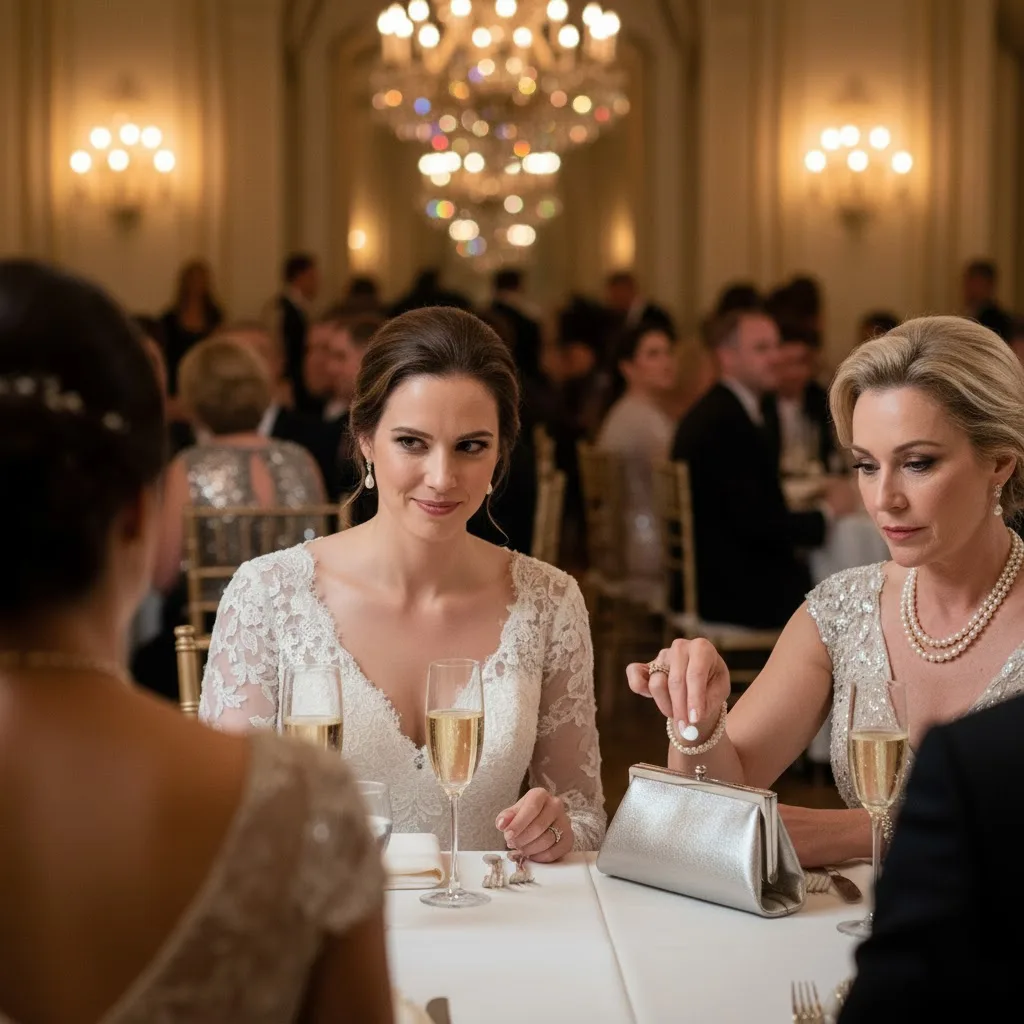
One hour later, the fabric tore. The color drained from her face in steady threads; she pressed a diamonded hand to her temple and smiled harder, as if expression could bully blood. Her chair scraped. She folded toward the floor with a dull, theatrical thud that wasn’t theater at all. The band stuttered silent. “Mom!” Ethan dropped beside her. Sirens made confetti of our send-off ribbon on the marble outside. I stood with my clean glass, all the breath in the hall leaning away from me, and tried to understand what I had just done—and what she had meant to do.
They called it an allergic reaction. At the hospital, Caroline sat upright and ghost-pale, her voice dipped in honey that stuck in your throat. Ethan kissed her forehead; lilies thinned the air. When he stepped out, the room cooled by degrees. “You switched the glasses,” she said, not a question. I didn’t answer. “It wasn’t poison.” Her sweetness fell away like a dropped napkin. “A sedative. A wobble. A little faint on the happiest day of your life. Headlines write themselves. My son would see—eventually—what I see.” She cataloged me with immaculate precision: no pedigree, no safety net, no use to a dynasty except as a story. I asked what she’d put in my drink. She smiled like a locked drawer. “Wouldn’t you like to know.”
In the weeks that followed, the story we told the world—stress, champagne, exhaustion—held together with straight pins. What didn’t hold was the quiet. A note arrived, anonymous only to anyone who hadn’t memorized her loops. You should have taken your drink. Now the game has begun. Then came the complaint to Ethan’s firm—fraud, misused funds—anonymous, surgical. My husband stopped sleeping, drowning in spreadsheets and humiliation he hadn’t earned. When I confronted Caroline, she didn’t bother to deny it. “I protect my son,” she said, twisting her pearls like a rosary for a religion of control.
So I learned the rules. I traced her foundations, her “impact” galas, the charities whose photos she occupied like a patron saint. The cracks were there for anyone willing to put in the hours: a $200,000 drift that found the wrong shore, a donor who was only ever her, a wire to a pharmaceutical name I recognized from late-night research the week of our wedding. I brought the folder to her door. She opened it, and color ran out of her face like water from a cut stem. “What do you want?” “Peace,” I said. “You stay out of our marriage. I stay silent.” She studied me as if she’d misread the map. “You really are your mother’s daughter,” she murmured, and placed a match beside tinder I didn’t know I was standing on.
The attic kept its dust like a promise. Boxes labeled in her unflappable hand, a trunk under a yellowed sheet. Inside: drawings, a cracked doll, and photographs that moved the ground. Caroline with baby Ethan. Beside her, a young woman in a maid’s uniform, dark-eyed, tender-mouthed—my face before my face existed. On the back: Marian—1998. Another photo: the same woman holding a little girl. Me. Morning made me brave and sick. “Who was Marian?” I asked. “Your mother,” Caroline said, calm as a ledger. “My husband’s mistake. I sent her away. She died having you.” It is possible for the room to tilt while all the furniture stays still. “You knew,” I said. “You knew I was—” “Your husband’s half-sister,” she finished, almost kindly. The word detonated without sound.
Grief has more shapes than love. Ethan listened with his hands over his face, and when he finally spoke, the boy in his voice startled me. “She used to sing,” he whispered. “I thought she was a nanny.” He believed me because the photographs didn’t give him a choice. He believed me because some aches in him had never had names. He called his mother; she invited us to dinner with the same tone she used for holidays and announcements and war. At the head of the table, three flutes breathed pale bubbles. “To family,” she said, and the words shivered. We didn’t touch our glasses. “For what?” Ethan asked. “Love or control?” She flinched like a woman hearing a verdict and lifted her own flute as if to bless herself. I watched her drink and couldn’t tell if she was ending a game or opening a door no one else could close.
The hospital called in the small hours. This time, the euphemisms failed. The obituary would say sudden; the papers would say shock; the family would say nothing. We left the house with its haunted molding and went somewhere nameless enough to be ours, a place where the sun warmed cheaper floors and the neighbors said good morning without checking a list. Ethan’s firm cleared him; the truth unspooled with the patience of justice. We ate on mismatched plates and slept with the windows cracked and let time make its slow repairs. On our anniversary, he brought out a single glass. He poured. We held it between us like a truce. “To family,” he said, voice low, “the kind we choose.” We drank, and the bubbles didn’t taste like fear anymore. They tasted like air after a storm—still metallic, yes, but clean.
What a toast builds is not always what it blesses. A glass can be a weapon or a promise; so can a name. I used to think family was a fixed geometry—blood and rings and the photo on the mantle. Now I know it’s a set of verbs: protect, tell, refuse, forgive, leave. Caroline loved the way a captain loves a ship: enough to sink it rather than surrender the wheel. Her love warped until it resembled harm. Mine learned to bend without breaking.
I keep the photographs in a box we open on purpose. Marian’s face looks back with a softness that isn’t weakness. I imagine the song she sang to a boy who didn’t know he’d be my husband, the lullaby that crossed rooms and years to find us anyway. The day I switched the glasses, I thought I was changing one moment; I was choosing a lifetime. The lesson is not about tricking fate or beating an enemy at her own beautiful game. It’s simpler, and harder: trust what you see, then test it; stand still when the room tilts; build a family that does not require a performance to survive. When we raise a glass now, the words fit: to family, yes—but only the kind that doesn’t need a pill to keep its story in place.
News

A Mafia Boss Threatened Dean Martin on Stage—Dean’s Reaction Was Pure Genius
A Mafia Boss Threatened Dean Martin on Stage—Dean’s Reaction Was Pure Genius Prologue: A Gun in the Spotlight Dean…

The Billionaire Had No Idea His Fiancée Was Poisoning His Son—Until the Maid Exposed Everything
The Billionaire Had No Idea His Fiancée Was Poisoning His Son—Until the Maid Exposed Everything Prologue: A Whisper That…

The Billionaire Catches Maid ‘Stealing’ Food… But When He Sees Who It’s For, He Breaks Down in Tears
The Billionaire Catches Maid ‘Stealing’ Food… But When He Sees Who It’s For, He Breaks Down in Tears Prologue:…

The Billionaire’s Fiancée Sets a Trap for the Maid — Until His Silent Daughter Exposed the Truth
The Billionaire’s Fiancée Sets a Trap for the Maid—Until His Silent Daughter Exposed the Truth Prologue: The Whisper That…

The Billionaire Went Undercover as a Gardener — Until the Maid Saved His Children from His Fiancée
Richard Whitmore’s hands trembled on the garden shears as he watched through the kitchen window. His new wife, Vanessa, stood…

Three Flight Attendants Vanished From a Vegas Hotel in 1996 — 28 Years Later a Hidden Wall Is Opened
.Every hotel, every casino, every neon-lit alley has a story, most of them ending in forgetfulness or denial. But some…
End of content
No more pages to load






