
The antiseptic smell didn’t leave with the shower steam; it clung to my hair, to my wrists, to the soft place just under my collarbone where panic had learned to sleep. Six months of that smell—IV bags ticking down like metronomes, vinyl recliners that sighed under the weight of fear, fluorescent lights that made everyone look like a ghost of themselves. My mother’s hand in mine, papery and hot. “It’s nothing,” she’d say, smiling through chapped lips, “just a little rain.” I was thirty-one and bone-tired, the kind of tired that makes your bones feel hollow. I sold my car, drained my savings, quit trying to date or sleep or pretend I had a life outside the oncology ward. I kept receipts in a Ziploc bag and hope in a coffee thermos. When the last chemo ended, I stocked her fridge—yogurt, broth, peaches soft enough to collapse under their own sweetness—lined her pills in a neat, color-coded row, and let myself into the house that used to feel like mine.
Halfway up the stairs I heard laughter. Not relief-laughter. Not we-made-it laughter. Sharp, bell-like laughter with a mean aftertaste. Then my mother’s voice, steady the way it only ever was when she knew she had an audience. “You should have seen her face,” she said. “She actually thought I’d be grateful.” My sister Autumn giggled, lazy as a cat. “Well, she did pay for everything.” A pause. “She’s finally good for something,” my mother replied. “Money.”
The banister left a dent in my palm where I squeezed. I stood there long enough to feel my heartbeat climb into my throat, then I walked back down, lifted my keys from the bowl by the door, and pulled the door shut very gently—as though not to wake a sleeping animal. It was the quietest exit of my life, and the loudest decision I have ever made.
There’s a particular kind of silence on a bus heading north in winter. Everyone is running from something; even the driver keeps his eyes on the dark ribbon of road like it might tell him what to do when he gets there. I chose a town called Willow Creek because the map said there was a river and the internet said rent was cheap. I took a room above a bakery, where dawn smelled like butter and 4 a.m. sounded like metal trays kissing stone. I worked the breakfast shift at a diner with cracked booths and coffee that could strip the paint from a porch swing. I learned the names of the men who left tips in quarters and the women who wore their weariness like perfume. At night, I wrote it down—every blistering word—into a spiral notebook that fattened with anger and then, gradually, with clarity.
The internet gave me a word for it: narcissist. It gave me another word: scapegoat. It gave me a forum full of strangers whose childhoods looked like mine had felt. Through them I found a support group in a church basement where the carpet was a shade of red meant to hide coffee stains and the chairs squeaked their own confessions. That’s where I met Robin. Thirty-four, eyes like dusk, laugh like unfurling cloth. Her mother weaponized silence; her father weaponized debt. She wanted to build a place where women could rest without explaining why they needed to. “A soft landing that still teaches you to stand,” she said, and something in me sat up straight.
We bought land no one else wanted: a weed-choked field by a creek that pretended to be a river when it rained. We learned to dig trenches and read plumbing diagrams by flashlight. We hauled salvaged windows in the backs of borrowed trucks, hammered joists until our elbows sang, and learned which goats would eat poison ivy and which goats would merely insult it. We called it Wisteria Wells because we planted wisteria by the first porch and watched it grip the trellis like a promise. One trailer turned into three; three turned into cabins with doors that locked from the inside without apology. A communal kitchen where soup always simmered. A meditation deck where the creek practiced the language of forgiveness. Women came with duffels and haunted eyes and left with smaller bags and lighter backs. I signed papers as I.D. Romero and kept Iris tucked inside, protected and unnamed.
Three years passed. No calls from home. No texts. Then an email with the subject line simply: Iris. Autumn—married name, new last name, same vowels. Betrayal, empty accounts, a man who ran with her money. “Please,” she wrote. “I have nowhere else.” I closed the laptop. Hours later, a voicemail wet with tears. “I’ve changed. Help me.” I let it ring in my pocket until the battery died.
Robin called from the office. “We just got an application,” she said. “Autumn Johnson. Thirty-two. Says she’s been left with nothing.” She didn’t know who owned Wisteria Wells. She didn’t know I.D. Romero was Iris, the sister who used to take the smaller half of a sandwich. “She meets the criteria,” I said, tasting iron. “We don’t discriminate—family included.” Robin exhaled. “Just be careful.”
Autumn arrived under a sky the color of dishwater, in a sedan that had inherited one too many arguments. Her hair—once varnished to gloss—hung in dull ropes; her eyes flicked across the cabins without curiosity. Robin met her with a clipboard, the gentleness she keeps for newcomers. I watched from the office window, the way you watch a storm moving toward a field you planted by hand.
For days, I was a ghost. I saw her in the kitchen, measuring out oatmeal as if hunger might punish her for imprecision. I saw her on the deck, listening to the creek like it owed her an answer. In group, she sat with her shoulders rounded as if to make room for a story bigger than the chair. “Terry cleaned me out,” she said, voice practiced, palms open. “Mom said I made my bed. I’ve always been alone.” She left out my name like a stain you scrub until the fabric thins.
On the fourth day, I walked into group with the late sun on my back and mud on my boots. The room smelled like eucalyptus and hard-earned honesty. Autumn’s eyes found my face and did not recognize it at first; then color drained as if someone had pulled the plug. “I built this,” I said—not loudly, but with the gravity of the creek after rain. “Every nail, every vine, every rule about how we speak to one another. Out of the ashes of what you and Mom kept lighting in me.”
Gasps hummed around the circle. Autumn’s mouth opened and closed. “I—” she tried. I raised a hand. “You came here for healing. Good. But healing begins where the story stops lying. This place is not a bank with softer lighting. And I don’t fund abusers anymore.”
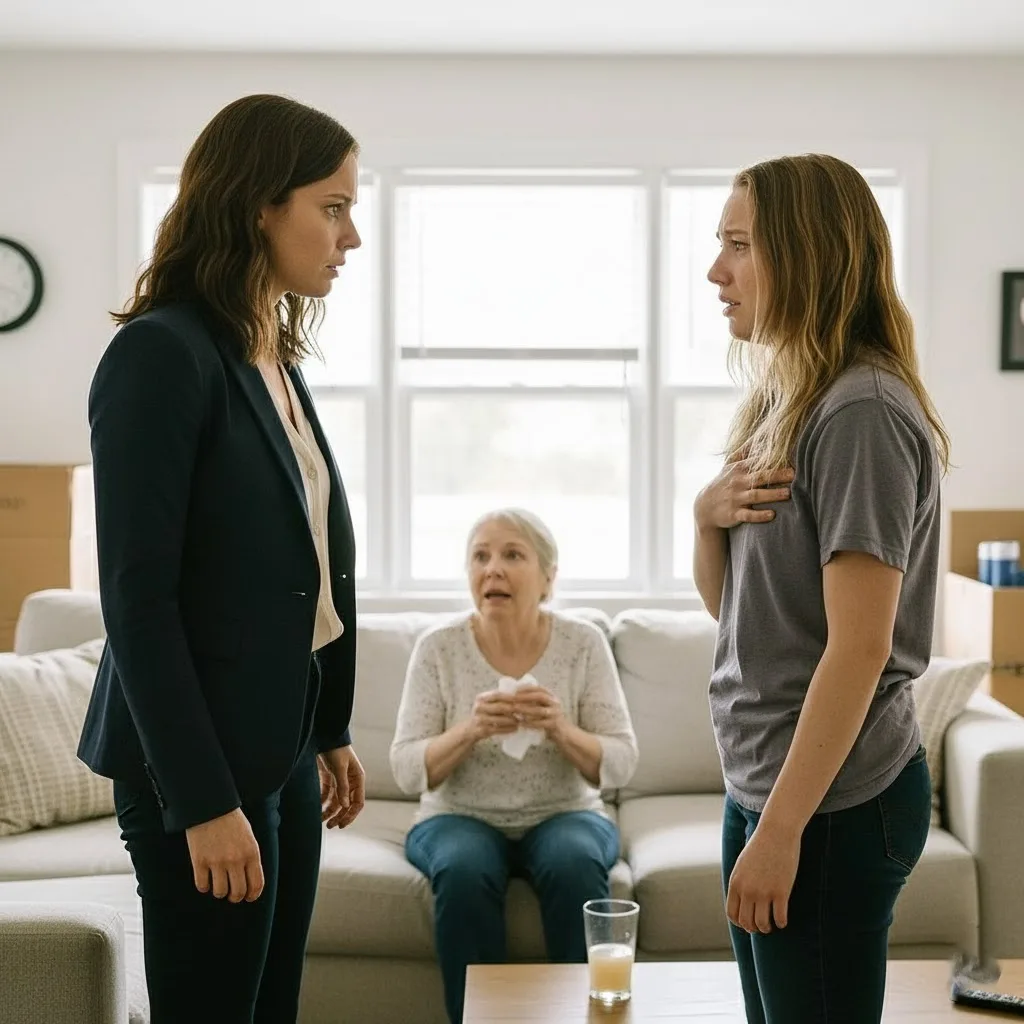
She stood so fast the chair legs skittered. The screen door slapped her anger into the hallway. That night she pounded on my cabin like memory with fists. I opened. She walked in, peered around as if the furniture might testify against her, then turned on me with the old family posture—chin high, eyes wet, palms empty. “You don’t understand what happened to me,” she said.
“To you?” I asked, not unkindly. “I sold my car and slept in hospital chairs. I memorized the color of nausea and the sound of a chemo pump alarm in my bones. I filled Mom’s fridge and lined up her pills like little soldiers. Then I heard her laugh and say I was finally good for something—money. You laughed, too.”
“I didn’t know you heard,” she whispered.
“You didn’t care,” I said. “Three years, Autumn. Silence, until your world fell apart and you needed a place softer than the one you’ve made. Mom called me unstable; you nodded. Mom taught you how to make a crisis into a crown; you wore it. I was the workhorse. You were the parade.”
Her tears were real. So were mine, once. “I’m sorry,” she said. “I just need help.”
“Your pain is not smaller than mine,” I said, “but it is yours. You made choices. You made your hell. You can walk out of it, but not on my back.”
She stared at me like I’d changed languages. “So that’s it?”
“That’s it. Pack your things. Wisteria Wells is for women who want truth more than comfort. You can come back when you want that, too.”
She didn’t slam the door when she left. The gravel under her tires sounded like someone chewing ice.
I stood on the porch until the red of her taillights dissolved into the trees. The night pressed its palm against my ribs. When I turned, Robin was leaning in the shadow of the door, one foot tucked behind the other, as if balance were the same as patience. “You okay?” she asked.
I considered the question—the old reflex to say yes in order to be loved. Then I felt the steadiness in my knees and the cool, clean line of my spine. “For the first time in years,” I said, and meant it.
In the morning, dew stitched bright threads across the field. I carried the talking stick into group and sat cross-legged on the rug. “Here,” I said, “we rebuild from truth. We don’t perform transformation—we practice it. We don’t let the past write our current address.” Heads nodded—not to please me, but because the sentence landed where it needed to. A woman in a purple hoodie let out a laugh that had been trapped for a decade. Someone else cried into her sleeves and didn’t apologize. The creek outside kept speaking in its single, fluent sentence.
After circle, I walked the paths we’d carved with borrowed shovels. The cabins looked both modest and miraculous, the way ordinary mercy always does. I touched the first wisteria we planted—the vine had thickened into a wrist, then an arm, then something like a story you could lean against. I thought of my mother’s house, my mother’s voice, the way gratitude can be counterfeited until even the giver doubts her own worth. I thought of how long it takes to untangle the lie that love equals usefulness. The air smelled like wood smoke and dish soap, like a house where living happens.
My phone buzzed once—an unknown number, a short text. I’m sorry. No name. No promise. I put the phone back in my pocket and let the creek keep the only reply necessary.
Some losses hollow you out; some clear you. I used to think survival meant learning to bear more weight. Now I understand it also means learning to set things down. Money was the cheapest thing I gave my mother. The most expensive was the part of myself that kept waiting for thanks like rain. The day I stopped expecting it, the drought ended.
Wisteria teaches you how time works: first it clings, then it roots, then it blooms with a softness that belies the strength of its grip. I am not the daughter who mistook usefulness for love anymore. I am the woman who built a place where usefulness is measured in soup bowls and shared silence, in beds made safe by clean sheets and locked doors, in the courage it takes to tell a story straight and then live a different ending.
If Autumn ever comes back and sits in our circle and says the truth plain, there will be a chair for her. Not because blood is thicker, but because truth is. Until then, the creek keeps speaking, the cabins keep sheltering, and the wisteria keeps holding on in the gentlest way there is—by growing toward the light.
News
A Mafia Boss Threatened Dean Martin on Stage—Dean’s Reaction Was Pure Genius
A Mafia Boss Threatened Dean Martin on Stage—Dean’s Reaction Was Pure Genius Prologue: A Gun in the Spotlight Dean…

The Billionaire Had No Idea His Fiancée Was Poisoning His Son—Until the Maid Exposed Everything
The Billionaire Had No Idea His Fiancée Was Poisoning His Son—Until the Maid Exposed Everything Prologue: A Whisper That…

The Billionaire Catches Maid ‘Stealing’ Food… But When He Sees Who It’s For, He Breaks Down in Tears
The Billionaire Catches Maid ‘Stealing’ Food… But When He Sees Who It’s For, He Breaks Down in Tears Prologue:…

The Billionaire’s Fiancée Sets a Trap for the Maid — Until His Silent Daughter Exposed the Truth
The Billionaire’s Fiancée Sets a Trap for the Maid—Until His Silent Daughter Exposed the Truth Prologue: The Whisper That…
The Billionaire Went Undercover as a Gardener — Until the Maid Saved His Children from His Fiancée
Richard Whitmore’s hands trembled on the garden shears as he watched through the kitchen window. His new wife, Vanessa, stood…
Three Flight Attendants Vanished From a Vegas Hotel in 1996 — 28 Years Later a Hidden Wall Is Opened
.Every hotel, every casino, every neon-lit alley has a story, most of them ending in forgetfulness or denial. But some…
End of content
No more pages to load






