
The knife against the roast made a sound too sharp for Sunday. It cut through the silence like glass splitting under pressure. My father sat at the head of the table, the self-appointed king of a crumbling kingdom, carving meat with the same authority he’d used all his life to carve out everyone else’s choices. My mother watched him with the nervous, fixed smile of a woman who had survived too many storms by pretending the furniture wasn’t shaking. And my brother, Ethan—perfect, polished Ethan—was talking about his next “big opportunity.”
I sat at the far end, where I’d always sat, near the window, the spot where I could breathe.
“…AI-integrated crypto solutions,” Ethan said proudly, swirling his wine. “A new generation of decentralized capital.”
My father nodded as if he understood any of it. “Brilliant. Absolutely brilliant. All we need now is family backing. Family stands together, right, Anna?”
I looked up from my plate. “Family stands, yes. It doesn’t have to fall together.”
He didn’t laugh. He never laughed when it came to me.
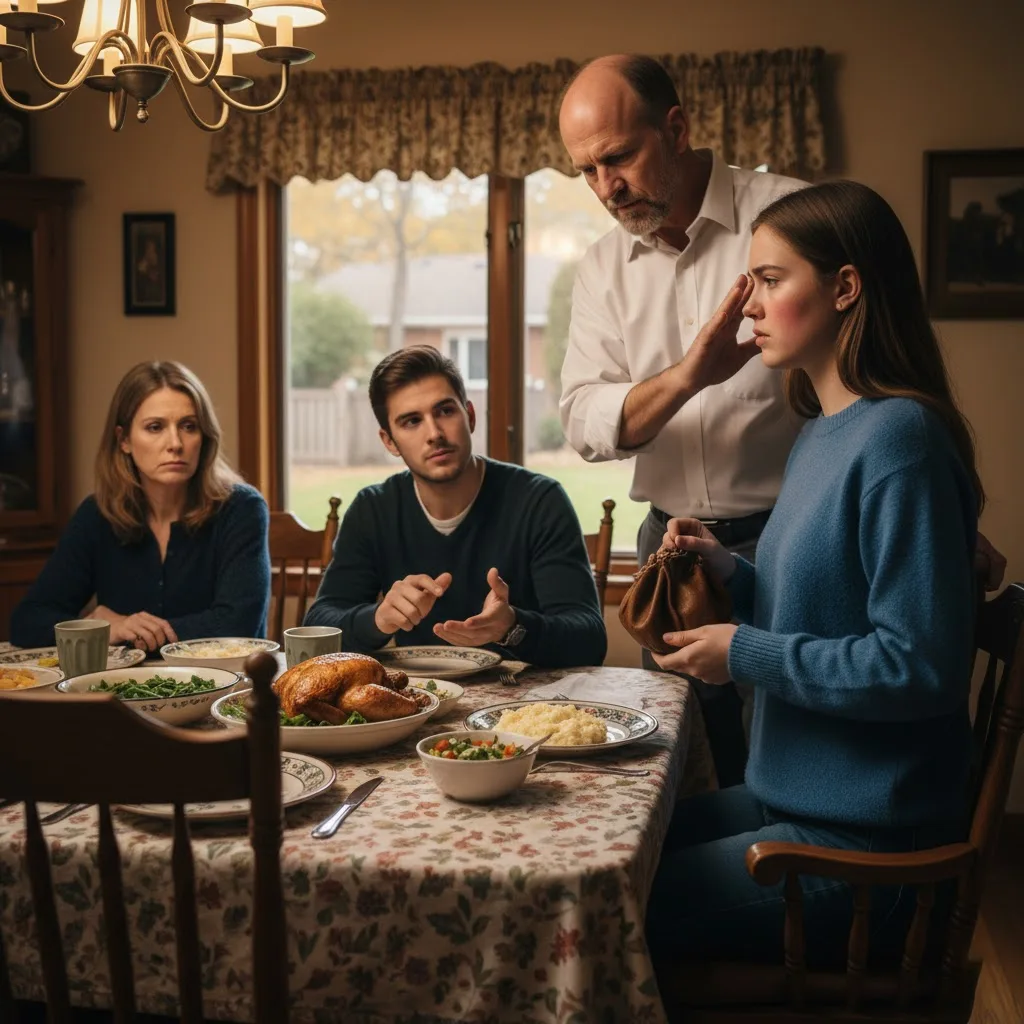
My father, Robert, was a man raised in an era where authority meant ownership. Every opinion, every inch of space in this house, belonged to him. My mother surrendered long ago. Ethan, the prodigal son, learned early how to turn obedience into currency. I learned silence. It was cheaper.
“Anna,” my father said, wiping his mouth with the back of his hand. “Your mother tells me you’ve saved quite a bit. For what? You don’t need your own place. This house is your home.”
I felt the air tighten. “It’s for my future,” I said carefully.
He leaned forward, his eyes burning with the kind of righteousness that disguises control as love. “Your future is your brother’s success. He’s the one carrying our name forward. You’ll give him your savings.”
“Dad, that’s not—”
He slammed his hand down on the table. Plates rattled. The wine in my glass trembled. “You’re just a teacher!” he roared. “You earn because I gave you a life stable enough to work for peanuts. Now you’ll give back to this family. Ethan needs capital. You’ll do your duty.”
Ethan didn’t look ashamed. He looked bored. My mother dabbed at her eyes with her napkin, the same performance she’d perfected over decades: silent tears, no rebellion.
Something broke quietly inside me—not like glass, but like thread. Thin, soft, final.
“No,” I said.
The sound was so small it might’ve been mistaken for a breath. But it changed everything.
My father’s head snapped up. “What did you say?”
“I said no,” I repeated, more clearly now. “I’m not giving him my money.”
His face contorted into something almost primal. “You dare defy me in my own house?”
He was on his feet before I could speak again. The slap came like lightning—loud, sharp, almost theatrical. My chair tipped. I hit the rug hard, the scent of the roast mixing with the copper taste of blood in my mouth.
I looked up. Ethan didn’t move. My mother didn’t speak. The silence was so complete I could hear the tick of the grandfather clock in the hall.
Something inside me went still—not fear, not pain. Stillness. The kind that comes when you’ve been hit one too many times, not physically, but by years of being small.
My father stood over me, breathing heavily, chest heaving with victory. “You will respect me,” he spat. “In my house.”
That was the moment the irony hit me so hard I almost laughed.
Because it wasn’t his house. Not anymore.
Six months earlier, I’d received a letter at work—a foreclosure notice. The house I’d grown up in, the one my father worshipped as proof of his “legacy,” was three weeks away from being repossessed. He’d drained every account trying to fund Ethan’s failed ventures. There were no savings, no assets, no legacy. Just debt.
I didn’t pay it off for him. I bought it out from under him. I used my savings, my small teacher’s salary, and a private loan. I let the bank foreclose, then purchased the title outright. I became, legally and quietly, the sole owner of this house.
They never noticed the mail had started coming to my address at school. They never wondered why the mortgage statements stopped.
I stood up slowly, wiped the blood from my lip, and faced him.
“You keep saying this is your house,” I said softly. “But you’re mistaken.”
“What nonsense are you talking now?” he barked.
I walked into the study, to the shelf that still held my grandmother’s photo and my childhood report cards, and pulled out the leather folder he’d never once opened. When I came back, I placed it in the center of the table. Silverware scattered.
He opened it. And there it was—the deed, notarized, my name printed in block letters beneath “Sole Owner.”
Six words I’d been waiting for him to read.
“This isn’t your house anymore,” I said. “You lost it—to the bank. And the man you just hit? He doesn’t own this roof. I do. You’ve been living here as my tenants.”
The silence cracked like ice under weight. My mother gasped. Ethan’s fork clattered against his plate. My father’s hands shook as he reread the papers, searching for a loophole that wasn’t there.
I looked at him—really looked at him. The great patriarch, the man who had ruled this house with an iron fist, undone by a daughter’s quiet math.
“You just assaulted your landlord,” I said.
He froze. His mouth opened, but no sound came.
The night air that rushed in when I opened the door smelled clean. Cold, but clean.
My father stood, still trembling with disbelief. My brother’s confidence had vanished, replaced by the dull panic of a man who has never stood on his own two feet.
“Now,” I said, voice steady, calm, final. “Please leave my house. Both of you.”
For the first time in my life, my father didn’t argue. He looked at me—really looked—and saw someone he couldn’t control. The truth was too heavy for his pride to carry.
When the door shut behind them, the house seemed to exhale. The walls, once filled with shouting, fell into a kind of sacred quiet.
My mother lingered in the dining room, her hands shaking. “Anna,” she whispered, “what will we do?”
I sat down at the head of the table, in his chair. “We’ll start over,” I said. “We’ll start honest.”
Later that night, I walked through the house room by room. The kitchen where I’d been scolded for dreaming too small. The hallway where my father’s voice had always followed. I touched the walls, the banister, the cool brass of the doorknobs—and felt, for the first time, that they belonged to me.
It wasn’t about the house. It never was. It was about reclaiming the space where I’d been taught to shrink.
Power, I realized, doesn’t always roar. Sometimes it simply stands, steady and quiet, and opens the door.
News

A Mafia Boss Threatened Dean Martin on Stage—Dean’s Reaction Was Pure Genius
A Mafia Boss Threatened Dean Martin on Stage—Dean’s Reaction Was Pure Genius Prologue: A Gun in the Spotlight Dean…

The Billionaire Had No Idea His Fiancée Was Poisoning His Son—Until the Maid Exposed Everything
The Billionaire Had No Idea His Fiancée Was Poisoning His Son—Until the Maid Exposed Everything Prologue: A Whisper That…

The Billionaire Catches Maid ‘Stealing’ Food… But When He Sees Who It’s For, He Breaks Down in Tears
The Billionaire Catches Maid ‘Stealing’ Food… But When He Sees Who It’s For, He Breaks Down in Tears Prologue:…

The Billionaire’s Fiancée Sets a Trap for the Maid — Until His Silent Daughter Exposed the Truth
The Billionaire’s Fiancée Sets a Trap for the Maid—Until His Silent Daughter Exposed the Truth Prologue: The Whisper That…

The Billionaire Went Undercover as a Gardener — Until the Maid Saved His Children from His Fiancée
Richard Whitmore’s hands trembled on the garden shears as he watched through the kitchen window. His new wife, Vanessa, stood…

Three Flight Attendants Vanished From a Vegas Hotel in 1996 — 28 Years Later a Hidden Wall Is Opened
.Every hotel, every casino, every neon-lit alley has a story, most of them ending in forgetfulness or denial. But some…
End of content
No more pages to load






