
Milwaukee, 1968. The house on Leighton Park Drive sat under a dim sky, the kind of gray that never promised morning. Inside, the air was too quiet—silence wasn’t peace there, it was strategy. I was sixteen and already fluent in survival. My name was Ellie Vance, and every evening I waited for the sound of the key in the front door, bracing for which version of my father would enter. If the door closed softly, we exhaled. If it slammed, we disappeared.
That night, I was at the kitchen table, pencil smudges on my fingers, a half-finished sketch in front of me: a bird breaking through a cracked cage. My father’s footsteps approached, heavy, unpredictable. I hid the drawing beneath a stack of school papers before he entered.
Arthur Vance was a man who believed control was love, and discipline was duty. He had grown up in the kind of Midwest that worshiped toughness—men drank their pain, women buried theirs. My mother, Margaret, had learned long ago how to move like a shadow around him. My older brother, Walter, had started imitating him—his sharp tone, his contempt. My little sister, Clara, followed me from room to room, clutching my sleeve like a lifeline.
School was my oxygen. In the art room, I was free. My drawings were the only places where truth could breathe. Miss Albbright, my art teacher, saw what I couldn’t say aloud. Without asking, she entered one of my drawings—a charcoal of a woman looking through barred windows—into a statewide competition. A month later, she pressed a letter into my hands: Second place. Exhibition in Madison. Prize money enclosed.
For the first time, I saw a door out. That night, under the flickering kitchen light, I showed the letter to my mother. She cried quietly, the way she always did, but this time there was joy behind it. “We’ll find a way,” she whispered, tucking the prize money into an old sugar tin. For a moment, the future seemed possible.
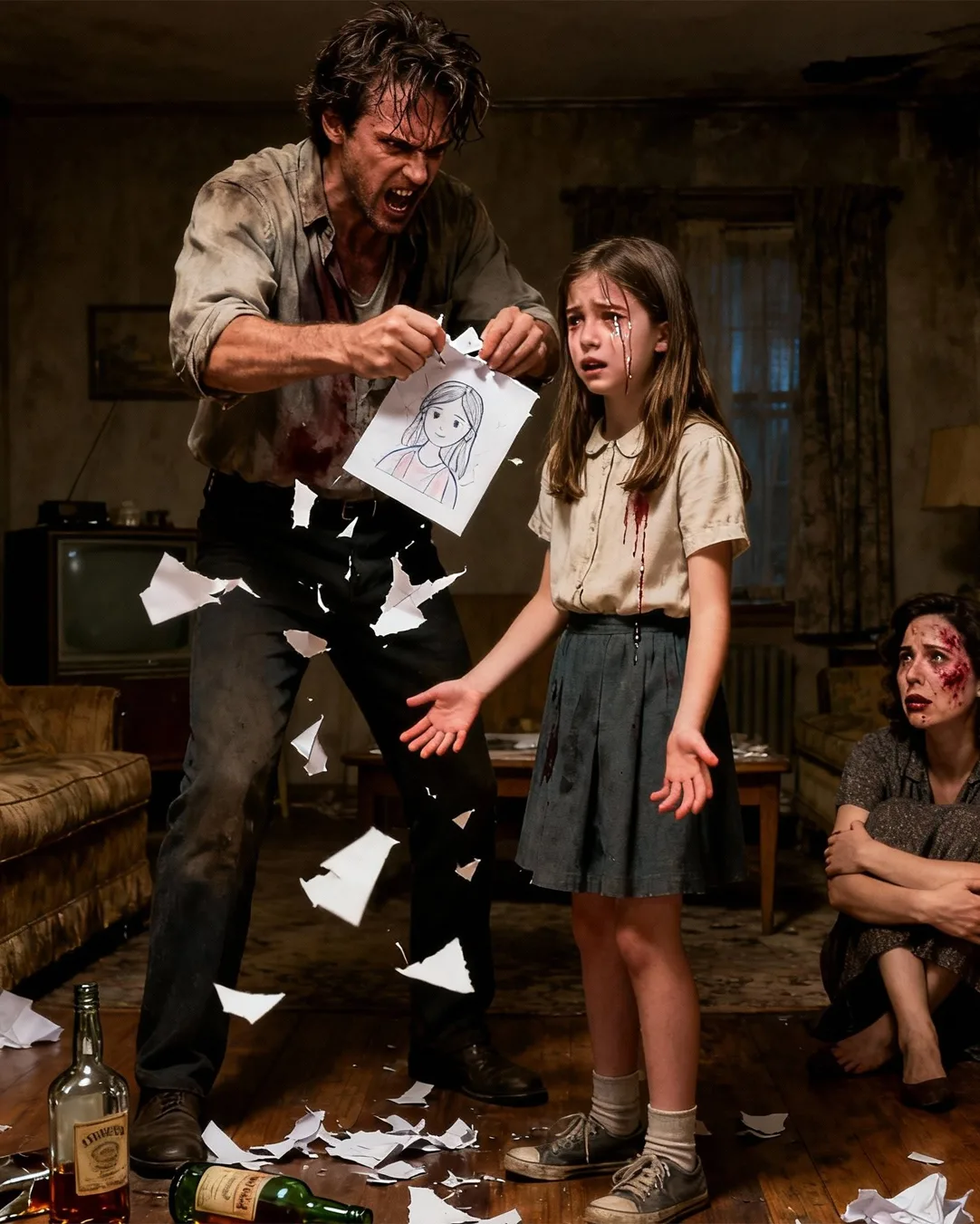
But secrets never lasted long in our house.The neighbor mentioned my award to my father two days later.
That night, the door didn’t open—it exploded. Arthur’s boots struck the linoleum. He marched into my room like a storm wearing skin. “You hiding something from me?” he shouted, ripping drawers open. The letter was on my nightstand before I could hide it. His face twisted when he saw the word winner.
“What is this?” His voice cracked like a whip. “You think you’re leaving this family to draw pictures?”
He tore the paper in two, then four, until the words turned to confetti in his fists. When my mother tried to stop him, his hand came down like instinct. The sound of her hitting the counter echoed through the kitchen. Blood dotted the tile.
Walter didn’t move. He only said, “You should’ve listened. Girls with ideas make trouble.”
That night, I hated him more than I feared my father.
The next morning, my mother’s face was swollen, but something in her eyes had changed. It was as if the fear had hardened into resolve. She waited until Arthur left for work before whispering, “We can’t stay, Ellie. We’ll die here if we don’t go.”
We began packing quietly. One suitcase. A few clothes. My sketchbook. A dream wrapped in silence.
But when the zipper caught halfway, the bedroom door opened. Walter stood there, his expression unreadable.
“What are you doing?” he asked, voice flat.
My mother lied quickly. “Nothing.”
His eyes fell to the suitcase under the bed. The corner of a dress sticking out. He understood instantly. “You’re leaving.”
My mother stood tall. “Yes.”
Walter’s face hardened. “Our father’s right,” he said. “You don’t belong anywhere else.”
Then, softly, dangerously, he added: “I’ll tell him.”Time froze. The clock ticked once. Clara clung to my arm so tightly I could feel her pulse through her fingers.
“Walter,” my mother whispered, “if you tell him, he’ll kill us. You know that.”
For a moment, I thought I saw the boy he used to be—the one who built snow forts with me, who hid Clara’s toys from our father’s temper. But the look vanished. He turned and slammed the door.
That night, none of us slept. Arthur returned late, drunk on anger and liquor, muttering about betrayal. But he didn’t know yet. Walter hadn’t told him—or not fully. The house trembled with the possibility of what might happen next.
And somewhere between fear and exhaustion, an idea formed. Desperation has its own logic.
Arthur relied on a thick, pungent liniment for his bad knee—a bottle he kept by the bedside, rubbing it in every night before sleep. Without it, he moved slower, weaker.
“What if,” I whispered to my mother in the dark, “we mix it—with glue?”
At first, she stared at me, horrified. Then her hand brushed the bruise on her cheek. She nodded.
The next afternoon, while he snored, we worked in silence. We poured out half the oil and replaced it with clear adhesive. My hands shook, my heartbeat a drum in my throat. When it was done, we wiped the bottle clean and set it back exactly where it had been.
That night, he didn’t notice anything. He rubbed his knee, cursed under his breath, and went to bed.
At dawn, the scream came.
A guttural, animal sound. He stumbled into the hallway, leg twisted, face pale with agony. The pain seized him, locking his knee until he fell—head first against the table edge. A crack, then stillness.
“Help me,” he gasped, blood pooling beneath him. “Call an ambulance!”
No one moved. My mother looked at him with something colder than hate—recognition. “We’re leaving,” she said quietly.
We took the suitcase and walked out the door.The morning air was sharp and unreal. It felt like stepping into someone else’s life. We didn’t run—we walked, heads high, past the sagging porch, down Leighton Park Drive, into the gray dawn.
We reached the bus station before sunrise. My mother’s cousin, Beatrice, lived in Cedar Creek, a quiet town two hours away. She opened her door before we could even knock, wrapping us in warmth that felt foreign, almost frightening.
For weeks, we flinched at every sound. We expected police. Walter. Retribution. But none came.
A month later, a neighbor from Milwaukee wrote to Beatrice: Arthur had died in the hospital. Internal bleeding. Walter had disappeared.
My mother never spoke his name again.
Slowly, we began to live. My mother mended clothes for neighbors. Clara went back to school. And I—hesitantly, fear still thrumming under my skin—picked up a pencil again.
My new art teacher, Mrs. Davenport, saw me instantly. “You draw like you’re remembering something,” she said.
I entered another contest—a charcoal of three women walking out of a shadow into the light. I won first place. The prize: a scholarship to the Art Institute of Chicago.
Leaving terrified me. But my mother pressed my hands and said, “You were born to create a life bigger than what we escaped.”
So I went.Chicago became my rebirth. I studied technique, but what I learned most was voice. I painted what I once feared to name: violence, silence, and the quiet defiance of women who endure.
Years later, I returned to Cedar Creek as an art teacher. I married a kind man, Samuel, a carpenter with patient eyes. We built a small life full of sunlight and laughter. My mother spent her last years surrounded by family, free at last.
Sometimes, late at night, I open my old sketchbook. The pages are filled with darkness—women without mouths, birds that cannot fly. My granddaughter once asked me, “Grandma, why do they all look sad?”
I smiled and told her the truth: “Because they are roots. Roots grow in darkness before flowers reach the light.”
What we endured did not define us. It shaped us into something stronger, something real.
We were not the story my father tried to write.
We became the authors of our own.
News
A Mafia Boss Threatened Dean Martin on Stage—Dean’s Reaction Was Pure Genius
A Mafia Boss Threatened Dean Martin on Stage—Dean’s Reaction Was Pure Genius Prologue: A Gun in the Spotlight Dean…

The Billionaire Had No Idea His Fiancée Was Poisoning His Son—Until the Maid Exposed Everything
The Billionaire Had No Idea His Fiancée Was Poisoning His Son—Until the Maid Exposed Everything Prologue: A Whisper That…
The Billionaire Catches Maid ‘Stealing’ Food… But When He Sees Who It’s For, He Breaks Down in Tears
The Billionaire Catches Maid ‘Stealing’ Food… But When He Sees Who It’s For, He Breaks Down in Tears Prologue:…

The Billionaire’s Fiancée Sets a Trap for the Maid — Until His Silent Daughter Exposed the Truth
The Billionaire’s Fiancée Sets a Trap for the Maid—Until His Silent Daughter Exposed the Truth Prologue: The Whisper That…

The Billionaire Went Undercover as a Gardener — Until the Maid Saved His Children from His Fiancée
Richard Whitmore’s hands trembled on the garden shears as he watched through the kitchen window. His new wife, Vanessa, stood…
Three Flight Attendants Vanished From a Vegas Hotel in 1996 — 28 Years Later a Hidden Wall Is Opened
.Every hotel, every casino, every neon-lit alley has a story, most of them ending in forgetfulness or denial. But some…
End of content
No more pages to load






