
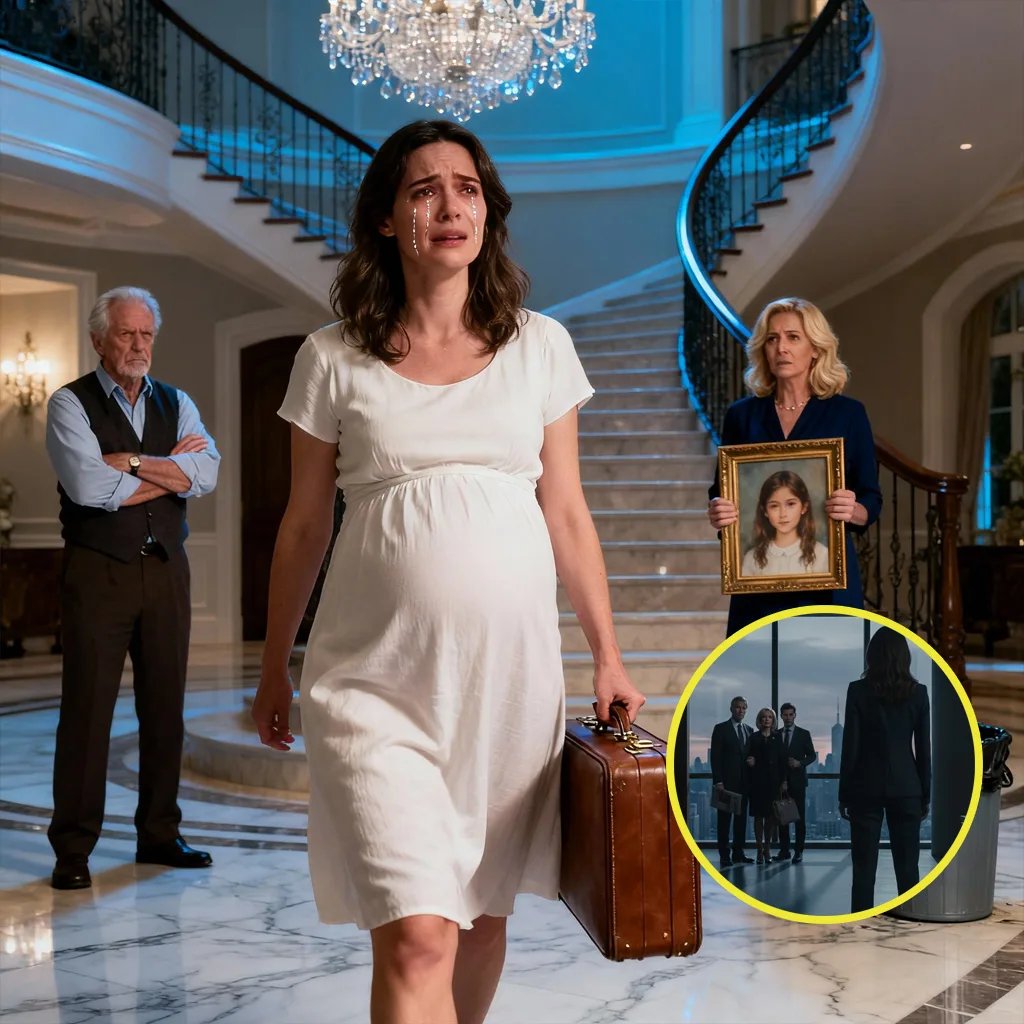
The rain in Greenwich didn’t fall—it attacked. Sharp, silver needles cutting through the night, slicing across the manicured hedges and marble steps of the Carter estate. Amelia Carter stood at the gates, soaked and trembling, one hand resting on the gentle curve of her six-month belly. Behind her, the world felt wide and dangerous. Before her, home had never looked more foreign.
Her mother stood under the porch light, pearls gleaming against the black silk of her dress. “You’ve disgraced this family,” Margaret hissed, her voice brittle as glass. Beside her, Richard Carter—the man who had built Carter Holdings into an empire of power and pretense—folded his arms. His gaze was cold, precise. “You made your choice,” he said. “Now live with it.”
Amelia’s breath came in shallow bursts. “It’s still your grandchild,” she whispered.
Richard didn’t flinch. “Not if it was born out of shame.”
The gates closed with a mechanical groan, locking her out of the only life she’d ever known. Behind her, the mansion’s windows glowed warm and distant. She took one last look at them before turning toward the dark road ahead.
The baby came that December, small and perfect and loud enough to fill the silence her family had left behind. She named him Leo. They lived in a one-bedroom apartment over a bakery, where the air always smelled like sugar and burnt toast. She took night classes, working as a paralegal by day and studying law by moonlight.
Some nights, when the city went quiet and Leo finally slept, she would stare at the photo on her dresser—her parents at a charity gala, smiles flawless, eyes empty—and wonder if she would ever forgive them. The answer was always the same: not yet.
Years bled together. Amelia graduated at twenty-five, passed the bar at twenty-six, and by twenty-nine, she was a name whispered in courtrooms: calm, brilliant, relentless. The girl who had once been thrown out of a mansion now wore tailored suits and carried her own kind of armor.
She never spoke of her family. Not even to Leo. When he asked about the people in the photographs she kept in the back of her closet, she said, “They live far away.”
But blood has a way of circling back—especially when money is involved.
It began on a Tuesday morning in March. The sky was gray, the kind of gray that made everything seem unfinished. Amelia was in her office, buried in briefs and contracts, when her secretary knocked. “Ms. Carter,” she said cautiously, “there are two visitors insisting on seeing you. They say they’re your parents.”
Amelia froze. Ten years of silence, and suddenly they were here. She felt a strange calm spread through her body, like a storm pulling in. “Send them in.”
Margaret entered first, chin lifted, pearls still perfectly aligned. Richard followed, older now, his once-imposing frame softened by time but not by humility. They didn’t sit. They didn’t smile. They looked at her desk, her diploma on the wall, the nameplate that read Amelia Carter, Esq.—and realization flickered in their eyes.
“We’d like to meet our grandson,” Margaret said, voice clipped.
Amelia leaned back in her chair. “You mean the one who made me a disgrace?”
Richard’s jaw tightened. “That was a long time ago. We were angry, misled—”
“You threw me out into a storm,” she said quietly. “Pregnant, with nowhere to go. Forgive me if I’m not rushing to bridge the gap.”
Margaret’s mask cracked. “You don’t understand, Amelia. Things have changed. Your grandfather—”
“Left you something,” Richard interrupted. “His will was… unexpected.”
Amelia’s gaze sharpened. “Unexpected how?”
Richard cleared his throat. “He left you half of Carter Holdings.”
The silence in the room was almost physical. Amelia blinked once. “Half?”
“Yes,” he said bitterly. “Half. And the estate in Greenwich. It’s all in your name now. We… didn’t realize until this week.”
Amelia looked down at her hands, her heartbeat steady. She remembered her grandfather’s voice, the only warm one in that house, whispering at the piano when she was a girl: ‘Kindness outlasts cruelty, Amelia. And truth has a long memory.’
She looked back up at her parents, seeing them clearly for the first time—not as gods, but as people who had mistaken control for love. “So,” she said softly, “you came here to ask for access to my son. Not to apologize.”
Margaret bristled. “We have every right—”
“No,” Amelia interrupted. “You don’t.”
For the first time, Richard Carter—the man who never blinked in a boardroom—looked uncertain. “You wouldn’t keep him from us,” he said quietly. “We’re family.”
Amelia rose, her voice steady but quiet enough to draw every ounce of their attention. “You made that decision ten years ago.” She opened the door. “Now I suggest you leave my office. You’re trespassing on my property.”
It took a moment for them to understand what she meant. Then realization dawned, cruel and poetic. They no longer owned the mansion. The company. The power. The world had turned, and she was standing at its center.
That night, Amelia drove to Greenwich for the first time in a decade. The gates were the same, black iron and rain-slick, but this time they swung open at her command. The mansion smelled faintly of dust and jasmine, and for a moment, she felt her younger self standing beside her—the frightened girl with rain in her hair and defiance in her heart.
Leo ran through the echoing halls, his laughter bouncing off the marble. “This is our house?” he asked.
“Yes,” Amelia said. “Ours.”
In the study, she found her grandfather’s portrait, still hanging over the fireplace. She stood in front of it for a long while. “You knew what you were doing,” she whispered. “You always did.”
Weeks passed. The house filled with warmth again: books on the stairs, drawings taped to the walls, the smell of burnt pancakes on weekends. Leo played piano in the same spot where she once sat as a child, his small hands finding melody in the dust.
And sometimes, when she saw her parents’ number flash on her phone, she let it ring. She wasn’t ready—not yet. Maybe one day. But forgiveness, she’d learned, is not something owed. It’s something earned.
On a summer afternoon, Amelia sat on the front steps of the mansion, watching Leo chase the dog through the garden her grandfather once planted. The sky was the color of glass, clear and fragile.
She thought about the past—the rain, the gates, the words that had exiled her. She thought about the strange symmetry of it all: the child cast out becoming the heir; the house that once rejected her now echoing with laughter.
People liked to say revenge was sweet. But this wasn’t revenge. It was reclamation.
Amelia didn’t need apologies. She didn’t need her parents’ approval. She had rebuilt her life from the rubble they left behind, and in doing so, she had found something far rarer than power.
Peace.
As the sun sank behind the trees, Leo ran up the steps, breathless, his hair catching the light. “Mom,” he said, tugging at her sleeve, “did you live here when you were little?”
Amelia smiled. “I did. But I think it’s finally home now.”
She looked up at the windows glowing gold in the sunset—no longer a fortress of judgment, but a house reborn. Some inherit wealth. Others inherit pain. Amelia had inherited both and turned them into something entirely her own.
Kindness outlasts cruelty. And truth, as her grandfather promised, has a long memory.
News

A Mafia Boss Threatened Dean Martin on Stage—Dean’s Reaction Was Pure Genius
A Mafia Boss Threatened Dean Martin on Stage—Dean’s Reaction Was Pure Genius Prologue: A Gun in the Spotlight Dean…

The Billionaire Had No Idea His Fiancée Was Poisoning His Son—Until the Maid Exposed Everything
The Billionaire Had No Idea His Fiancée Was Poisoning His Son—Until the Maid Exposed Everything Prologue: A Whisper That…

The Billionaire Catches Maid ‘Stealing’ Food… But When He Sees Who It’s For, He Breaks Down in Tears
The Billionaire Catches Maid ‘Stealing’ Food… But When He Sees Who It’s For, He Breaks Down in Tears Prologue:…

The Billionaire’s Fiancée Sets a Trap for the Maid — Until His Silent Daughter Exposed the Truth
The Billionaire’s Fiancée Sets a Trap for the Maid—Until His Silent Daughter Exposed the Truth Prologue: The Whisper That…

The Billionaire Went Undercover as a Gardener — Until the Maid Saved His Children from His Fiancée
Richard Whitmore’s hands trembled on the garden shears as he watched through the kitchen window. His new wife, Vanessa, stood…

Three Flight Attendants Vanished From a Vegas Hotel in 1996 — 28 Years Later a Hidden Wall Is Opened
.Every hotel, every casino, every neon-lit alley has a story, most of them ending in forgetfulness or denial. But some…
End of content
No more pages to load






