
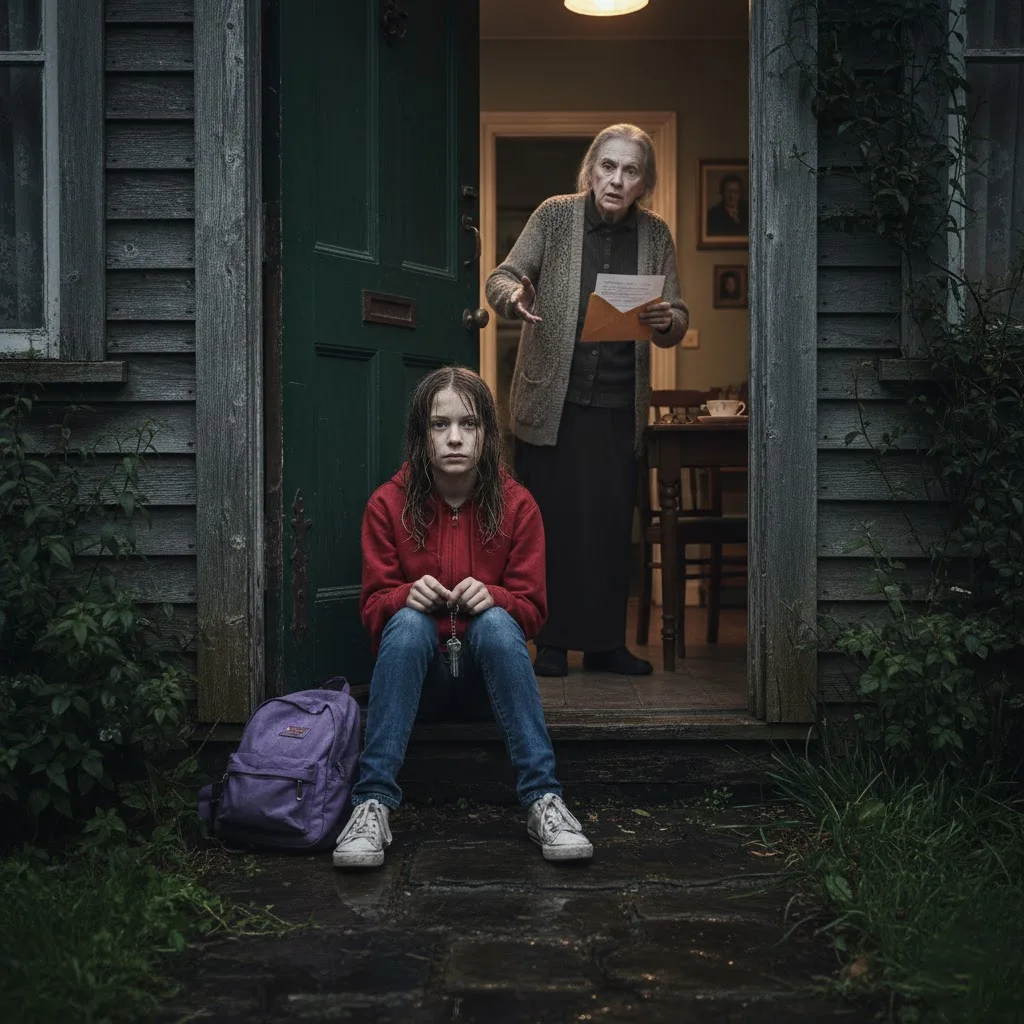
Rain hammered the porch light into a hazy coin, a small moon over an eleven-year-old girl curled beside the welcome mat like something the storm had washed up. Hannah’s hair was stringy and soaked; her knuckles were pink from knocking. The key in her fist, the one on a glittery lanyard she’d chosen herself, wouldn’t slide into the new brass mouth of the lock. She pressed the phone to her cheek. “Mom, it doesn’t fit. I think they changed it.”
The line crackled with the sound of a hospital—voices, carts, the soft hiss of sanitizer. Her mother’s voice tried to be steady and failed. “Try Grandma again. I’m leaving soon.” Hours later, the porch light buzzed. A door opened. A woman with a glass of wine lifted her chin and said, almost pleasantly, “You don’t live here anymore.” The door clicked shut; the rain kept falling. Somewhere in the city, a nurse tore off her gloves, grabbed her keys, and drove through the storm with both hands clenched white on the wheel.
It had been a house of arrangements, not a home: a place organized by schedules and grudges. Elena moved back after her father’s diagnosis—the retired doctor who smelled of coffee and disinfectant and forgiveness. She set pillboxes with the exactness of an ICU, cooked soft foods, taped charts to the fridge. In those two years, the old man’s laugh returned. He told Hannah stories, mispronounced TikTok, fell asleep during cartoons. Elena’s mother drifted through like a hostess between tables—pouring wine, fussing with throw pillows, shining at the bell of her favorite guest: Brittany, the first daughter, the favored orbit. When Brittany arrived, the house brightened theatrically. When she left, the dimmer clicked.
Then the illness ended, quickly and absolutely. Within three days the bedroom turned pale yellow. Within a week there were bunk beds where the hospital cot had been, a parade of new frames on the dresser—Brittany’s children smiling, no sign of the man who’d died there. In the kitchen, whispers: It makes sense for Brittany to live here full-time. Elena was only ever here for her father. Elena made tea and tasted metal.
Her father had planned for what he couldn’t prevent. A folder from his lawyer, Jonathan Wells, explained in tidy paragraphs what his years of absence could not: he’d placed the house in a living trust. Elena, trustee and beneficiary. Not out of spite, the lawyer said, but out of precision. He’d wanted to make sure the life he left behind had a roof.
Elena didn’t say a word. You don’t walk into a house of fresh lilies and tell the mourners the walls belong to you. She waited for a decent time to pass. Decency, in that house, had an expiration date measured in opportunism. Five days later the locks were changed and an eleven-year-old stood in the rain.
By the time Elena’s car skidded into the driveway, the storm had unstitched the day into a smear of gray. Hannah shivered on the porch, a small satellite that had been denied reentry. Elena wrapped her in her own warm, scrub-smelling jacket. The porch light clicked brighter. The door opened. Her mother stood framed in the glow, the glass in her hand making a neat circle of red against the rim. “Elena,” she said, as if surprised by an appointment she’d forgotten. “We needed privacy.”
“You locked my daughter out in the rain,” Elena said. Her voice had the brittle calm of someone balancing a tray stacked with plates.
“She’s eleven,” her mother replied. “She’s fine. We’ve decided you and Hannah don’t live here anymore. Less tension.” Behind her, Brittany leaned in, phone in hand, expression pitched to soft concern. The television flickered; Brittany’s kids lounged under Hannah’s daisy blanket—the one she’d stitched herself, petals uneven and proud. Something in Elena settled into a flat line. No pleading, no argument. “Understood,” she said, and turned away.
The car ride was quiet enough to hear the little plastic beads on Hannah’s lanyard click together. “Are we going to be okay?” the girl asked. “Of course,” Elena said. “Grandma doesn’t like me, does she?” Elena kept her eyes on the wet road. “Grandma doesn’t like anyone. It’s not a you problem.” Hannah almost smiled.
Sleep didn’t come. By dawn, adrenaline had cooled into something metallic and useful. Elena called the hospital to take leave, then called Jonathan. “She changed the locks,” she said. “Do you have the trust?” “In my car.” “Come now.”
The law, when it’s clean, is a relief. The trust was airtight; the deed indifferent to family theatrics. Jonathan drafted, printed, sealed. “Do you want to serve it?” he asked. “No,” Elena said. “I’m done knocking on that door.”
They parked halfway down the block. Jonathan walked up alone and handed over the notice. Elena watched from the car as comprehension drained the color from her mother’s face, as Brittany snatched the pages and scaled up to outrage, as Jonathan’s mouth moved in even syllables that meant, simply, you must go. That night, a second call: accusations of forgery and undue influence, an emergency petition in response, a police report attached: an eleven-year-old left in the rain. A judge signed the order before lunch. The sheriff scheduled the eviction for Friday at ten.
At 9:58, the neighborhood smelled like wet earth and mild scandal. Two deputies knocked. Elena stood by the sidewalk pretending to read something on her phone, counting the seconds. Inside, voices rose and collided. The door opened hard. “She forged everything!” her mother shouted, pointing down the walk. Brittany lifted her phone, red-eyed, like a reporter covering a war. The deputy unfolded the court order and read it in a voice tuned to neutral. Fifteen minutes to collect essentials. No, not the armoire. No, not the dining set. Essentials.
The minutes played out in a sloppy ballet: drawers yanked, bags overstuffed, a picture of the grandchildren tucked under an arm, a picture of the dead husband snatched as if it were a passport. Ryan, Brittany’s husband, muttered legal threats that evaporated in the rain. At the threshold, Elena’s mother paused and delivered the line she’d rehearsed her whole life: “I hope you’re proud.” Elena wasn’t. Pride is loud; she felt only the quiet weight of oxygen returning to a room.
A deputy turned, placed a cool set of keys in her palm, and said the three words she would replay later in the half-sleep between grief and relief: “It’s yours now.”
She opened every window and let the day pour through. Perfume thinned to dust; the rooms exhaled. She picked Hannah up from school at three. “Are we moving again?” the girl asked as the car turned onto their street. “Home,” Elena said. The word felt strange, like a sweater you forgot was yours. Inside, the echo had a pleasant kind of emptiness. Hannah ran the circuit—hall, kitchen, living room—and laughed when the sound of her feet came back to her. She found the daisy blanket folded on a chair and smoothed the stitched petals with her palm. “This is ours again,” she said. “It always was,” Elena whispered.
Six months lengthened. They blocked numbers and unlearned the twitch of checking the peephole. The gossip found them anyway—how Brittany’s house couldn’t hold two queens, how a second lockout invited a second pair of patrol cars, how a dining set posted on Marketplace turned into a public argument in the comments: You don’t even live here. History, obligingly, rhymed.
Elena and Hannah planted herbs along the fence line. Mint tried to take over; basil sulked and then forgave. On Saturdays they painted baseboards and left handprints where only they would notice. Some nights, Elena caught herself listening for a bell that would never ring again—the pill alarm, her father’s call. She stood in the pale yellow room and did not repaint it. Instead she set his books back on the shelf, not as a shrine but as ballast. The house seemed to stand a little straighter.
People think families break in a single moment—a slam of a door, a final word. More often, they fray quietly until the fabric gives, and the truth, impolite and durable, remains. A lock can be changed in ten minutes. Belonging takes longer. Elena learned the difference in the wet light of a porch where an eleven-year-old waited and was told she was not welcome. She learned it again when a deputy handed her keys with the matter-of-fact tenderness of a nurse passing a newborn across a curtain: not a prize, but a responsibility.
The trust her father signed was a legal instrument; it was also a sentence rewritten. He could not apologize for years of absence with paper, but he could choose, at the end, to name what was real. Sometimes love arrives late with neat margins and a notary stamp. Sometimes protection is quiet like that.
On an evening when the sky held its breath between blue and black, Hannah stood barefoot in the yard and announced the mint had won. Elena laughed. The sound startled her—it had room in it. Through the open windows, the house listened and was new. In the kitchen, the extra keys hung on a hook. No one rattled them. No one threatened to use them.
It is a simple story, really: a girl in the rain, a mother who drove through a storm, a house that remembered its owner. After the noise, the quiet stayed. In that quiet, things grew.
News

A Mafia Boss Threatened Dean Martin on Stage—Dean’s Reaction Was Pure Genius
A Mafia Boss Threatened Dean Martin on Stage—Dean’s Reaction Was Pure Genius Prologue: A Gun in the Spotlight Dean…

The Billionaire Had No Idea His Fiancée Was Poisoning His Son—Until the Maid Exposed Everything
The Billionaire Had No Idea His Fiancée Was Poisoning His Son—Until the Maid Exposed Everything Prologue: A Whisper That…

The Billionaire Catches Maid ‘Stealing’ Food… But When He Sees Who It’s For, He Breaks Down in Tears
The Billionaire Catches Maid ‘Stealing’ Food… But When He Sees Who It’s For, He Breaks Down in Tears Prologue:…

The Billionaire’s Fiancée Sets a Trap for the Maid — Until His Silent Daughter Exposed the Truth
The Billionaire’s Fiancée Sets a Trap for the Maid—Until His Silent Daughter Exposed the Truth Prologue: The Whisper That…

The Billionaire Went Undercover as a Gardener — Until the Maid Saved His Children from His Fiancée
Richard Whitmore’s hands trembled on the garden shears as he watched through the kitchen window. His new wife, Vanessa, stood…

Three Flight Attendants Vanished From a Vegas Hotel in 1996 — 28 Years Later a Hidden Wall Is Opened
.Every hotel, every casino, every neon-lit alley has a story, most of them ending in forgetfulness or denial. But some…
End of content
No more pages to load






