
The night was slick with rain and neon when Andrew Taylor stepped out of the gala. The glass doors of the Grand Astoria swung shut behind him, muting the hum of champagne laughter and orchestral strings. For the first time in years, he’d refused his driver and security detail. He wanted to walk—alone.
The billionaire tech founder looked out over downtown Chicago, its skyline burning in gold and blue. On any other night, he might have admired the symmetry of the streets, the way the city pulsed like circuitry. Tonight, he just wanted to breathe without being followed by cameras or calendars.
He turned down a quieter block, his footsteps echoing off the slick pavement. Somewhere behind him, the sound of another pair of shoes followed. Then two more.
When the shadows peeled themselves from the mouth of an alley, he stopped cold. One man stepped forward, the other hovering behind. The flash of metal in a trembling hand told him what he already knew.
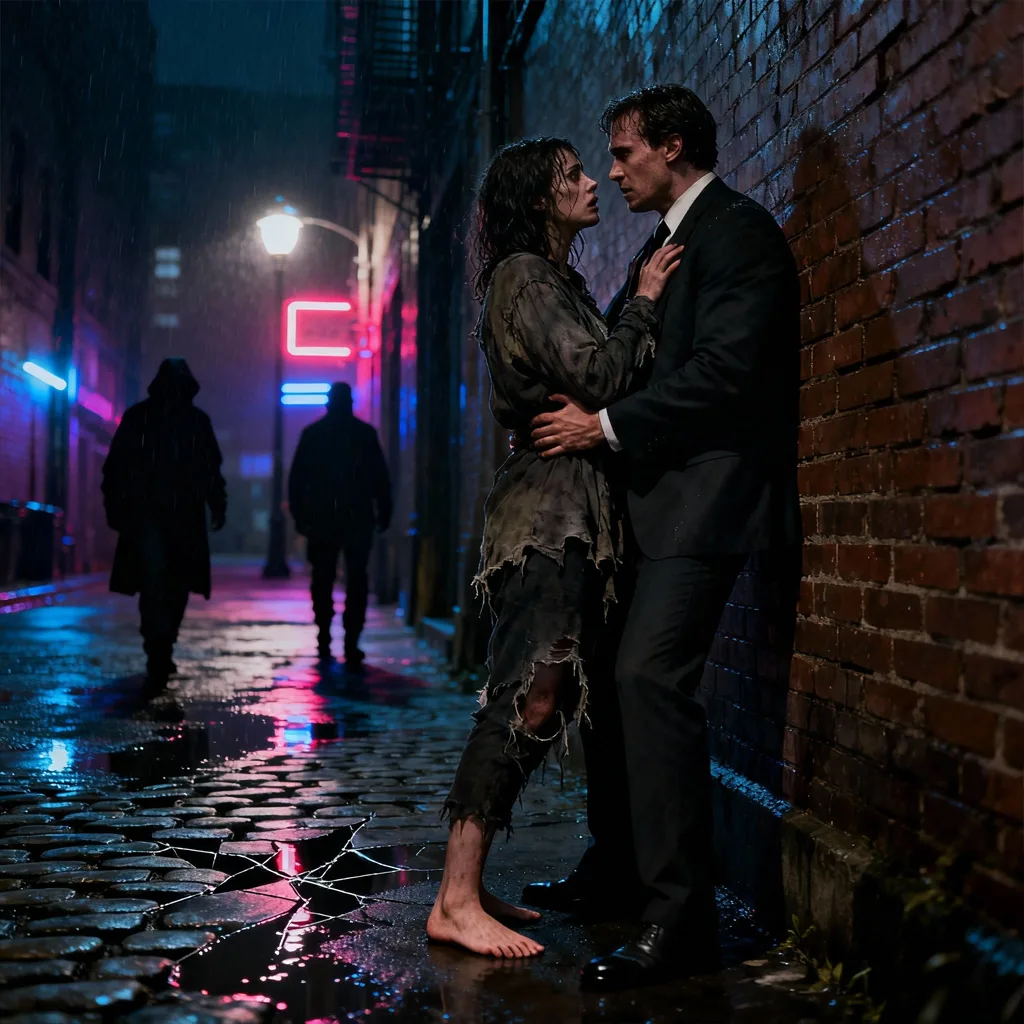
Andrew’s breath hitched.
That was when a voice came from behind him, low and urgent:
“Stand still. Don’t say anything—you’re in danger.”
He turned his head slightly. A girl stood there—thin, ragged, with tangled hair and eyes that didn’t belong to a child.
“What—”
She didn’t let him finish. “Trust me.”
Before he could react, she grabbed his arm and pulled him backward into a dark doorway, pressing herself close enough that he could feel her heartbeat. To anyone watching, they looked like two lovers stealing a moment in the shadows.
Her voice was barely a breath. “They won’t shoot if I’m in front of you.”
Andrew froze, his body rigid against hers. The men’s voices echoed down the street. A few tense seconds stretched into eternity before their footsteps receded.
When she finally stepped back, he could see her shaking. “You’re safe now,” she said, trying to sound casual. “For the moment.”
He swallowed hard. “You just saved my life.”
“Yeah, well,” she said, tucking a strand of hair behind her ear. “Don’t make a habit of walking around here alone.”
He wanted to thank her, to give her something, but she was already turning away.
“Wait—what’s your name?” he called.
She paused, glanced back, and gave a faint, defiant smile. “Lila.”
Then she vanished into the wet dark, leaving only the echo of her name behind.
The next morning, the city was bright and blameless, pretending last night never happened. Andrew sat in his corner office on the 64th floor, surrounded by glass, money, and silence. His assistant was briefing him on quarterly reports, but he wasn’t listening. All he could see was the girl in the alley—her hand gripping his sleeve, the fearlessness in her voice.
For years, Andrew had funded shelters, clinics, education programs—charity written in checks and press releases. But that girl hadn’t needed charity. She had been the one saving him.
He left the office early that day. The driver tried to follow, but Andrew waved him off and took the train downtown. He spent hours walking through the same streets, talking to shelter workers, buying meals for people who might know her.
Most didn’t.
Then, at a church shelter on the edge of the South Loop, an older volunteer nodded. “You’re looking for Lila? Tough girl. Keeps to herself. Been on the streets a while. Smart as a whip, though. She doesn’t trust anyone.”
That night, Andrew left a blanket, a note, and a gift card in the alley where she’d saved him. The note was short:
“Thank you. I’d like to see you again—on your terms. —Andrew.”
For days, there was nothing. Then, a week later, as he was walking toward his car, he felt a tap on his shoulder.
He turned—and there she was.
“You left a note,” Lila said. Her voice was guarded, her eyes sharper than he remembered.
“I did,” Andrew said softly. “I meant it.”
She crossed her arms. “You really want to meet me? Or do you just feel guilty about being rich?”
He smiled faintly. “I’ve felt guilty about worse. This isn’t about that. I just want to thank you properly.”
She studied him for a long time. “Fine. But somewhere public. No fancy restaurants.”
They ended up in a 24-hour diner, sitting across from each other in a cracked vinyl booth. The fluorescent lights buzzed overhead, casting both of them in a too-honest glow.
Over black coffee and pancakes, she told him pieces of her story. She’d run away at twelve. Group homes. Foster families. Violence. She’d learned how to survive by being invisible—until last week, when something in her refused to stay unseen.
“I didn’t save you for a reward,” she said flatly. “I just… saw the gun, and I couldn’t let it happen. People walk past each other like ghosts in this city. I didn’t want to be another one.”
Andrew listened, silent. For years, he’d built empires on code and precision, but sitting across from this girl, he realized how much of his world was built on distance.
“You remind me of someone,” he said quietly. “Of who I wanted to be before I started building walls.”
She looked away, uncomfortable. “Don’t make me a project.”
“I won’t,” he said. “I’ll make you a promise. Whatever you want—a place to stay, a job, school—you’ll have it. Not because you saved me. Because you deserve it.”
She didn’t answer. But her eyes softened, just a little.
Weeks passed. She didn’t take his money. Not at first. But she took his number. They started meeting for coffee on Wednesdays—no cameras, no attention. He learned her rhythms, her silences, her guarded humor. She learned that his power didn’t intimidate her.
By spring, she agreed to take a GED course. By summer, she was volunteering at a youth shelter, her natural leadership surfacing through the cracks of her cynicism. Andrew made quiet arrangements behind the scenes—donations in other people’s names, connections that opened doors without her ever knowing he’d turned the key.
When he attended her high school equivalency ceremony, he stood in the back, unnoticed, watching her cross the stage in borrowed shoes and a bright, defiant smile.
Years later, she invited him to the opening of her own nonprofit—The Horizon Project, a safe haven for homeless youth. The air was filled with camera flashes, applause, the hum of hope. Lila stood at the podium, her voice steady, her gaze unflinching.
“I started this because someone once told me I mattered,” she said. “He didn’t just give me a chance. He gave me the choice to build my own.”
When she stepped down, she found him in the crowd. “You came.”
“I wouldn’t have missed it,” he said.
She smirked. “You know, you’d be dead without me.”
He smiled. “Maybe. But life would’ve been meaningless without you.”
Outside the event hall, the city glowed under the same restless skyline. Two lives—one born from privilege, one carved from survival—had collided in a single act of courage on a rain-slick street.
Andrew looked at her, and in her eyes saw the reflection of the man he’d forgotten he could be.
Lila looked back, and for the first time, didn’t see a savior—just someone who’d believed she was worth saving.
Sometimes fate doesn’t arrive with thunder. Sometimes it whispers from the dark: Stand still. Don’t say anything. You’re in danger.
And sometimes, that whisper isn’t a warning.
It’s the beginning of being seen.
News

A Mafia Boss Threatened Dean Martin on Stage—Dean’s Reaction Was Pure Genius
A Mafia Boss Threatened Dean Martin on Stage—Dean’s Reaction Was Pure Genius Prologue: A Gun in the Spotlight Dean…

The Billionaire Had No Idea His Fiancée Was Poisoning His Son—Until the Maid Exposed Everything
The Billionaire Had No Idea His Fiancée Was Poisoning His Son—Until the Maid Exposed Everything Prologue: A Whisper That…

The Billionaire Catches Maid ‘Stealing’ Food… But When He Sees Who It’s For, He Breaks Down in Tears
The Billionaire Catches Maid ‘Stealing’ Food… But When He Sees Who It’s For, He Breaks Down in Tears Prologue:…

The Billionaire’s Fiancée Sets a Trap for the Maid — Until His Silent Daughter Exposed the Truth
The Billionaire’s Fiancée Sets a Trap for the Maid—Until His Silent Daughter Exposed the Truth Prologue: The Whisper That…

The Billionaire Went Undercover as a Gardener — Until the Maid Saved His Children from His Fiancée
Richard Whitmore’s hands trembled on the garden shears as he watched through the kitchen window. His new wife, Vanessa, stood…

Three Flight Attendants Vanished From a Vegas Hotel in 1996 — 28 Years Later a Hidden Wall Is Opened
.Every hotel, every casino, every neon-lit alley has a story, most of them ending in forgetfulness or denial. But some…
End of content
No more pages to load






