
Every afternoon, when the final bell rang at Brookridge Middle School, Clara Carter walked the same route home — a stretch of cracked sidewalks, maple trees shedding early autumn leaves, and the low hum of quiet Ohio suburbia. Beside her, Mia and Jordan talked about tests and teachers and the latest TikTok clips. But Clara’s attention always drifted toward the corner of Maple Park — where the woman sat.
She was always there. Wrapped in too many coats for the season, hair tangled into a dull brown nest, eyes too bright for someone so weathered. In her lap rested a small teddy bear, worn to the fabric beneath its fur.
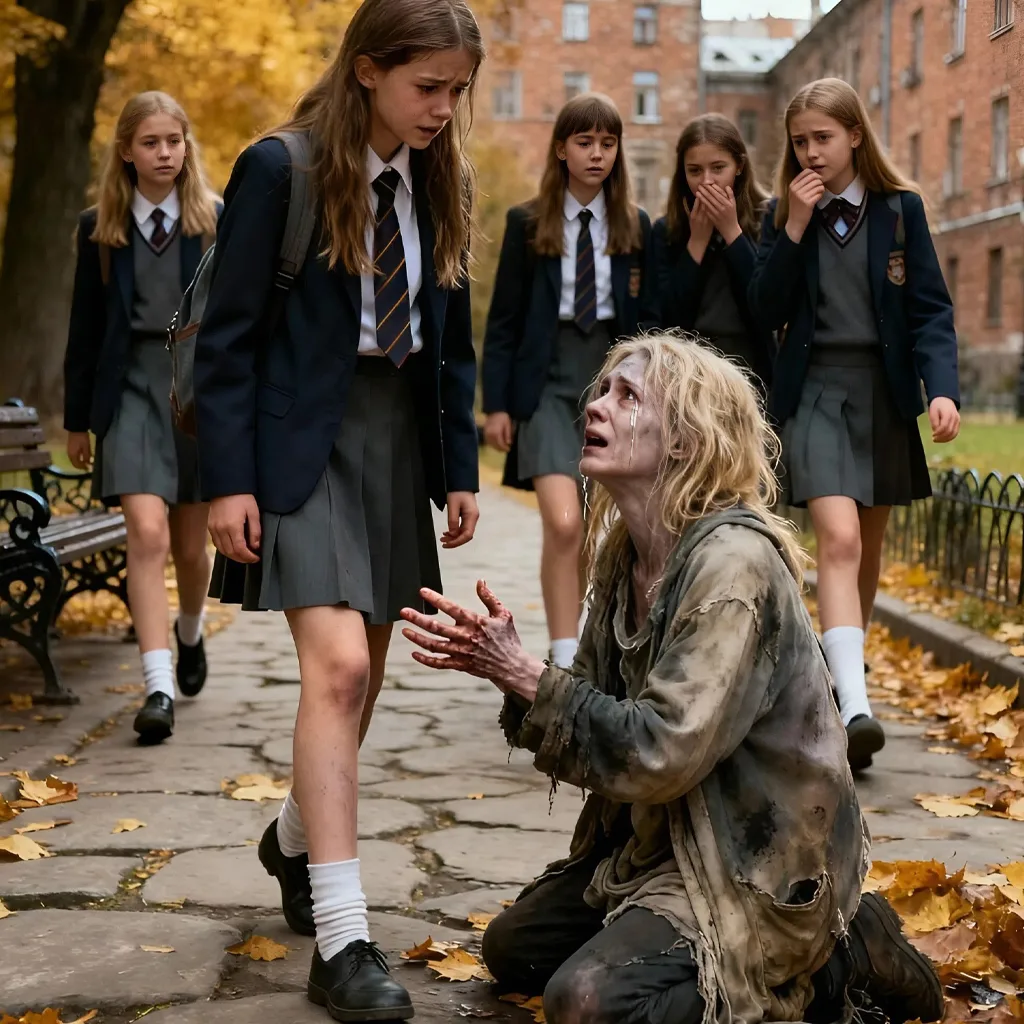
When Clara passed, the woman would suddenly come alive.
“Clara! Clara, look at me!” she’d cry, voice breaking through the ordinary afternoon air. “It’s me—your mother!”
Mia always tugged Clara’s arm. “Ignore her. She says that to everyone.”
But Clara knew that wasn’t true. The woman never said another name. Only hers.
That night, Clara lay awake, her lamp casting soft gold across the walls. The woman’s voice echoed in her mind — the way she’d said it, not like a guess, but a memory.
How did she know my name?
Clara’s life, on paper, was good. Perfect, even. Mark and Elaine Carter — her adoptive parents — were the kind of people neighbors described as “solid.” Elaine baked for fundraisers, Mark never missed a PTA meeting. They hugged her, showed up for her recitals, filled every silence with care.
There were family photos in every room — vacations, Christmas mornings, goofy smiles. To anyone else, it was a home built on love. But sometimes, in the middle of dinner, when Elaine would reach across the table and touch her hand, Clara would wonder: What if someone else used to hold me like that?
The woman from the park haunted her like a half-remembered dream. There was a word she’d shouted once that stuck in Clara’s chest: Star. It meant nothing, yet when she heard it, she felt something deep and familiar move inside her.
The question began as a whisper in her mind, then grew into a storm she couldn’t silence.
It happened after the rain. The sky was gray and heavy when Clara dropped her notebook in a puddle near Maple Park. She bent down to grab it, but the woman was already there — crouched beside her, holding the soggy pages like something precious.
“You have your father’s eyes,” the woman murmured. “They told me you died.”
Clara froze. “What did you say?”
The woman looked up, and for the first time, Clara saw no madness — only grief so sharp it cut the air between them.
“They took you from me,” she whispered. “They said I was unfit. They told me you were gone. But you’re here. My baby. My Star.”
The world tilted. The rain, the noise, the smell of wet leaves — all of it vanished into a pulse of disbelief. Star. She remembered it now — the faint hum of a lullaby from when she was barely more than a toddler.
She ran home, heart hammering.
“Who is she?” she demanded the moment she burst through the front door. “How does she know about my birthmark? Why does she call me Star?”
Elaine and Mark exchanged a look so heavy it collapsed the air.
Finally, Elaine spoke, her voice small and trembling. “Clara… there are things we never told you.”
The doorbell rang before she could say more.
Mark opened it — and there she was. The woman from the park, rain dripping from her sleeves, eyes desperate but steady.
“Please,” she said. “Just let me speak to her.”
Elaine’s face crumpled. “Lydia,” she whispered.
Clara’s heart stopped. “You know her?”
The room filled with the kind of silence that can’t be undone.
They sat her down. Elaine on one side, Mark on the other, and Lydia across from her — a stranger and yet not at all.
Mark began carefully. “When you were two, you were in a children’s shelter. The records said your mother was unstable, unable to care for you. We were told she’d given up her rights.”
“That’s not true,” Lydia said, voice shaking but clear. “I was in a car accident. I was in a coma for three months. When I woke up, my baby was gone. They said she’d been placed permanently. I searched for years. No one believed me.”
Clara’s breath hitched. “So I wasn’t abandoned?”
Lydia’s tears came fast. “Never. I never stopped looking.”
Elaine buried her face in her hands. “I should’ve told you. I just— I was afraid of losing you.”
Over the next weeks, Clara lived in a strange limbo between two lives. She met Lydia in cafés, at parks, in the library. Lydia told her about her father, who had died before she was born. She sang her the lullaby that ended with the word Star. She told her about the yellow baby blanket she’d sewn herself — the one that still sat in Clara’s room, unexplained.
Every detail was real. Too real.
In time, Mark and Elaine stopped trying to guard her from it. They began coming along, quietly, as if trying to understand the pieces of the story themselves. It wasn’t simple. There were tears, guilt, apologies that came out clumsy and unfinished. But something new began to grow — not forgiveness yet, but space for it.
One Saturday afternoon, Clara made a choice.
“I want to bring Lydia here,” she said. “I want us to talk. All of us.”
Elaine hesitated, then nodded.
When Lydia arrived, she stood on the porch, unsure if she belonged. Clara took her hand and led her inside.
For a long time, no one spoke. The house, so full of memories, felt like it was holding its breath.
Then Elaine said softly, “I’m sorry. I should have tried to find you. I should have told her the truth.”
Lydia wiped her eyes. “You loved her. I can see that. I don’t want to take her away. I just want to know her.”
Mark, usually the quiet one, finally said, “Maybe she deserves both of you.”
Clara reached out and joined their hands — Elaine’s and Lydia’s — across the space that had once divided her life.
The sound of rain tapped against the windows. For the first time, it didn’t feel like an ending.
In the months that followed, Lydia moved into transitional housing and started receiving help. The Carters helped her find medical care, a job, and a second chance at stability. She began to regain her footing in the world — piece by piece, like a photograph slowly coming back into focus.
Clara spent weekends with her, learning things she didn’t know she’d forgotten — her favorite nursery rhyme, her father’s laugh, the way Lydia used to hum while folding laundry. At home, Elaine and Mark remained her parents, her anchors. But now, her world was wider.
By her fifteenth birthday, it was no longer about choosing sides. It was about acknowledging truths that had been buried too long.
That day, the four of them — Lydia, Elaine, Mark, and Clara — stood together for a photo. Lydia’s arm rested gently around her daughter’s shoulder; Elaine’s hand, warm and steady, held Clara’s.
Clara smiled — the quiet, grounded smile of someone who finally knew where she came from.
Later that night, she posted the photo with a caption that read simply:
Family isn’t just who raises you, or who gives you life. It’s who refuses to stop searching for you — even when the world tells them to give up.
It was the kind of truth that didn’t need to be explained. It just needed to be lived.
News
A Mafia Boss Threatened Dean Martin on Stage—Dean’s Reaction Was Pure Genius
A Mafia Boss Threatened Dean Martin on Stage—Dean’s Reaction Was Pure Genius Prologue: A Gun in the Spotlight Dean…
The Billionaire Had No Idea His Fiancée Was Poisoning His Son—Until the Maid Exposed Everything
The Billionaire Had No Idea His Fiancée Was Poisoning His Son—Until the Maid Exposed Everything Prologue: A Whisper That…
The Billionaire Catches Maid ‘Stealing’ Food… But When He Sees Who It’s For, He Breaks Down in Tears
The Billionaire Catches Maid ‘Stealing’ Food… But When He Sees Who It’s For, He Breaks Down in Tears Prologue:…
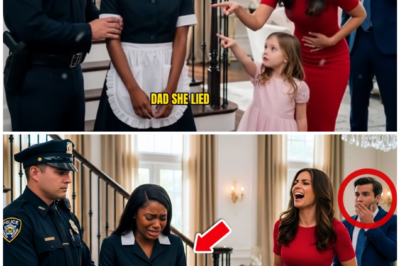
The Billionaire’s Fiancée Sets a Trap for the Maid — Until His Silent Daughter Exposed the Truth
The Billionaire’s Fiancée Sets a Trap for the Maid—Until His Silent Daughter Exposed the Truth Prologue: The Whisper That…
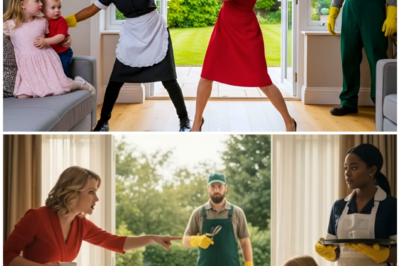
The Billionaire Went Undercover as a Gardener — Until the Maid Saved His Children from His Fiancée
Richard Whitmore’s hands trembled on the garden shears as he watched through the kitchen window. His new wife, Vanessa, stood…
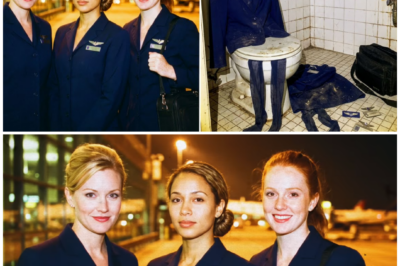
Three Flight Attendants Vanished From a Vegas Hotel in 1996 — 28 Years Later a Hidden Wall Is Opened
.Every hotel, every casino, every neon-lit alley has a story, most of them ending in forgetfulness or denial. But some…
End of content
No more pages to load






