
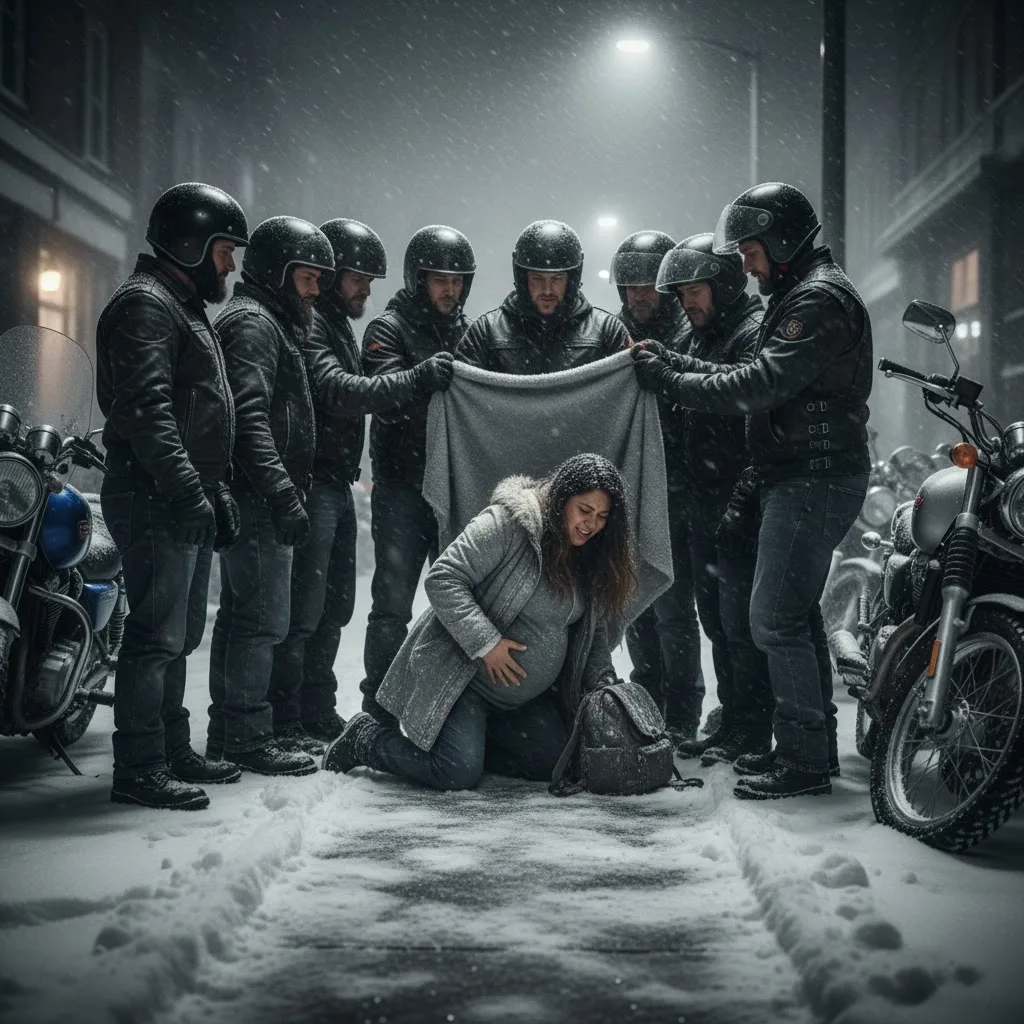
The city had gone white. Snow came down in sheets so thick it erased the horizon, swallowing cars, stoplights, and sound. Wind scraped the corners of buildings, making the world feel smaller, tighter—like breathing through a straw. On the corner of 5th and Main, beneath a flickering streetlamp, Samantha Rivera crouched against a wall, her thin coat stiff with frost. She was twenty-nine, pregnant, and alone. Her breath came in short bursts that steamed the air.
The contractions had started an hour earlier. At first, she’d told herself it was false labor—that she could make it to the shelter before the storm closed in. But now, the pain rolled through her in waves too deep to ignore. The city had emptied; taxis were ghosts, buses canceled. No one stopped.
“Please,” she whispered, her voice lost to the wind. “Not here. Not like this.”
Her gloved hands pressed against her belly as if she could hold time still. The snow fell harder, dizzying in its persistence. Somewhere nearby, an engine roared—one, then another, then several more, the sound growing until it drowned out the storm.
Through the blur of white came ten motorcycles, headlights cutting long golden lines through the snow. They moved as one, a strange cavalry in black leather and chrome. When they stopped, the night went quiet except for the hiss of cooling engines.
“Ma’am,” said a deep voice, “you’re not moving another inch. We’ve got you.”
The man who spoke was Jack “Hawk” Thompson, leader of the Iron Vultures Motorcycle Club—a name that made headlines for charity rides and blood drives as often as for the noise complaints that followed their arrival. They looked like trouble: tattoos, boots, the smell of oil and wind. But under the streetlight, their faces were raw with concern.
Sam blinked up at them, confusion cutting through her panic. “Who are you?”
“Friends,” Hawk said simply, kneeling beside her. His breath came out in small clouds. “You’re in labor. We’re staying right here.”
The bikers formed a ring around her, bodies blocking the wind. One tore off his jacket and wrapped it around her shoulders. Another spread blankets on the icy ground. Someone called 911, shouting into the storm, “She’s crowning, for God’s sake, hurry!”
Neighbors, watching from their windows, saw only shapes—a woman, a circle of bikers, the storm collapsing around them. A few turned away, unsure what they were witnessing. Others stayed, faces pressed to glass, waiting for something to happen.
Minutes became elastic. Sam’s cries mingled with the wind, with the men’s low, steady voices. They spoke to her the way people do when fear must be tamed. “You’re doing great.” “Almost there.” “Breathe with me, sweetheart.”
And then, in one fierce, final push, the sound came—a newborn’s cry, sharp and alive against the silence of snow.
For a moment, no one moved. The storm itself seemed to pause. Hawk took off his gloves, hands trembling as he handed Sam her child—a small, red, perfect boy. The baby wailed once, then settled against his mother’s chest, skin to skin beneath layers of borrowed leather.
Sam looked up at her circle of unlikely guardians, tears freezing on her cheeks. “You stayed,” she whispered.
Hawk nodded. “We always stay.”
The paramedics arrived minutes later, lights pulsing weakly through the storm. They pushed through the ring of bikers and stopped, astonished. A homeless woman, a newborn, and ten leather-clad men—snow swirling around them like confetti at the end of some wild parade.
“She’s stable,” said one paramedic, kneeling. “And the baby’s perfect.”
As they lifted Sam onto a stretcher, Hawk adjusted her blanket, tucking it close around her shoulders. She caught his wrist. “Thank you,” she said, her voice raw.
“Don’t thank me,” he said. “Just keep that little one warm.”
By morning, the story had outrun the storm. Photos circulated online: the Iron Vultures standing guard as paramedics carried mother and child away, snow drifting over their boots. Headlines called them heroes. The bikers shrugged it off. “We were just passing through,” Hawk told a reporter. But anyone who saw the footage knew better.
When Sam woke in the hospital, the world was soft again. The snow had stopped. Her baby—her son—slept in a bassinet beside her. The nurse told her the bikers had waited outside the ER until dawn, then disappeared quietly into the morning.
She named the baby Hawk.
The days that followed blurred together: diapers, warmth, the surreal comfort of being safe. Then, one afternoon, the door opened and the Iron Vultures filed in—awkward and huge, carrying a bouquet of sunflowers that looked absurd in their hands. Hawk grinned. “We figured we’d check on our newest member.”
They brought supplies: baby formula, winter coats, a car seat one of their wives had donated. The club’s mechanic offered to help find her housing through a shelter network they funded each winter. Sam, who had lived invisible for so long, didn’t know how to respond to so much kindness.
“I don’t know how to repay you,” she said.
“You already did,” Hawk replied. “You fought for him. You survived. That’s enough.”
In the months that followed, the Iron Vultures became her family. They visited weekly, fixed her leaky sink, babysat when she had job interviews. Hawk—the man she’d named her son after—taught her how to ride a motorcycle in a parking lot one spring afternoon. She laughed more in those months than she had in years.
Word of the storm birth spread far beyond the city. Donations poured into shelters. Neighbors who once crossed the street to avoid the homeless began stopping to talk, to listen. The night’s story had changed something in the city—a small calibration of empathy.
By the next winter, Sam and her son had a modest apartment on the east side. The bikers helped her move in. When they left, Hawk pressed a worn patch into her hand: the Iron Vultures emblem, wings outstretched.
“For when you need reminding,” he said. “That someone’s always got your back.”Years later, when the boy named Hawk asked his mother why she smiled every time it snowed, Sam told him the story. About the night the city disappeared in white, about strangers who became salvation, about how sometimes the loudest engines carry the gentlest souls.
He listened wide-eyed, clutching her hand. “They saved me,” he said.
Sam nodded. “They saved both of us.”
Outside, snow began to fall again—slow, patient flakes that softened the streets. Somewhere, the low rumble of motorcycles echoed down Main Street, fading into the distance.
In a world quick to judge by appearances, the Iron Vultures had rewritten the script. They had shown that mercy could wear leather and ride through storms. That heroism didn’t need polish or permission—it only needed presence.
When Sam walks past 5th and Main now, she pauses at the corner where it all began. The city is the same, but she is not. She looks at her son running ahead, his laughter bright against the cold, and she thinks of the circle of men who stood against the snow to make room for a new life.
Some stories don’t need monuments. Just memory.
And in hers, ten engines still roar against the wind, refusing to leave anyone behind.
News

A Mafia Boss Threatened Dean Martin on Stage—Dean’s Reaction Was Pure Genius
A Mafia Boss Threatened Dean Martin on Stage—Dean’s Reaction Was Pure Genius Prologue: A Gun in the Spotlight Dean…

The Billionaire Had No Idea His Fiancée Was Poisoning His Son—Until the Maid Exposed Everything
The Billionaire Had No Idea His Fiancée Was Poisoning His Son—Until the Maid Exposed Everything Prologue: A Whisper That…

The Billionaire Catches Maid ‘Stealing’ Food… But When He Sees Who It’s For, He Breaks Down in Tears
The Billionaire Catches Maid ‘Stealing’ Food… But When He Sees Who It’s For, He Breaks Down in Tears Prologue:…

The Billionaire’s Fiancée Sets a Trap for the Maid — Until His Silent Daughter Exposed the Truth
The Billionaire’s Fiancée Sets a Trap for the Maid—Until His Silent Daughter Exposed the Truth Prologue: The Whisper That…

The Billionaire Went Undercover as a Gardener — Until the Maid Saved His Children from His Fiancée
Richard Whitmore’s hands trembled on the garden shears as he watched through the kitchen window. His new wife, Vanessa, stood…

Three Flight Attendants Vanished From a Vegas Hotel in 1996 — 28 Years Later a Hidden Wall Is Opened
.Every hotel, every casino, every neon-lit alley has a story, most of them ending in forgetfulness or denial. But some…
End of content
No more pages to load






