
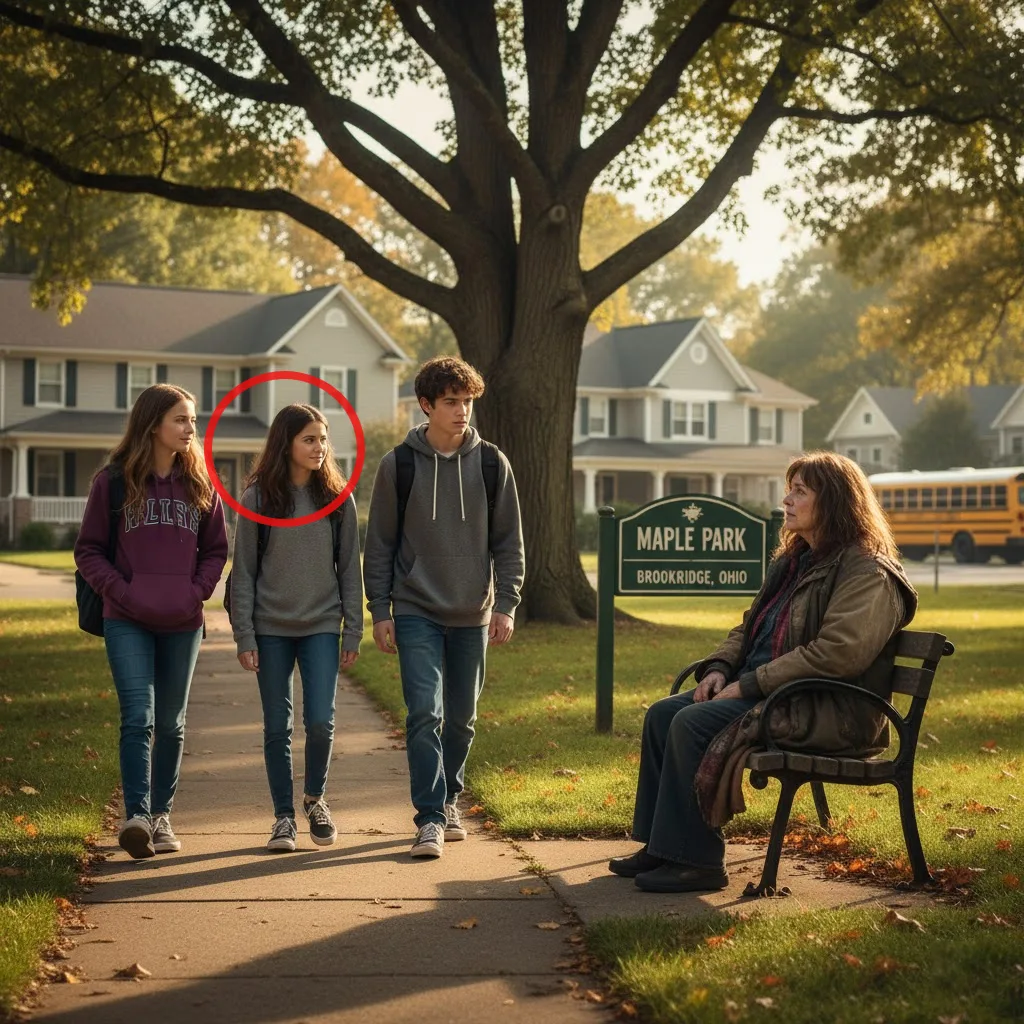
 The school bell always rang the same way — sharp, final, echoing down the polished hallways of Brookridge Middle School. Every afternoon, Clara Carter, fourteen, slung her backpack over one shoulder and walked home with her two best friends, Mia and Jordan. They took the same route every day, cutting through Maple Park, a small patch of grass and benches framed by tired oaks.
That’s where she always was.
A woman sat on the far corner bench, bundled in mismatched coats, hair tangled, eyes darting at every sound. She never spoke to anyone — except Clara.
“Clara! Clara, look at me!” the woman would cry, her voice hoarse. “It’s me — your mother!”
People stared. Mia would grip Clara’s wrist, whispering, “Ignore her. Don’t look.” But Clara always did — just a glance — and every time, she saw something haunting in the woman’s face. Recognition.
At home, Clara’s life was everything that word was supposed to mean: safe, warm, predictable. Her adoptive parents, Mark and Elaine Carter, were kind, attentive people. Mark packed her lunches; Elaine left notes in her textbooks. Their suburban house was filled with sunlight and laughter — a far cry from the sadness that lingered on that park bench.
Yet the woman’s voice wouldn’t leave her.
One afternoon, while walking through Maple Park in the rain, Clara dropped her notebook. As she bent to grab it, a pair of trembling hands reached down first. It was her — the woman from the bench.
“You have your father’s eyes,” she whispered.
Clara froze. “What did you say?”
The woman’s expression softened, grief flashing through her eyes. “They told me you died,” she murmured. “They took you from me, Star.”
The name hit Clara like a jolt. Star. A word that had no reason to mean anything — yet stirred something deep and aching inside her. A lullaby half-remembered. A voice she’d heard long ago.
Terrified, Clara ran all the way home, drenched and shaking.
That night, she confronted her parents.
“Who is that woman?” she demanded. “Why does she know about the birthmark behind my ear? Why did she call me Star?”
Elaine’s face turned ashen. Mark set down his coffee. Silence pooled between them.
“Clara,” Elaine began, “there are things we’ve never told you.”
Before she could say more, the doorbell rang.
When Mark opened it, rain poured in — and standing in the doorway was the woman from the park.
Her clothes clung to her skin. Her hands shook as she clutched a small, tattered teddy bear. “Please,” she said, voice raw. “I need to see her. Just once.”
Mark stepped in front of Clara. “You need to leave.”
Then Elaine’s voice broke. “Lydia,” she whispered. “You can’t keep doing this.”
Clara’s heart dropped. “You know her?”
The truth unraveled like a thread pulled too tight. Lydia — her birth mother — had been found unfit to care for her when Clara was two. But Lydia spoke over Elaine’s trembling words.
“I never abandoned her,” Lydia cried. “I was in a car accident. In a coma for three months. When I woke up, my baby was gone. They told me she was adopted — that she’d been lost to me forever.”
Clara stared, the room spinning. She turned to her parents, who sat pale and silent. “You knew?”
Elaine’s voice cracked. “We were told you’d been abandoned. By the time I learned the truth… you were ours. I didn’t know how to undo it.”
Lydia took a step forward, her tears falling freely. “I searched hospitals, shelters, anywhere that might tell me where you were. No one believed me.”
The three stood there — the woman who’d given Clara life, the one who’d raised her, and the girl caught in between.
The following days were heavy with silence. Clara barely spoke at dinner. She avoided the park, avoided questions, avoided mirrors. But inside her, something restless stirred — a need to understand, not just to forgive.
So she found Lydia.
At first, they met in public places — a library, a diner booth, a quiet bench in the park. Lydia told her stories of her father, who had died before Clara was born, and of the small apartment they once shared filled with music and laughter. She told her about the lullaby she’d sung every night — “You’re my star, my light, my forever.”
Every word unlocked another buried memory — a melody Clara hadn’t realized she remembered, a smell, a tone of voice.
Back home, Mark and Elaine watched her change — softer, quieter, but also steadier. They worried, of course, but they also began to understand. Secrets, they realized, had protected no one.
One Saturday, Clara did something no one expected. “I want her to come here,” she said. “All of us — together.”
When Lydia arrived, she stood hesitantly in the doorway, as though one wrong move might shatter everything. Clara took her hand and led her inside.
The living room was silent. Then Elaine, her voice trembling, said, “I should have tried to find you. I should have told her the truth. I was scared. But I’m sorry.”
Lydia’s chin quivered. “I know you love her. I can see that. I don’t want to take her away. I just want to know her again.”
Mark looked between them — the mother who’d lost her child, and the one who’d found her. “Maybe,” he said quietly, “she deserves both of you.”
Clara reached out, taking both their hands. And for the first time, the space between love and loss didn’t feel like a divide — it felt like a bridge.
In the months that followed, Lydia moved into an apartment nearby with the help of the Carters. She began working at a local daycare, rebuilding her life piece by piece. The Carters visited often.
Clara spent weekends with her — learning how to cook Lydia’s favorite dishes, listening to old songs, rediscovering the parts of herself that had been lost.
And yet, nothing about her bond with Mark and Elaine faded. It deepened, reshaped by truth rather than illusion. The family didn’t return to what it had been — it became something new.
On Clara’s fifteenth birthday, all three of her parents stood beside her as she blew out the candles. In the photo, Lydia’s hand rests on her shoulder, and Elaine’s arm wraps around them both.
Later, Clara posted the picture online. The caption read simply:
“Family isn’t who you come from or who you end up with. It’s who never stops searching for you — and who stays when you’re found.”
That night, the stars outside her window shimmered brighter than usual. Somewhere, a lullaby echoed in her memory — the same one that had once been whispered through a hospital room and a lifetime apart.
And for the first time, she felt whole.
News

A Mafia Boss Threatened Dean Martin on Stage—Dean’s Reaction Was Pure Genius
A Mafia Boss Threatened Dean Martin on Stage—Dean’s Reaction Was Pure Genius Prologue: A Gun in the Spotlight Dean…

The Billionaire Had No Idea His Fiancée Was Poisoning His Son—Until the Maid Exposed Everything
The Billionaire Had No Idea His Fiancée Was Poisoning His Son—Until the Maid Exposed Everything Prologue: A Whisper That…

The Billionaire Catches Maid ‘Stealing’ Food… But When He Sees Who It’s For, He Breaks Down in Tears
The Billionaire Catches Maid ‘Stealing’ Food… But When He Sees Who It’s For, He Breaks Down in Tears Prologue:…

The Billionaire’s Fiancée Sets a Trap for the Maid — Until His Silent Daughter Exposed the Truth
The Billionaire’s Fiancée Sets a Trap for the Maid—Until His Silent Daughter Exposed the Truth Prologue: The Whisper That…

The Billionaire Went Undercover as a Gardener — Until the Maid Saved His Children from His Fiancée
Richard Whitmore’s hands trembled on the garden shears as he watched through the kitchen window. His new wife, Vanessa, stood…

Three Flight Attendants Vanished From a Vegas Hotel in 1996 — 28 Years Later a Hidden Wall Is Opened
.Every hotel, every casino, every neon-lit alley has a story, most of them ending in forgetfulness or denial. But some…
End of content
No more pages to load






