
Rain hammered the windshield in relentless sheets, turning the quiet Portland street into a blur of gray and silver. The wipers moved in slow, rhythmic arcs, slicing through the downpour. Inside the patrol car, Officers Daniel Harris and Olivia Price sat in silence, the kind of silence that fills the space between one emergency and the next. It was nearly midnight, the kind of hour when most of the city slept and only the lost were awake.
Then, out of the rain, a small figure appeared. A girl—barefoot, hair plastered to her face—running full tilt toward their car. Her feet slapped against the pavement, splashing through puddles. She pounded on the window with tiny fists, her voice breaking through the storm.
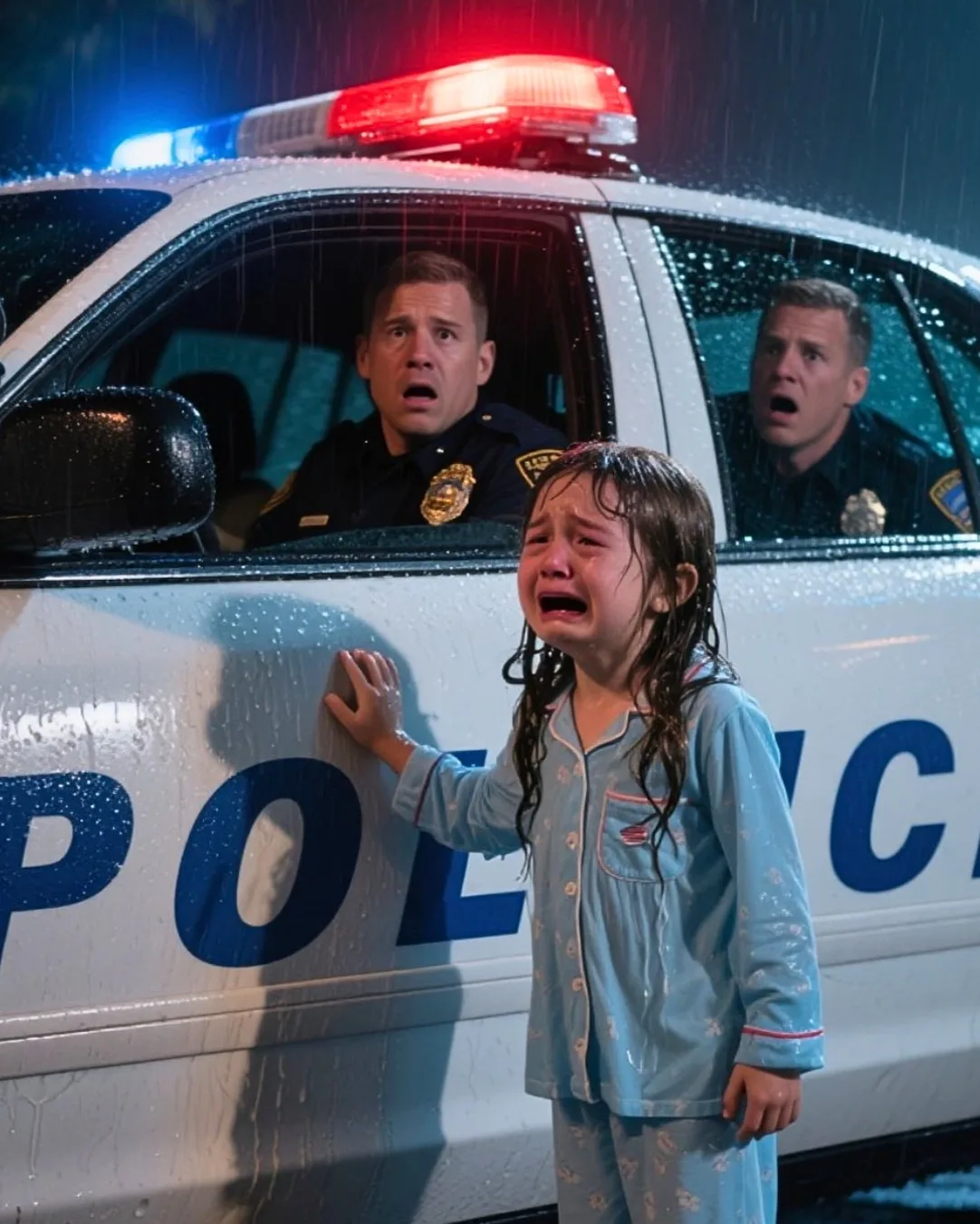
“Please come home with me! My mom—she won’t wake up!”
Daniel was out of the car before Olivia could react. The child’s voice carried a kind of panic that cuts straight through procedure. He crouched beside her, lowering himself to her trembling height.
“Hey, sweetheart. What’s your name?”
“Lily,” she sobbed. “Lily Anderson. Please, hurry.”
The rain soaked through Daniel’s uniform in seconds. “Show us where, Lily.”
They followed her through winding, narrow streets—her small figure darting ahead, barefoot against the cold asphalt. The neighborhood was old, the kind where every porch light flickered and every window told a story no one wanted to share. When they reached her house, the front door was open just enough to whisper danger.
The smell hit them first: metallic, heavy. The unmistakable scent of blood.
“Police,” Olivia called out. No answer.
The living room was dim, a lamp knocked over, a family photo frame shattered on the floor. The smiling faces in the picture—Lily, a woman with kind eyes, a man with his arm around her—were ghosts now.
In the kitchen, Olivia froze. A woman lay sprawled across the tiles, blood seeping outward in slow red rivers. A broken wine bottle glinted nearby.
Daniel checked for a pulse. Nothing. “Deceased female,” he said into his radio, his voice steadier than his shaking hands.
Lily stood at the doorway, holding a stuffed bear to her chest. Her lip quivered. “Did I do something wrong?”
Daniel turned, his throat tight. “No, honey. You did everything right.”
He looked toward the hallway. A man’s jacket. A shattered lamp. A hole in the wall where someone’s fist had landed.
Detective Rachel Monroe arrived within the hour, rain still clinging to her coat. By then, the coroner’s van idled outside, its back doors yawning open like a wound. Lily sat in the patrol car, wrapped in a blanket, her eyes too old for seven.
“Name’s Laura Anderson,” Olivia briefed her. “Thirty-three. Multiple contusions. Likely blunt-force trauma. Neighbors heard shouting before the storm.”
Rachel nodded grimly. Domestic. It always came back to that word.
In the back room, an officer bagged muddy footprints—men’s size 11 boots. On the kitchen table sat two wine glasses, one half full, the other shattered.
Jason Anderson. The husband. Unemployed. Prior domestic disturbance calls, no charges pressed. The story was as familiar as it was sickening.
“Put out an alert,” Rachel ordered.
By morning, they found his truck abandoned twenty miles north, near a rest stop by the highway. Beer bottles littered the front seat. A photo of Lily was taped to the dashboard, smiling through the silence. Jason was nowhere to be found.
Back at the station, Rachel sat with the girl. The room was small, warm, safe—or meant to be. Lily clutched her bear, her voice trembling.
“Daddy was yelling. Mommy told me to hide in the closet. Then I heard her scream.”
Rachel’s hand froze mid-note. “You were very brave, Lily.”
Lily looked up, her eyes glassy. “Is Mommy still sleeping?”
Rachel’s throat burned. “She’s resting now, sweetheart.”
That night, a search team combed the woods near the rest stop. The storm had passed, leaving only the smell of wet pine and gasoline. It was past midnight when the radio crackled.
“Unit 5 to Command—we’ve found him.”
Jason Anderson was hanging from a tree branch, his body swaying gently in the wind. In his hand: the same photo from his dashboard. The ink had bled from the rain, the faces blurred together.
Days later, the sun returned as if the sky had forgotten what it witnessed. The Anderson house sat cordoned off with yellow tape, its windows reflecting nothing. The news cycle moved fast—tragic story, familiar pattern—but the echoes of that night stayed with those who’d seen it.
Lily moved in with her aunt, Rebecca Moore. The woman met Rachel outside the courthouse one afternoon, her voice barely above a whisper. “She’s been having nightmares. Keeps waking up screaming her mom’s name. But…” she paused, managing a thin smile. “She says she wants to be a police officer. To help other kids like her.”
Rachel swallowed hard. “She already has.”
The case file closed, the paperwork finished, but the weight of it lingered. Domestic violence cases always left ghosts in their wake—the kind that didn’t show up in reports. The kind that haunted officers in the silence of their drives home.
A week later, Rachel found an envelope on her desk. It was small, addressed in crayon. Inside was a note written in uneven letters.
“Dear Detective Rachel,
Thank you for helping my mommy. I miss her, but I’m not scared anymore.
Love, Lily.”
Rachel read it twice before folding it neatly and placing it beside her badge. Outside, sirens wailed somewhere far away, blending into the city’s hum.
Rain has a way of washing things clean, but it never truly erases. It only blurs the lines long enough for us to forget what was underneath. That night, a little girl ran through a storm because love was louder than fear. She didn’t know the word “bravery.” She just knew her mother needed help.
Lily Anderson became the face of something larger—an innocence carved out of tragedy, a reminder that behind every statistic is a heartbeat that once believed the world was safe.
Years later, when Rachel thought about that night, she never remembered the crime scene or the reports or the headlines. She remembered the small knock on the glass. The trembling voice. The girl who saved what little light was left in a home already gone dark.
Because sometimes, heroism doesn’t wear a badge or carry a gun. Sometimes it runs barefoot through the rain, clutching a stuffed bear, refusing to let silence win.
News

A Mafia Boss Threatened Dean Martin on Stage—Dean’s Reaction Was Pure Genius
A Mafia Boss Threatened Dean Martin on Stage—Dean’s Reaction Was Pure Genius Prologue: A Gun in the Spotlight Dean…

The Billionaire Had No Idea His Fiancée Was Poisoning His Son—Until the Maid Exposed Everything
The Billionaire Had No Idea His Fiancée Was Poisoning His Son—Until the Maid Exposed Everything Prologue: A Whisper That…

The Billionaire Catches Maid ‘Stealing’ Food… But When He Sees Who It’s For, He Breaks Down in Tears
The Billionaire Catches Maid ‘Stealing’ Food… But When He Sees Who It’s For, He Breaks Down in Tears Prologue:…

The Billionaire’s Fiancée Sets a Trap for the Maid — Until His Silent Daughter Exposed the Truth
The Billionaire’s Fiancée Sets a Trap for the Maid—Until His Silent Daughter Exposed the Truth Prologue: The Whisper That…

The Billionaire Went Undercover as a Gardener — Until the Maid Saved His Children from His Fiancée
Richard Whitmore’s hands trembled on the garden shears as he watched through the kitchen window. His new wife, Vanessa, stood…

Three Flight Attendants Vanished From a Vegas Hotel in 1996 — 28 Years Later a Hidden Wall Is Opened
.Every hotel, every casino, every neon-lit alley has a story, most of them ending in forgetfulness or denial. But some…
End of content
No more pages to load






