
The ocean threw its breath against the glass as the last light fell into the Pacific, and Eleanor Hayes watched a red napkin tremble in the wind of a passing waiter. Her wineglass, half-full and perfectly still, caught a moving reflection—two boys hovering at the lip of her table on the cliffside patio. Rail-thin. Sunburned. Sneakers gray with road dust. “Ma’am,” the taller one asked, voice careful as if he didn’t trust the sound of it, “could we maybe have your leftovers?” She lifted her eyes and her hand went slack. A silver fork rang once against porcelain and then the world narrowed to two faces. Same cowlick skewing right. Same solemn, storm-gray eyes. Same crescent scar notched in the left eyebrow where a coffee table had once won a fight. Eleanor’s breath misfired. Eight years vanished. In their place: pancakes cooling on a Chicago counter; a golden retriever shedding sunshine on the floor; a red bike clattering against cement; a police station clock refusing to move. The taller boy swallowed. “We haven’t eaten since yesterday.”
After the boys disappeared from a crowded park, the city was an endless grid of flyers and false sightings. The au pair had turned away for one phone call; a second was all it took to steal a lifetime. The marriage didn’t make it through the search. Neither did her old career. The tech company had come later, almost by accident—sleepless nights poured into an app, luck catching like flint. Money filled the space where answers did not. She bought time with private detectives and lost it with every birthday that passed unlit. Lucas and Noah would be fifteen now, if time had the decency to keep going in a straight line. It didn’t. It pooled in strange places and evaporated where you needed it most.
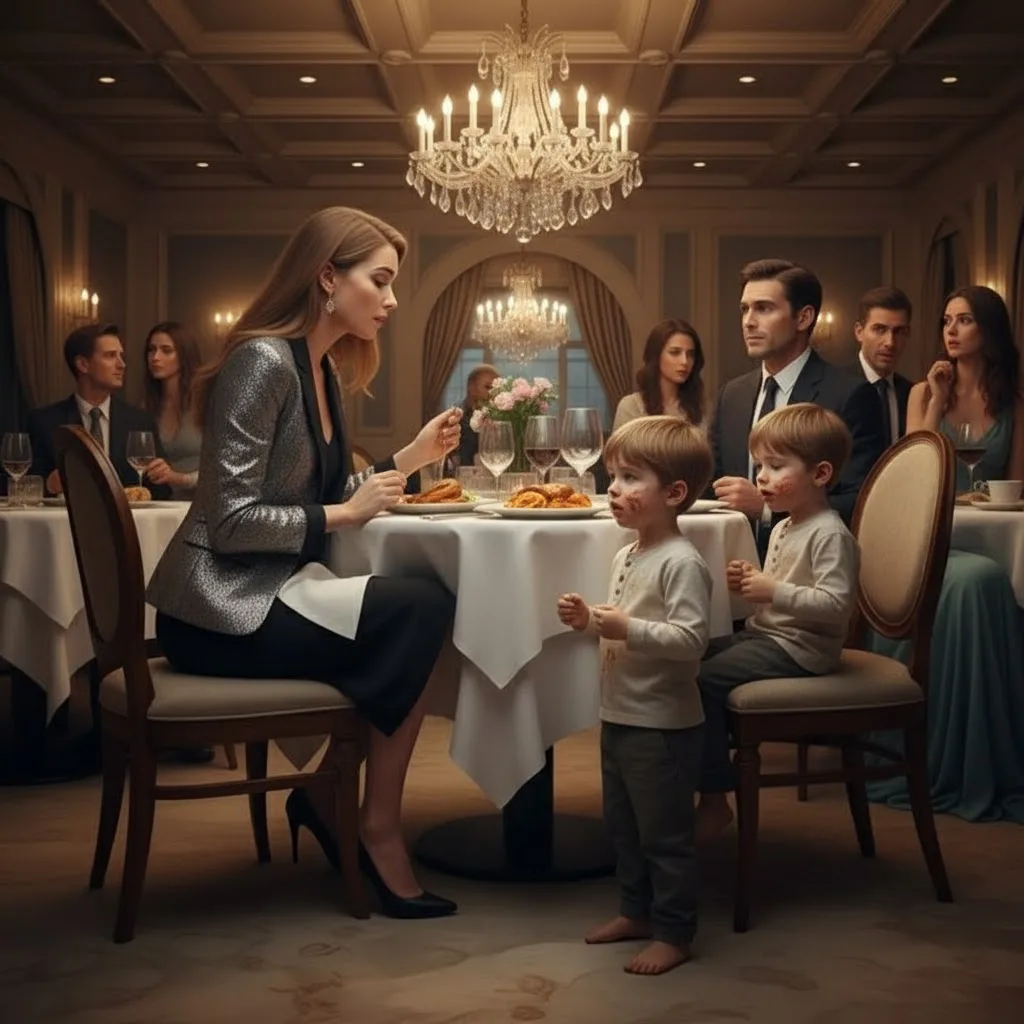
On this west-coast evening in 2025, she’d come to the Pacific View Bistro to practice being a person again—food on a plate, napkin in a lap, the predicate to small talk. Instead she was staring at mirrors from another life. Up close the likeness was unbearable—Noah’s dimple, Lucas’s careful posture, the way both boys carried their hunger like a secret they were already ashamed of. “Sit,” Eleanor said, before any thought could argue. “You’ll have something hot, not scraps.” She ordered burgers, fries, milkshakes with extra malt. Her voice sounded like it belonged to someone who knew what to do. Her hands shook like she didn’t.
“How old?” she asked, when the first heat of hunger had passed. “Fifteen,” said the taller one. “I’m Lucas. He’s Noah.” Names like detonations. She steadied herself against the table edge. “Where are your parents?” A glance passed between them—the practiced kind shared by people who have learned to tell the same story. “We don’t really have any,” Lucas said. “Foster homes. Group homes. We aged out early.” Noah studied his fingers as if answers might be printed there. “Before that?” Eleanor asked softly. “Any old addresses? Another last name?” Noah reached, found the thread. “We’ve always been Miller,” he said. “They said our mom left us at a hospital.” Paper can lie for years without getting caught. The body remembers what the file can’t hold.
She tried not to press, but her questions kept finding air. “Earliest memory.” Noah: “Blue room. Bunk beds. I was top. A moon nightlight.” It landed like a stone in still water. Their room had been sky blue, a crescent lamp glowing through thunderstorms. Lucas: “A woman who smelled like oranges and coffee. She sang in the car. Sunshine.” Eleanor had worn citrus perfume. She had sung “You Are My Sunshine” until the words frayed.
“This will sound impossible,” she said, voice low so the ocean wouldn’t overhear. “I had twin sons who vanished when they were seven. They were Lucas and Noah. You look like them. You… are them.” The boys went still, the way wild animals do when a twig snaps in the wrong place. “That’s not funny,” Lucas said, a flare of anger trying to outrun fear. “I’m not joking,” Eleanor answered. “My name is Eleanor Hayes.” The waiter slid the check between them and the sky went from copper to indigo.
They were at an urgent care twenty minutes inland before doubt could get a proper foothold. It was the kind of clinic that smelled like bleach and worry. A nurse swabbed cheeks, drew blood, pressed labels flat with thumbnails. Eleanor paid for expedited processing that moved at the speed of a slow prayer. The boys fidgeted with paper cups sweating sugar. To fill the buzzing, she asked for pieces of the map they carried in their bones. Noah saw a red bike, a dog with a butter-soft ear, hands that clapped paint across a poster of the solar system. Lucas remembered a kitchen timer shaped like a tomato, the click-click-click before cookies, the way a man’s laugh—he couldn’t name him—filled the space between the clicks.
Near midnight, a door opened with a soft sigh. The doctor gestured her into a closet-sized office, the monitor’s blue light making everyone look like a late-night confession. “Ms. Hayes,” he said gently, “the probability of biological maternity is effectively one hundred percent.” The room expanded and contracted, a lung learning to breathe again. Eleanor gripped the chair back until her fingers recognized their job. When she stepped into the hallway, both boys stood. “Well?” Lucas asked, trying to sound like someone who didn’t need the answer. “You’re mine,” she said. “You’re my sons.” Noah moved first—an awkward collision that found the old geometry of a family. Lucas followed, arms around both, a huddle in an ugly corridor where something holy managed to happen anyway.
They checked into a hotel that hid its kindness under industrial carpet and water pressure that made a promise it couldn’t keep. The boys fell asleep in the back seat before she cut the engine, mouths open in identical soft parentheses. Upstairs, they took the beds nearest the window as if instinct demanded a line of sight to escape. Eleanor sat in the armchair between them, a sentinel with a phone full of numbers she could finally call for something other than condolences. The morning would bring detectives and social workers, a prosecutor with careful questions, old case files slapping the table like wet laundry. It would bring a father who would break and then rebuild in a new shape, an au pair who had never forgiven herself, a city that would pretend the ending proved the middle had been inevitable. It would bring therapists with soft voices who understood that memory returns like tide—generous one day, stingy the next.
For now, she watched the rise and fall of their breathing, the twin cadence that had once set the rhythm of her days. She thought about the eight unspooled years: where had they slept, who had taught them to lace shoes, to run from certain kinds of shouting? She would learn the names of the homes and the edges of the harms, and she would measure out justice without letting vengeance take the wheel. Money, at last, would do what it was meant to do—buy time, safety, a net woven tight enough to hold. She placed her phone face down on the table. The screen lit once anyway: a message from a number she recognized by the ache in her ribs. Is it true? It could wait. The boys turned in their sleep, mirrored motion, a choreography the world had failed to break.
At dawn the ocean returned to its work as if nothing had shifted. In their room, everything had. Lucas blinked awake first, disoriented, then steadied on her face. Noah reached for the milkshake cup he’d fallen asleep holding, straw bent like a question mark. “We have a lot to do,” Eleanor said. “But first—pancakes.” The boys smiled in perfect, startled unison, and she felt the past and present lay themselves side by side without arguing for once.
Grief is a house with lights that switch on in rooms you forgot you had, sometimes years after you’ve moved out. Hope is a key you keep in your pocket even when everyone tells you the lock has been changed. Eleanor had lived with both—grief as landlord, hope as squatter. In the end, neither was wrong about the address. What saved her wasn’t the miracle alone, but the discipline that met it: ask questions, order food, take them somewhere that can tell the truth. Love, it turns out, is both a gut and a plan.
There will be days ahead when memory stings more than it soothes, when the boys’ laughter sounds like an echo from a well. There will be courtrooms and forms and the small humiliations bureaucracies inflict on the newly mended. But there will also be the ridiculous mercy of ordinary things—the way syrup maps a plate, the way a new toothbrush feels on sore gums, the way “Mom” returns to a mouth and fits there. In a world that loses so much and so often, the lesson isn’t that miracles arrive on command. It’s that when they do, you hold still, you hold fast, and you hold on—long enough for the lost to find the door back home.
News

A Mafia Boss Threatened Dean Martin on Stage—Dean’s Reaction Was Pure Genius
A Mafia Boss Threatened Dean Martin on Stage—Dean’s Reaction Was Pure Genius Prologue: A Gun in the Spotlight Dean…

The Billionaire Had No Idea His Fiancée Was Poisoning His Son—Until the Maid Exposed Everything
The Billionaire Had No Idea His Fiancée Was Poisoning His Son—Until the Maid Exposed Everything Prologue: A Whisper That…

The Billionaire Catches Maid ‘Stealing’ Food… But When He Sees Who It’s For, He Breaks Down in Tears
The Billionaire Catches Maid ‘Stealing’ Food… But When He Sees Who It’s For, He Breaks Down in Tears Prologue:…

The Billionaire’s Fiancée Sets a Trap for the Maid — Until His Silent Daughter Exposed the Truth
The Billionaire’s Fiancée Sets a Trap for the Maid—Until His Silent Daughter Exposed the Truth Prologue: The Whisper That…

The Billionaire Went Undercover as a Gardener — Until the Maid Saved His Children from His Fiancée
Richard Whitmore’s hands trembled on the garden shears as he watched through the kitchen window. His new wife, Vanessa, stood…

Three Flight Attendants Vanished From a Vegas Hotel in 1996 — 28 Years Later a Hidden Wall Is Opened
.Every hotel, every casino, every neon-lit alley has a story, most of them ending in forgetfulness or denial. But some…
End of content
No more pages to load






