
The ocean wind pressed long fingers against the cliff, combing the umbrellas on the patio of the Pacific View Bistro. In her wineglass, Eleanor Hayes saw a ripple and then—impossible—two faces in miniature. Two boys hovered at the edge of her table, thin as shadows, their oversized T-shirts bleaching to gray beneath the salt air. “Ma’am,” the taller one said, voice catching on the word, “could we have some of your leftovers?” The request knocked a fork against china. Eleanor looked up. The world narrowed to the familiar cowlick on the right, the moon-nick scar above the left brow, the same stormy gray eyes that had once squinted at pancakes and sunlight in a Chicago kitchen. Time did what it does when grief finds a seam: it split. The salmon cooled. The patio hush deepened. Somewhere below, the surf kept its old appointment with the rocks.
Eight years earlier, Eleanor had sat in a police station under a humming clock while an officer explained procedure and the word “abduction” cleaved her life into before and after. Lucas and Noah—seven then, untamable, ordinary, hers—had vanished from a crowded park while the au pair checked a buzzing phone. Search grids, flyers, interviews, psychic letters, ransom rumors: noise without signal. Eleanor grew rich by accident, an app arriving at the right hour, luck laid over sleeplessness like a thin blanket. She poured the money into private investigators, drones, tip lines, campus cameras, until even hope learned thrift. She kept the house in case the boys needed a latitude to remember. She kept their moon-shaped nightlight in a drawer. She kept breathing.
On the cliff in 2025, the boys in front of her were about fifteen—the age her sons would be now. “What did you say your names were?” she asked, the air raw in her throat. “Lucas,” the tall one said, nodding to the other. “This is Noah.” Names like keys put into an old lock. The sensible part of Eleanor—trained by lawyers and disappointment—wanted chain of custody: records, timelines, DNA. The animal part wanted to fold them into her, to stop the draft moving through her bones. She did the only thing both halves agreed on. “Sit,” she said, soft but firm. “I’ll order you dinner. Then we’ll talk.”
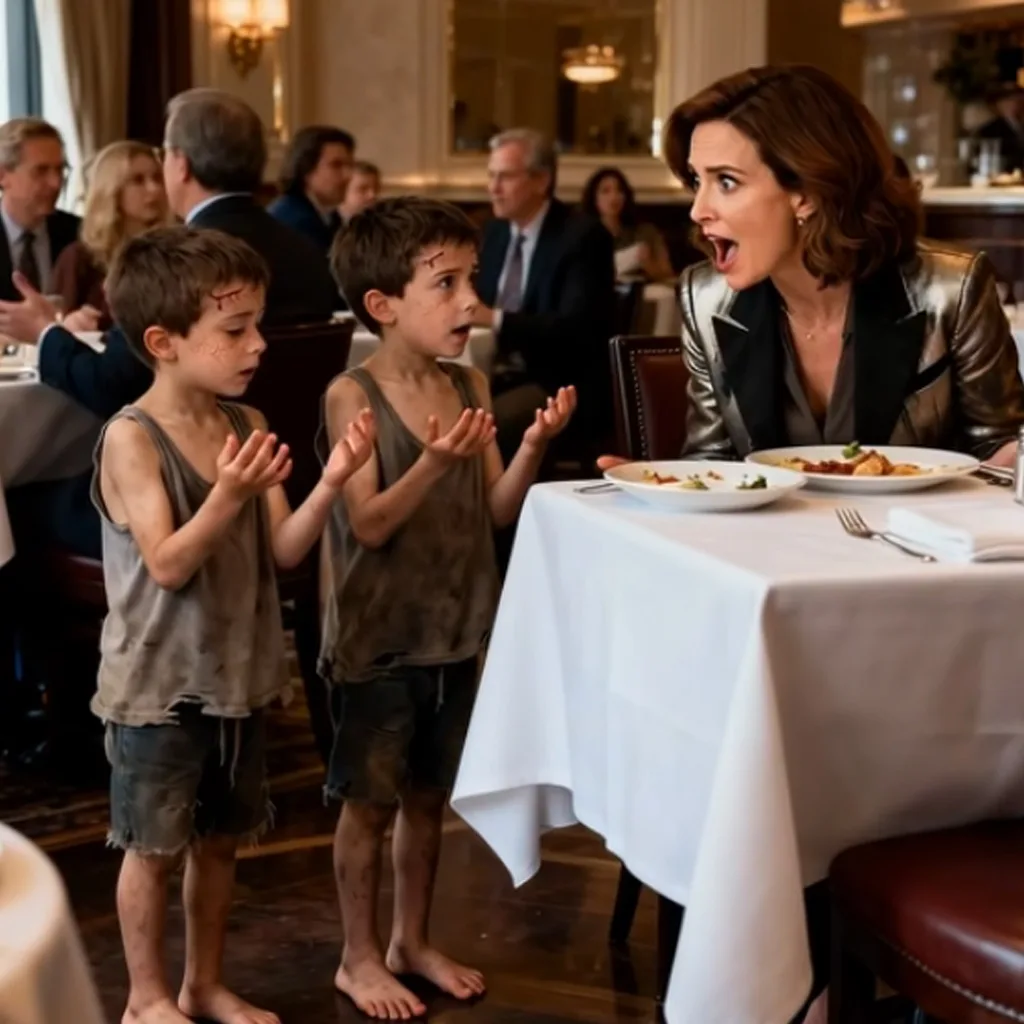
Burgers arrived. Fries steamed. The boys ate quickly but not greedily, glancing up between bites as if the food might revoke itself. Up close, the resemblance did not blur; it insisted. “How old are you?” Eleanor asked. “Fifteen,” Lucas said. “Where are your parents?” A muscle jumped in his jaw. Noah studied his hands. “Don’t have any,” Lucas answered. “Foster homes. Group places. We aged out.” “Before that?” Eleanor said, voice thinner. “Do you remember… anything else? A different last name?” “Miller,” Noah said carefully. “We’re Lucas and Noah Miller. They said our mom left us at a hospital.” Files can lie. Paper can be told what to think. “What’s your earliest memory?” Eleanor asked. “A blue room,” Noah murmured. “Bunk beds. A nightlight shaped like the moon.” Lucas looked past her, into some private weather. “A woman who smelled like oranges and coffee,” he said. “She sang in the car. Sunshine something.”
Eleanor steadied her water glass with two hands. She had worn citrus. She had sung “You Are My Sunshine” through snow and errands and ordinary Tuesdays. She felt the cliff tilt. “Listen,” she said. “I had twin sons. They disappeared eight years ago. You look and sound exactly like them. You even have”—she nodded at Lucas’s brow—“that scar from the headboard.” Lucas’s fry stopped midair. “That’s not funny,” he said. “I’m not joking,” Eleanor answered. “I’m Eleanor Hayes.” Silence gathered. “We don’t remember being seven,” Noah whispered. “Just flashes. A playground. A red bike.” Her boys had ridden a red BMX. She signed the bill with a hand that could still sign anything, and drove inland to a small clinic where the receptionist didn’t blink at the word “expedited.”
In fluorescent light the color of old milk, a nurse swabbed cheeks, drew Eleanor’s blood, labeled vials. The boys clutched their empty milkshake cups like passports. Eleanor texted no one. The waiting sat on her chest. On the wall, a television sold serenity: pastel beaches, pills with lilting names. At last the doctor called her into a small office where a monitor hummed. He spoke gently, as if approaching a skittish animal. “Preliminary results show near-certain maternity,” he said. The sentence landed like rain on a roof you weren’t sure could hold. Eleanor closed her eyes. She stood very still, as if movement might wash the ink away. When she stepped back into the corridor, the boys rose in the same instant, as if arranged by the same spring. “Well?” Lucas asked, almost angrily. “You’re mine,” Eleanor said. “You’re Lucas and Noah Hayes. You’re my sons.”
The hug was clumsy and fierce and wrong-sized, all limbs and apology. They cried in an ugly hallway that smelled faintly of antiseptic and wintergreen gum. A janitor pushing a mop lingered a respectful beat and kept moving. Outside, the night air had the clean taste of something beginning. Eleanor drove toward a hotel with two beds and a door she could post her body across. In the rearview mirror, the boys slept the sleep of people not accustomed to sleeping, mouths open, hunger briefly quieted. Eleanor watched them and rehearsed everything ahead: statements, detectives who would be careful and clinical, therapists who would coax memories into shapes that did not cut, a legal system that grinds even when it intends to mend. Also groceries. Also laughter practiced back into habit. In the hotel room, they stood looking at the beds as if unsure of permission. “Brush your teeth,” she said, handing them new toothbrushes still in their crackling plastic. The domesticity steadied them, and her. “I don’t like mint,” Noah said, instantly apologetic. “I’ll get bubblegum on the way home,” she answered, and the word home opened like a window in summer.
In the weeks that followed, truth assembled itself carefully. Files clinked into place. There was a forged discharge here, a misfiled transfer there, a woman with a history of moving children through the cracks. The au pair—older now, frightened, sorry—talked to a detective until the sun went down. Some things remained splinters. The mind, in its mercy, had sealed rooms to prevent collapse. The boys spoke in images: the low growl of a particular truck, the taste of canned peaches, a man with a country singer’s jawline. Eleanor learned when to stop asking. She learned the weight of their sleep patterns, their sudden startles, the way they flinched at door buzzers and relaxed at dogs. She learned the choreography of three in a kitchen, bodies relearning how to orbit without collision. Some days joy arrived so bright it hurt: Noah at the window during a storm, narrating the rain; Lucas laughing—really laughing—at a joke that didn’t have to be explained. Some days grief walked in uninvited and sat down in the old chair. They made room. Healing, it turned out, wasn’t a verdict. It was a long, stubborn practice.
On a calm afternoon weeks later, Eleanor took the boys back to the cliff. The patio was noisy with normal life—first dates, anniversaries, the practiced tenderness of waiters. She set her water glass on the table and watched the surface steady. In the reflection she saw three faces that were hers and not hers, stitched together by chance, by error, by a mother’s refusal to stop naming what was missing. The boys argued about fries, about bikes, about whether the moon nightlight should be plugged in again or retired like a jersey. She listened to the ordinary music and thought of all the versions of that night that had been possible: the choice to look away, to treat likeness as coincidence; the choice to feed and forget; the choice to disbelieve her own memory because it hurt too much to risk being wrong. What she understood now felt simple and costly. Love is not merely the feeling that swells in the chest; it is the act that moves the feet. It orders burgers. It pays for tests. It sits under bad lighting and opens its veins to proof. It goes home with two strangers who are your sons and learns, again, their reasons for the scar and the cowlick and the gray in their eyes.
Later, when the night came in clean and salt-scented, Eleanor left the moon-shaped lamp on in the hallway. The light was small and faithful. In the room, two boys slept the sleep of people who had been found. Eleanor lay awake listening to their breathing—one quick, one heavy—and let her own fall into rhythm between them. Not every story returns what it took. This one did not give back the years. It returned a future. On the bedside table, a glass of water kept a perfect circle. If she leaned closer, she could almost see her reflection divide and join again, as if time itself, finally, had decided to stop arguing.
News

A Mafia Boss Threatened Dean Martin on Stage—Dean’s Reaction Was Pure Genius
A Mafia Boss Threatened Dean Martin on Stage—Dean’s Reaction Was Pure Genius Prologue: A Gun in the Spotlight Dean…

The Billionaire Had No Idea His Fiancée Was Poisoning His Son—Until the Maid Exposed Everything
The Billionaire Had No Idea His Fiancée Was Poisoning His Son—Until the Maid Exposed Everything Prologue: A Whisper That…

The Billionaire Catches Maid ‘Stealing’ Food… But When He Sees Who It’s For, He Breaks Down in Tears
The Billionaire Catches Maid ‘Stealing’ Food… But When He Sees Who It’s For, He Breaks Down in Tears Prologue:…

The Billionaire’s Fiancée Sets a Trap for the Maid — Until His Silent Daughter Exposed the Truth
The Billionaire’s Fiancée Sets a Trap for the Maid—Until His Silent Daughter Exposed the Truth Prologue: The Whisper That…

The Billionaire Went Undercover as a Gardener — Until the Maid Saved His Children from His Fiancée
Richard Whitmore’s hands trembled on the garden shears as he watched through the kitchen window. His new wife, Vanessa, stood…

Three Flight Attendants Vanished From a Vegas Hotel in 1996 — 28 Years Later a Hidden Wall Is Opened
.Every hotel, every casino, every neon-lit alley has a story, most of them ending in forgetfulness or denial. But some…
End of content
No more pages to load






