
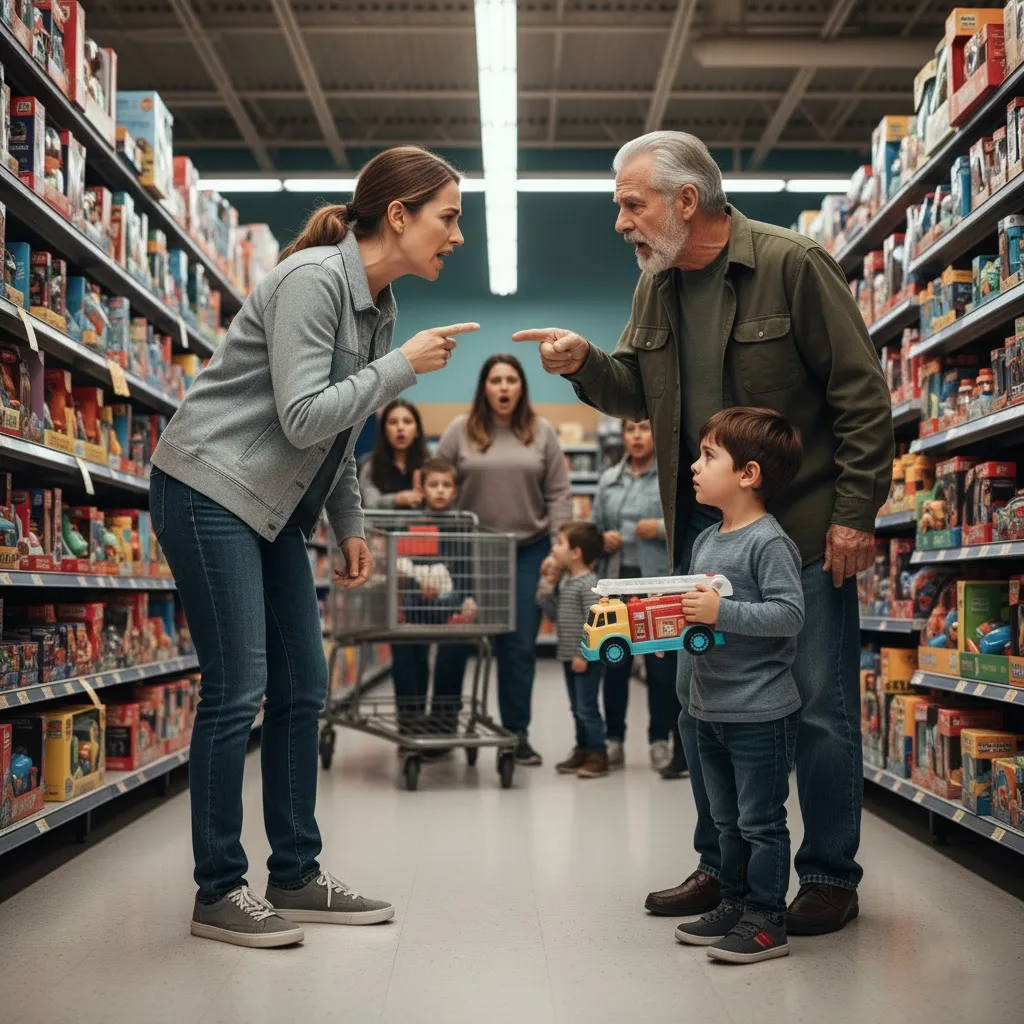
The supermarket lights hummed like tired bees above a polished aisle of toys—reds, yellows, plastic sirens promising small joy. I had a list in my pocket and my five-year-old’s hand in mine. Levi’s fingers were warm and certain, the way children hold on as if steadying the earth itself. He spotted the fire truck first: cheap, cherry red, wheels that clicked faintly when they turned. “Can I?” he asked, voice soft as a church whisper. “You’ve been good,” I said. He lifted it with two hands, reverent.
The cart hit my hip before I saw my father. The shove jolted the air. “What the hell do you think you’re doing?” he barked, loud enough to bend faces down the aisle. He ripped the truck from Levi’s hands and hurled it. Plastic bounced, skittered, vanished under a shelf. My mother’s slap followed—crisp, theatrical—the kind that leaves a heat shaped like a hand. Phones hovered. No one moved. “We came for essentials,” my father said, fingers digging into my wrist. “Not to waste money on junk.” Levi folded behind the paper towels, shoulders trembling. I lifted him, turned toward the doors, and heard my mother’s final, practiced cruelty: “You should be grateful we let you live with us.” The doors opened as if obeying a spell. Cold March air met us like truth.
They loved rules more than people. In Cedar Falls, appearances were a second weather system; my parents could read its pressure by the minute. He chaired clubs and wore his authority like a flag. She managed committees and perfected the kind of smile that could slice a person without leaving blood. I had moved back after Levi’s father left, a bad decision wrapped in exhaustion. “Temporary,” I’d said. “Until I’m steady.” Temporary calcified into “our house, our rules”: take our card, take our commentary, take our unasked-for judgment as payment. The slap in the fluorescent aisle wasn’t new; it was merely public. That night I drove with the highway unspooling like a long, dark dare, Levi asleep in the back, his breath catching now and then the way children cry even after they stop. I texted an old friend—Hannah, the kind of person who keeps the porch light on out of habit—and she opened her door without a single question. “Mac and cheese,” she said, pushing a warm bowl into my hands. I told her everything. She asked one thing: “Why prove yourself to people who refuse to see you?” The question hollowed me in a clean way, like a surgeon’s blade.
Work came in the shape of night shifts at a warehouse—stack, scan, lift, repeat—wages that felt like breathing after being underwater too long. I saved. I learned the comfort of cash that didn’t talk back. My parents sent messages when silence no longer satisfied them: We’re calling the cops. You’ll come crawling back. Your sister’s engagement needs extra hands. The familiar script. I didn’t crawl. I studied. Their reputation had always felt too glossy; when you grow up with polish, you know the scent of it. Charity accounts, duplicate “donations,” vendors who didn’t exist—paper ghosts with my father’s pen tucked beneath their sheets. I gathered what the town pretended not to notice: invoices, dates, the careful arithmetic of theft. On the night of my sister’s engagement, I entered the community hall in a catering cap. My father’s jaw ticked when he saw me. “Working,” I said, and balanced a tray that wasn’t heavy. The mayor’s aide took the envelope I pressed into his hand; the mayor’s smile faltered midway through a toast; a quiet flurry of calls became the loudest sound in Cedar Falls. Cameras flashed at the lobby’s edge like heat lightning. “You can’t prove—” my father began. “We’ll audit,” the mayor said, not unkindly, which felt worse. My mother’s face cracked around the lipstick. I took Levi’s hand. “You built a house out of control,” I told them, voice low, steady. “I just opened the windows.”
Freedom arrived like dust after a storm—visible in certain light, everywhere once you recognized it. It wasn’t sweet; it was still. Levi started kindergarten, learned to run toward doors without flinching. I slept in a new apartment with a leaky faucet and a steady lock. Therapy taught me a private language: survival brain, nervous system, what safety feels like in the body. Sometimes it is simply a kettle singing in an empty kitchen and no one correcting how long it should boil. When the police called to say my parents’ complaint had been tossed, I stood in the grocery store where the aisle had broken me and bought a fire truck. “Big sale today,” the cashier said. I paid cash. Months later a letter arrived in my father’s square hand: Your mother isn’t well. She’d like to see Levi. Mercy isn’t a ladder back into a house that burned you; it’s a door you choose. We went. The nursing home smelled like lavender and clock oil. My mother looked smaller, as if her bones had set down a burden finally. “I’m tired of being mad,” she said to my son. “Then you can rest now,” he answered, because children are sometimes born already knowing what it takes adults a lifetime to learn. She pressed a small box into my hand later: a baby Polaroid, pearl earrings, a note—Love shouldn’t hurt. Use your freedom better than I used mine. I didn’t forgive her there; forgiveness isn’t a ceremony. But something unclenched. I drove home in open sky, placed the pearls in a jar beside Levi’s toy truck, and slept without hearing doors.
Years widened. We moved again—to a porch with chipped paint and a yard Levi insisted we “let grow messy.” I learned the shape of a day no one claimed from me: pancakes, drop-off, work where my name was mine, evenings of homework, storybooks, quiet. When my parents’ house sold and their names slid out of the paper’s social column into the court docket, I felt nothing triumphant. Justice, when it’s honest, is housekeeping—putting things back where they belong. A final letter arrived from a lawyer after my mother died. I read it at a desk that faced morning light, then carried the jar of pearls to the ocean and let them go. They flashed once, small stars in a shallow sky, then sank. Grief can be an anchor; it can also be a release.
In the old story I was a daughter who owed, a mother who begged permission to choose, a woman who mistook endurance for love. In the true story, I was already someone—just quiet about it. Quiet is not the same as weak. A slap in a fluorescent aisle began a chain of small refusals: to apologize for tenderness, to accept harm dressed as help, to hand a child a world that taught him to shrink. I once thought revenge would taste like victory; it tastes like ash. What endures is simpler: a red truck bought without permission; a lock that answers only to your key; a boy who asks, “Was it my fault?” and learns to say, “We love more, for them.” The past did not vanish; it stopped steering. Some mornings I still wake smelling floor wax and microwave popcorn, and I touch the jar and the truck—one for what was lost, one for what was saved. Then I make coffee, wake my son, and step into a day no one else narrates. Freedom, it turns out, sounds like automatic doors opening and you walking through, not because you’re chased, but because you chose the aisle that leads outside.
News

A Mafia Boss Threatened Dean Martin on Stage—Dean’s Reaction Was Pure Genius
A Mafia Boss Threatened Dean Martin on Stage—Dean’s Reaction Was Pure Genius Prologue: A Gun in the Spotlight Dean…

The Billionaire Had No Idea His Fiancée Was Poisoning His Son—Until the Maid Exposed Everything
The Billionaire Had No Idea His Fiancée Was Poisoning His Son—Until the Maid Exposed Everything Prologue: A Whisper That…

The Billionaire Catches Maid ‘Stealing’ Food… But When He Sees Who It’s For, He Breaks Down in Tears
The Billionaire Catches Maid ‘Stealing’ Food… But When He Sees Who It’s For, He Breaks Down in Tears Prologue:…

The Billionaire’s Fiancée Sets a Trap for the Maid — Until His Silent Daughter Exposed the Truth
The Billionaire’s Fiancée Sets a Trap for the Maid—Until His Silent Daughter Exposed the Truth Prologue: The Whisper That…

The Billionaire Went Undercover as a Gardener — Until the Maid Saved His Children from His Fiancée
Richard Whitmore’s hands trembled on the garden shears as he watched through the kitchen window. His new wife, Vanessa, stood…

Three Flight Attendants Vanished From a Vegas Hotel in 1996 — 28 Years Later a Hidden Wall Is Opened
.Every hotel, every casino, every neon-lit alley has a story, most of them ending in forgetfulness or denial. But some…
End of content
No more pages to load






