
THE WOMAN IN THE RAIN
(A Story of Betrayal, Survival, and the Quiet Rebuilding of a Life)
The Storm
Lightning split the Ohio sky, bleaching the world in white. For one blinding instant, everything was visible—the perfect hedges, the flag flapping on the porch, the reflection of my own face in the glass door I was pounding on. Barefoot, soaked to the bone, six months pregnant, I stood outside my own house while the people inside—the man I loved and the mother who’d raised him—watched me through the glass.
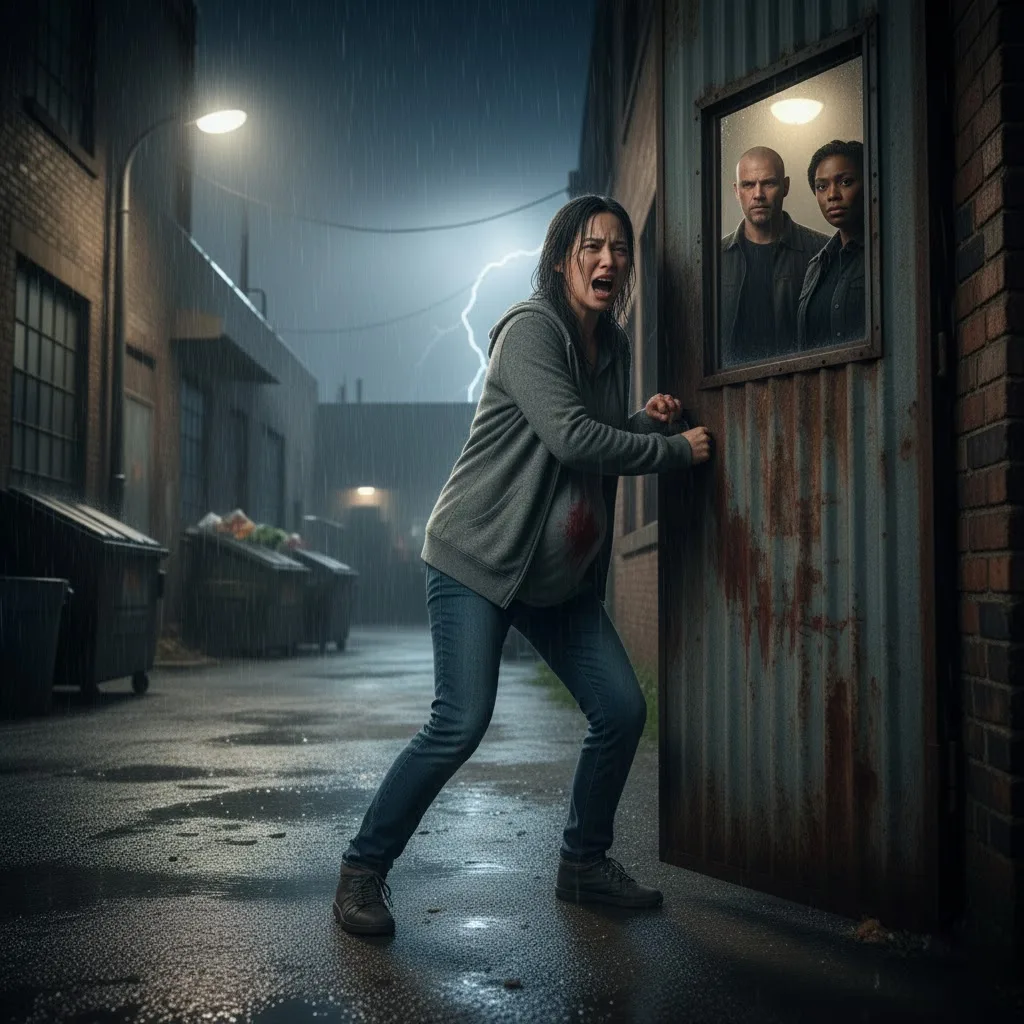
“Please!” I screamed, my palms raw and red. “I’m pregnant! Your baby is inside me!”
Through the fogged window, I saw their shapes—their stillness colder than the rain. My husband, Thomas, turned first, his outline fading into the yellow light of the living room. His mother, Diane, lingered a heartbeat longer. She met my eyes through the glass, expression unreadable, then reached up and flicked off the light. The world went black.
The first pain came like a knife twisting inside me—low, deep, sharp. I clutched my belly, gasping, rain running into my mouth. My daughter kicked once, desperate and strong. I whispered her name to the storm, though she didn’t have one yet. The night swallowed my voice.
I didn’t know it then, but the woman who had believed in love and marriage and safety died on that porch. The rain washed her away.
The Cold After Love
I don’t remember how long I stood there—minutes, hours, an eternity of pounding, bleeding, begging. The street was empty, the world asleep. I tried the windows, the garage, even the back door. All locked. Every escape sealed. They’d planned this.
When the cramps grew stronger, I dropped to my knees on the porch steps. The cold bled through me, bone-deep, numbing and merciless. I whispered Thomas’s name, then Diane’s, then simply “help.” No one came. The rain didn’t stop.
Then headlights cut through the storm—a black sedan slowing at the curb. I thought I was hallucinating until the door opened and a tall man stepped out. He was soaked in seconds, moving fast, his voice slicing through the rain.
“Elena.”
I looked up, barely recognizing the face I hadn’t seen in years. Alexe Volkov. My foster brother. The only person who had ever truly protected me.
He was beside me in an instant, his jacket wrapping around my shoulders. “Who did this?” he asked, voice low and dangerous.
“Thomas,” I gasped. “Diane. They locked me out. The baby—”
He didn’t speak again until he had me in the car, heat blasting, his hands gripping the wheel so tight his knuckles whitened. “You’ll live,” he said. “She’ll live. Then we make them pay.”
At the hospital, the world blurred—white coats, bright lights, voices shouting words I couldn’t understand: hypothermia, contractions, blood pressure. I clung to the sound of my daughter’s heartbeat on the monitor, strong and defiant. Alexe stood by the bed, refusing to leave. “I’m her family,” he said. “I’m all she has.”
When it was over—when the doctor said we were safe—I cried until there was nothing left.
The War Begins
By morning, Alexe was already on his phone, his voice sharp in two languages. Lawyers. Investigators. Money. “He thinks he’s safe,” Alexe said, glancing at me. “He’s wrong.”
My phone buzzed. A text from Thomas:
Don’t come back. It’s over. You brought this on yourself.
No apology. No concern. Just the quiet cruelty of a man who’d decided I no longer existed.
I watched Alexe read the message, his jaw tightening. “He’s weak. But you’re not. You survived worse before.”
We began planning. Or rather, Alexe did, and I followed. He found me a lawyer—a sharp, unsentimental man named Carter—who laid out the plan like a chessboard. “You file for emergency protection. You claim your share of the house, the assets. We go after both of them legally and financially. You have the truth on your side.”
The truth, I thought, had nearly killed me. But this time, it might save me.
While I healed, Alexe gathered information. Old debts. Hidden bank transfers. Diane’s charities weren’t as pure as they appeared. Within weeks, anonymous tips began circulating. News headlines followed:
Local Philanthropist Under Investigation for Fraud.
Thomas called me repeatedly. I didn’t answer. His voice filled my voicemail, growing desperate, angry, pleading. “Elena, we can fix this. Just come home.”
Home. The word had lost its meaning.
When the court date came, I faced them both. Thomas looked smaller than I remembered. Diane’s face was frozen, her perfect composure cracking at the edges.
Carter spoke clearly. “My client was locked outside in the freezing rain while six months pregnant. She nearly lost her child. This was not an accident—it was cruelty.”
Thomas stammered, “She was unstable—”
The judge silenced him. “You left your wife outside in the rain. Case closed.”
He granted me full protection, possession of the house, and access to our joint accounts. Thomas’s lawyer’s shoulders sagged. Diane’s hands trembled. For the first time, I felt something close to power.
Outside, Alexe smiled, slow and satisfied. “First strike,” he said. “More to come.”
Rebuilding
The story didn’t end with the verdict. Scandal spread faster than forgiveness. Diane lost her charity positions. Thomas was suspended from his job. Their names became whispered warnings.
I sold the house—the same one where I had once begged through glass—and bought a small apartment overlooking the river. I started working again. Quiet jobs, honest work. My belly grew heavy, my daughter kicking stronger every day.
One night, I visited the house one last time before closing. The rooms were empty, the walls echoing with old arguments and broken dreams. I left the keys on the counter and walked out without looking back.
Alexe drove me into the city. “It’s over,” he said.
I nodded, though I knew it wasn’t. Some endings don’t come with peace—only space to breathe again.
In the apartment, I built a life from the ground up. Morning light through the curtains. Coffee brewing. The sound of traffic below. I met new people. Kind people. The kind who didn’t need to know the whole story.
When my daughter was born, I named her Vera—truth. Because truth was all that had saved us.
What Survived
The world outside didn’t change. It was still hard, indifferent, sometimes cruel. But I did.
I learned that love without respect is just captivity. That silence can kill faster than hate. That sometimes the only way to survive is to let the storm strip you bare and build yourself again, from bone to heart to hope.
Alexe visited when he could, always watchful, always half in shadow. He told me Diane had moved away, that Thomas was broke and bitter. “They can’t touch you anymore,” he said.
I believed him. But it wasn’t revenge that healed me. It was the small, ordinary moments—Vera’s laughter, sunlight on her hair, the hum of the city beneath our window.
The night I brought her home from the hospital, I stood by that window for a long time. The sky was clear, stars scattered like forgiveness. I thought of the porch, the rain, the woman who had once begged to be let in.
I whispered to her—to my old self—“We made it.”
And for the first time, I believed it.
Because survival, I learned, isn’t just about living through the storm. It’s about finding warmth again when it’s over—and daring to stay in the light.
News
A Mafia Boss Threatened Dean Martin on Stage—Dean’s Reaction Was Pure Genius
A Mafia Boss Threatened Dean Martin on Stage—Dean’s Reaction Was Pure Genius Prologue: A Gun in the Spotlight Dean…

The Billionaire Had No Idea His Fiancée Was Poisoning His Son—Until the Maid Exposed Everything
The Billionaire Had No Idea His Fiancée Was Poisoning His Son—Until the Maid Exposed Everything Prologue: A Whisper That…

The Billionaire Catches Maid ‘Stealing’ Food… But When He Sees Who It’s For, He Breaks Down in Tears
The Billionaire Catches Maid ‘Stealing’ Food… But When He Sees Who It’s For, He Breaks Down in Tears Prologue:…

The Billionaire’s Fiancée Sets a Trap for the Maid — Until His Silent Daughter Exposed the Truth
The Billionaire’s Fiancée Sets a Trap for the Maid—Until His Silent Daughter Exposed the Truth Prologue: The Whisper That…

The Billionaire Went Undercover as a Gardener — Until the Maid Saved His Children from His Fiancée
Richard Whitmore’s hands trembled on the garden shears as he watched through the kitchen window. His new wife, Vanessa, stood…
Three Flight Attendants Vanished From a Vegas Hotel in 1996 — 28 Years Later a Hidden Wall Is Opened
.Every hotel, every casino, every neon-lit alley has a story, most of them ending in forgetfulness or denial. But some…
End of content
No more pages to load






