
The first hit wasn’t a punch so much as a sound—the tinny, ringing thud of spine to locker, metal vibrating like a tuning fork and swallowing the hallway’s chatter whole. Phones lifted midair, laughter wheeled into silence. Emily Carter’s books slithered across the floor in a scatter of paper and graphite. She didn’t flinch. She didn’t grab for anything. She just braced one palm against the cool seam of locker 217 and looked up at the boy who thought this place was his.
Tyler Morris stood close enough for her to count the frayed threads on his letterman sleeve. Two satellites hovered just behind him—Jake, shoulders squared for the spectacle, and Brianna, mouth tilted in that careful line between bored and cruel. “You didn’t pay,” Tyler said, not loudly—he never needed volume. Power made its own megaphone here.
Emily’s voice was level. “I’m not paying you.”
Something like surprise flickered and died in Tyler’s eyes. He shoved her again, the way people push elevators that don’t come faster for being bullied. He drew back his fist. The phones held their breath.
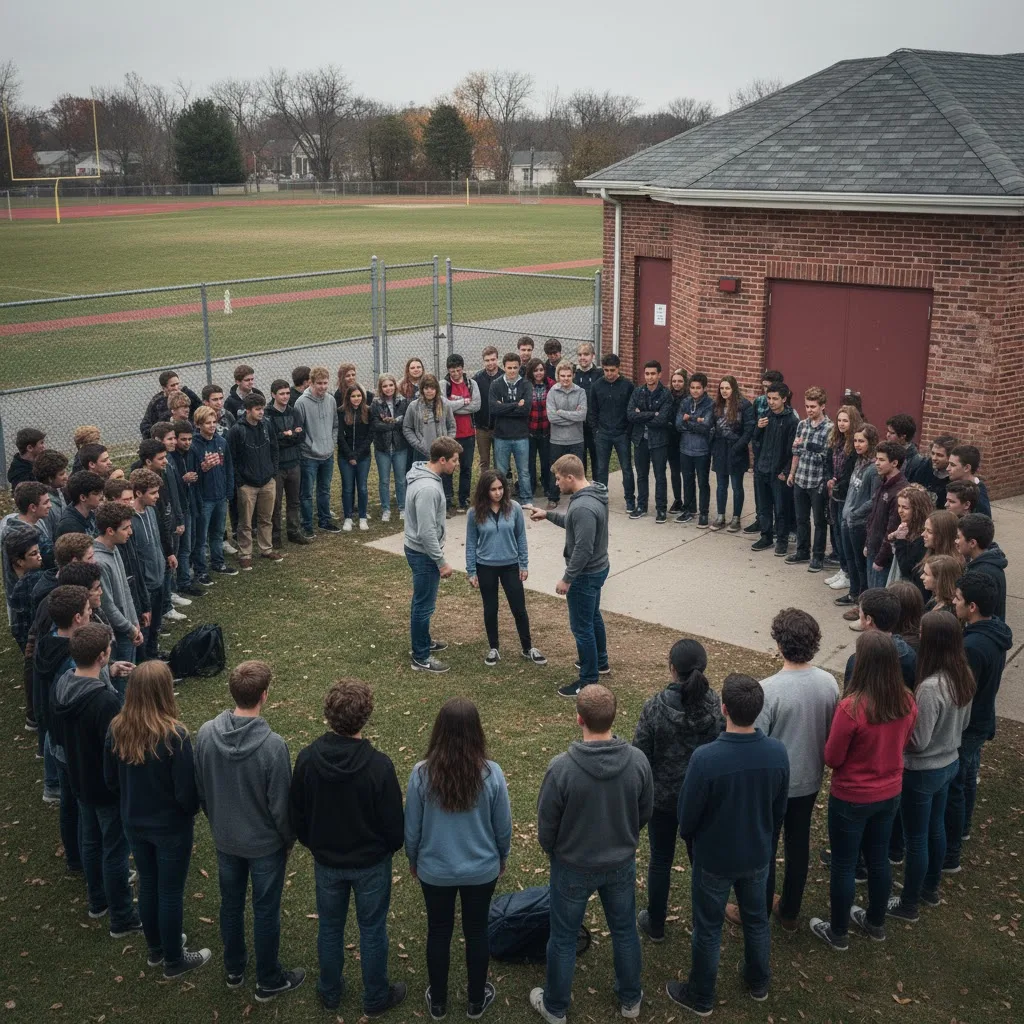
He never reached her.
Emily’s body shifted a half-inch—weight, angle, geometry. She caught his wrist with a soft mechanic’s care, turned his momentum sideways, and set him bent at the waist with his cheek hovering above the tile. The sound in the hallway changed: a gasp, a scrape of rubber soles, somebody’s whispered “holy—” cut off by wonder. She wasn’t smiling. She wasn’t angry. She was focused, like a musician finding the note.
“Stop trying to hit me,” she said, quiet as a click.
Emily had arrived three days ago with a black backpack stitched with a tired wolf and a habit of choosing window seats. Arizona plates on a sun-bleached SUV, rumor said. A dad who woke before dawn and counted car lengths on instinct. A mother who lived in scrubs and night shifts. She walked like her feet knew where they belonged and took orders from no hallway.
The rules at Jefferson High weren’t written anywhere, which made them feel like weather—unchangeable and everyone’s problem. Pay Tyler’s crew twenty bucks a week and eat in the safe shadow of the back tables. Keep your eyes down when Brianna laughed. Pretend Jake’s hand on your shoulder meant friendship. If something went wrong, the adults arrived late with ideas about “conflict resolution” and “teachable moments.” Nobody ever taught the moment to stop.
No one had asked why Emily’s gaze was steady as a plumb line. Why she shrugged during fire drills, counting exits like it was second nature. Why her hands were nicked and taped in places most girls covered with rings. If anyone had cared enough to search, they would have found a thumbnail from last summer: bright lights, chain-link, a referee lifting Emily’s gloved hand while she tried not to grin through a mouthguard. Junior lightweight champion. Youngest in state history. A child who learned to break a fall before she learned to braid her own hair.In the space after the first move—Tyler’s arm pinned but unharmed, Emily’s feet exactly where they needed to be—Jake lunged. Of course he did. Bullies borrow courage from crowds. Emily released Tyler and pivoted, hooking Jake’s ankle with a little sigh of inevitability. He hit the floor harder than anyone expected, not hurt so much as shocked, and a ripple of laughter leaked through the fear. Brianna tried to play it clever. “You’re dead,” she breathed, like a spell. “He runs this school.”
“He doesn’t run me,” Emily said. Six words. A counterweight dropped into the pulley system of an entire ecosystem, and something shifted.
Security footage is always unforgiving and always incomplete; when Mr. Harris sat Emily in the vice principal’s chair that afternoon, he pointed to pixellated shoves and blurred limbs like a weather man tracing storm lines. “We don’t tolerate violence,” he said, palms together as if prayer could fix policy.
“I didn’t throw a punch,” Emily answered. “He did. I stopped it.” She didn’t mention the plate she kept spinning in her head every minute of every day since she was nine: distance, angle, momentum, options. She didn’t mention the way she measured damage the way other kids measured time.
He gave them both a day of in-school suspension, equality masquerading as fairness. On the ride home, her father held his breath over the email twice and then chuckled without humor. “You put him down gently,” he said, eyes soft at the edges. “That’s restraint.”
“I’m tired,” she admitted, the truth sliding out sideways. “I’ve been in cages that felt kinder.”
By lunch the next day the internet had done what it does—found the cage, the armbar, the slow grin, the announcer’s voice calling her name. A girl named Maya watched the clip on a cracked screen and glanced across the cafeteria to the new girl eating an apple with her back to the wall. “Tyler chose the wrong movie,” she said to nobody.
Change didn’t arrive with sirens. It seeped. A freshman boy came home with the same twenty dollars he’d left with, eyes wide as if money could grow back. A clarinetist admitted his locker hadn’t been “checked” in two days. The robotics kid walked past Tyler without that flinch baked into his shoulders. By Friday, Maya stopped Emily at the lockers, her voice catching on thank you in a way that made Emily swallow. “For my brother,” she added, because it matters who we name when we talk about courage.
Tyler still glared, an orbit disturbed, his gravity off. He muttered things that sounded like threats but came out shaped like embarrassment. Brianna tried to smirk with less conviction. Jake avoided tile floors when he could help it.
Emily didn’t become a legend; she became a fact. She joined the wrestling room that smelled like old sweat and purpose and taught a senior two weight classes up how to fall without fear. She did her homework in the library with the windows that faced the football field and the sun that tracked across her notebook like a slow metronome. She answered questions in chemistry and kept her earbuds in when the hallway wanted confession from a girl who had borrowed none of their myths. She never bragged. She never posted. She never strutted past the place the metal had rung.
On a Tuesday in November, Mr. Harris stopped her and asked, this time for real, about the tape on her knuckles. She told him about the gym across town where the owner made kids mop the ring before they got to use it, about the older girls who didn’t let you quit just because your ribs argued, about breathing through a choke and hearing your own heartbeat slow instead of speed. He nodded in the awkward way of grown men discovering they understand less than they thought. The next week, the school quietly announced a self-defense workshop after classes. Emily showed up late, stood at the back, and watched kids practice falling on mats that whispered when they hit.
At home, her mother came in at dawn and took off her shoes in the dark so the house would stay asleep a little longer. “They put you in a box?” she asked when she read the suspension email.
“Only for a day,” Emily said. “I’ve had worse cages.” Her mother laughed, tired and relieved, and kissed the top of her head like she was still eight instead of a person who could fold a boy twice her size without breaking him.
Hallways have rules the way weather has moods, and both teach the same cruel lesson: some things you endure, some you bring an umbrella, and some you stand in until the storm learns your name. Emily didn’t fix Jefferson High. She bent a single beam in its scaffolding and the structure groaned, and sometimes that’s enough to change the way a shadow falls.
There’s a romance to the idea that courage is loud. Sometimes it is. Sometimes it’s a cheer in a gym, a glove lifted, a belt slung around a too-thin waist under a too-bright light. More often it’s smaller: a refusal at conversational volume, a hand that redirects instead of destroys, a girl who knows precisely how much pressure keeps a shoulder safe.
The kids who filmed that first thud will watch the clip a hundred times and swear they saw more than they did. Maybe they’ll edit it until the locker sounds like thunder and Emily looks mythic. But the real thing—the thing worth remembering—was quieter. A choice. Not to pay. Not to run. Not to hurt when stopping was enough.
Power at Jefferson had always been paperwork no one filed, a rumor that became ordinance because no one bothered to test it. Emily turned a page and found it blank. She wrote her own sentence. Not a manifesto. Just a line: He doesn’t run me. In some places, that’s all it takes. In others, it’s the first step. Either way, the bell rang, kids shuffled to class, and somewhere a freshman felt twenty dollars heavy in his pocket and later, years from now, wouldn’t be able to explain why that day mattered, only that the air in the hallway tasted different.
The metal lockers never forgot the sound she made them make. Neither did the city of phones, or the boy who learned what it feels like to be handled instead of worshiped, or the girl who realized her brother’s money wasn’t a tax but a theft. And Emily—she walked the same way she had on day one: feet certain, gaze steady, anchored not by fear but by the simple math of who she was and where she refused to yield.
News

A Mafia Boss Threatened Dean Martin on Stage—Dean’s Reaction Was Pure Genius
A Mafia Boss Threatened Dean Martin on Stage—Dean’s Reaction Was Pure Genius Prologue: A Gun in the Spotlight Dean…

The Billionaire Had No Idea His Fiancée Was Poisoning His Son—Until the Maid Exposed Everything
The Billionaire Had No Idea His Fiancée Was Poisoning His Son—Until the Maid Exposed Everything Prologue: A Whisper That…

The Billionaire Catches Maid ‘Stealing’ Food… But When He Sees Who It’s For, He Breaks Down in Tears
The Billionaire Catches Maid ‘Stealing’ Food… But When He Sees Who It’s For, He Breaks Down in Tears Prologue:…

The Billionaire’s Fiancée Sets a Trap for the Maid — Until His Silent Daughter Exposed the Truth
The Billionaire’s Fiancée Sets a Trap for the Maid—Until His Silent Daughter Exposed the Truth Prologue: The Whisper That…

The Billionaire Went Undercover as a Gardener — Until the Maid Saved His Children from His Fiancée
Richard Whitmore’s hands trembled on the garden shears as he watched through the kitchen window. His new wife, Vanessa, stood…

Three Flight Attendants Vanished From a Vegas Hotel in 1996 — 28 Years Later a Hidden Wall Is Opened
.Every hotel, every casino, every neon-lit alley has a story, most of them ending in forgetfulness or denial. But some…
End of content
No more pages to load






