
The Invitation Nobody Expected: How a Single Mother Became the Center of a Ballroom—and the Life She Never Saw Coming
Rain flossed the city’s skyline, beading along the tall windows of a grand hotel that locals called a palace when they were trying not to sound impressed. Inside, the ballroom pulsed with a practiced glamour: the swan-glide of tuxedos, the bell-glass clink of laughter, the perfume-cloud of money and marriages arranged like centerpieces. Strings hummed in the corner. A waiter navigated a tray of flutes as deftly as a violinist handles a bow.
At a corner table, a woman sat alone with a patience that wasn’t bitterness so much as muscle memory. Vivian Harper had learned to fold herself into evenings like this: to absorb a thousand glances, to house the polite curiosity that gossips carry like currency. She was thirty, a single mother, a reluctant veteran of weddings where every toast felt like a private test. Her ex-husband had perfected the art of absence; she, the art of not flinching when people noticed it.
“She comes alone again,” someone near the dance floor murmured—soft enough to masquerade as empathy, sharp enough to draw blood.
Vivian turned the stem of her glass and cataloged color: the room’s old-money amber, the chandelier’s starburst white, the blue silk of a bridesmaid’s train. She carried herself like a quiet answer to a question nobody had the grace to ask out loud. That was the thing she learned after the divorce—loneliness had its own choreography. You nodded. You smiled. You left early if the speeches started to sound like advice.
The waltz shifted. A couple brushed her table like a tide. Vivian looked down at her hands and remembered the only company that mattered—her son, Liam—seven years old, a whirlwind of Lego brilliance and cereal-milk mustaches. She’d left him with her mother in a walk-up where the radiator rattled like an optimistic drummer. He would be asleep by now, at least in theory. He liked to outsmart bedtime.
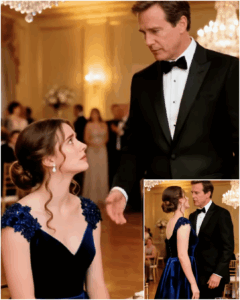
“Dance with me,” a voice said, not loudly, but with the kind of gravity that parts conversation like water.
She looked up and saw a man who made the air reorganize around him. Tall. A suit calibrated for movement rather than display. A small scar at his jawline, the kind that makes you wonder about chapters he will never read aloud. His eyes were a private-weather gray, not cold, just watchful.
“I don’t even know you,” she said—reflex, not refusal.
“Good,” he replied. “No one will know you’re pretending to be my wife.”
A single beat passed—ridiculous—and then a second—alarming—and then a third, in which Vivian understood that whatever game he was playing, the room was already keeping score. He extended his hand. She took it before her mind finished assembling the word no.
Movement can be an alibi. On the floor, beneath a chandelier that threw silver coins of light across polished wood, they became a story. Heads turned. The orchestra—sensing a shift in appetite—softened into a languid waltz that made everything seem slower and more expensive.
“I don’t understand,” she whispered, measuring his shoulder with her breath.
“They’re watching me,” he said, with the absent humor of people who live in complicated sentences. “If they think I’m married, they leave my family alone. Tonight, you are my family.”
“Are you in danger?”
“Always,” he said, and almost smiled, as if he knew how little that word meant in rooms like this.
When the song ended, he bowed as if the pretense had always been a courtesy and not a shield. “Thank you, Mrs. DiLorenzo.”
It was the first time she heard his name—the last name first, as power likes to introduce itself. “And after this?”
“We keep pretending,” he said, eyes unarmored for the first time. “For now, it keeps you safe.”
The card arrived in the morning, cream thick enough to make an envelope feel like a decision. The driver wore rain like jewelry. Mr. Antonio DiLorenzo requests your presence, the script read—no RSVP, only expectation. Vivian’s instinct said no; curiosity, which had survived everything else, said ten minutes.
She wore caution like a coat and followed a driver through a city that had taught her both hustle and grace. The gates to the house were the kind that swing for headlines. Inside, the marble didn’t try to be discreet. Wealth, when it’s honest, does not apologize—only the people using it do.
He was at the far end of a room that made fireplaces look small. The tie was loosened; the fatigue in his eyes wasn’t weakness so much as the check you write for vigilance. He gestured not to the couch, not to the obvious chair in front of the desk, but to a window where rain made a cathedral of the view.
“You did well last night,” he said.
“I did it to survive the evening,” she replied.
“Unfortunately, those watching believe you’re my wife. If they think otherwise, they’ll act. I won’t allow that.” He let the sentence sit. “Bodyguards. A driver. Some downtime here when you need it. Call it a role.”
“And my son?” That word arrived before any other. It felt good in the room, like the only anchor that mattered.
“He is part of the role,” Antonio said. “We protect family.”
The word protect has been used for worse promises. Vivian had no appetite for the theater of power. Yet a practical truth asserted itself: danger did not require her consent to exist. If the ballroom eyes had already drafted her into a play, safer to read the script than improvise the threats.
What she hadn’t rehearsed was how quickly logistics become intimacy in houses that prefer secrets. Days stacked into weeks. Security men learned to soften their presence for school pickups. Liam became a small sovereign in a landscape of granite and glass, teaching the staff the names of his toy heroes as if allotting titles. Vivian watched Antonio move through his world with a paradox she would learn to recognize: gentleness underwritten by force, force tempered by rules he kept mostly to himself.
“Why me?” she asked one evening, rain braiding the windows with the same slow patience as that first night.
“Because you have nothing left to lose,” he said. The sentence sounded brutal until he added, “And because you didn’t run.”
There was no seduction to his honesty—only a kind of ledger balancing she sensed he did with everyone. She stayed because the alternative felt like an invisible target; she stayed because Liam slept through the night for the first time in months; she stayed because pretending, against all logic, made the rest of her life feel more true.
Rumor, which eats fact for breakfast, purchased new shoes. The circles that take attendance at charity galas began to whisper about a clandestine wedding. Vivian’s name turned into a speculation that people pronounced as if auditioning for proximity. She learned Antonio’s silences, the ones that meant later and the ones that meant never. He learned her son’s cereal preference and that her happiest sound was a seven-year-old telling a joke badly.
On a night donated to philanthropy, danger stopped being hypothetical. The curb-side choreography—car doors, camera flashes, the dyspeptic click of paparazzi—collapsed under the blunt physics of acceleration. Headlights gunned too close, and metal sneered at metal. Men got out of a sedan in a way that made other men reach for the air around their waistbands. Vivian felt the way a room holds its breath before glass breaks.
Antonio moved as if a choreographer had taught him. One push, one angle, her body behind his. A strike thudded where she had been. The rest was noise—shots, shouts, the expansion of time into uselessness. Her scream, ungenerous to its owner, tore the night in a way that the city refused to acknowledge.
Later, in a hospital where fluorescent light pretends to be fair, she sat next to a bed that had turned the bravest man she knew into something small enough to scare her. “You could have died,” she said—not accusation, not romance, just arithmetic.
“Better me than you,” he answered, and smiled the kind of smile that keeps more promises than it breaks.
“Then I think we’re even,” she said, her laugh a sob that refused to apologize for itself.
He reached for her hand. “Marry me,” he said—simply, as if asking for water.
“Is this another act?”
“No,” he said, eyes steady. “This is the only truth I have left.”
Truth is rarely a surprise. It arrives like something you’ve been hearing backstage for months.
The wedding wasn’t a spectacle, though the world would have paid for one. The same orchestra played, auditioning memory without repeating it. The same windows wore rain like approval. Vivian wore a dress that remembered she was a mother first and a bride second; Antonio wore a suit that looked like privilege and responsibility had finally agreed on a cut.
“Do you remember our first dance?” he asked as they turned, the room receding until it was only sound and the firm geometry of a hand at a back.
“I could never forget,” she said. “You kidnapped me into happiness.”
He laughed, a private sound that kept the photographers at a polite distance. “You rescued me from pretending.”
If the story ended there, the gossip pages would have been satisfied. But marriage is a geography; the map only begins at I do. Here is what happened after: the guards learned to be visible to those who needed safety and invisible to those who needed dignity. The household found a rhythm that included bedtime stories and treaty negotiations over vegetables. Liam absorbed vocabulary nobody wanted him to learn and patience everyone hoped he would. Vivian kept her day job because money—hers—was part of the identity that had saved her.
The world tested the narrative as if checking a fence for weaknesses. A rumor about an old rival. A drone above the back garden that didn’t belong to any of the neighbors. A photograph on a blog that aimed for knife-edge commentary and landed on pettiness. Vivian discovered the politics of being seen with a man whose name rearranged rooms. She also discovered the kindness of people for whom that name meant safety, salaries, school fees, second chances.
Family is not a static noun. It expands. A grandmother moved into the guest apartment after surgery, bringing a soup recipe that beat every chef who had ever trained in Paris. Old friends learned the gate code and the new rules. Weddings, christenings, funerals—the life-calendar—recalibrated around a table long enough to seat twelve and hopeful enough to make room for one more chair.
One afternoon in spring, Vivian found Antonio in an upstairs study he rarely used. He was still, watching the window like a screen saver. On the desk lay an envelope with law-firm gravitas. Inside: the last document of a settlement that retired the final threat against his family. It was the end of the performance that had begun on a chandeliered floor.
“What do we call it now?” she asked.
“Life,” he said. “Still dangerous. Less loud.”
She noticed the scar at his jaw the way one notices the moon in daylight: unnecessary and yet reassuring. The quiet between them wasn’t a pause; it was a home.
Trouble doesn’t phone ahead. On a humid evening cracked open by thunder, a call came from the school. Liam, now nine and desperate for a world big enough for his curiosity, had been followed by a car whose driver pretended to be lost and asked questions that practiced innocence. The staff, alert and unafraid, intervened. Security reports were filed. Vivian sat in a principal’s office, hands folded, breath doing that useless dance it does when adrenaline pretends to be competence.
Antonio arrived in the way a storm finishes arriving. He listened. He asked for the recording. He read the details with a mind that took information apart and put it back together with better screws. He thanked the secretary by name. In the car, he didn’t promise the impossible; he recalibrated the possible. Routes changed. Schedules concealed themselves. The family’s perimeter breathed—but tighter, wiser.
That was the other lesson Vivian learned after marriage: power is not immunity. It is vigilance, work, the ability to bend the world a degree at a time toward safety. It is the humility to accept help and the courage to say no to pride.
The story of that ballroom—of mockery interrupted by invitation—acquired a life of its own. Comment sections performed their peculiar theater. Some insisted on a fairy tale. Others demanded a scandal. Few understood what filled the space between those poles: Tuesday mornings, laundry, algebra homework, the negotiations that shape a marriage more than the vows do.
What she did understand, in the private archive where mothers keep certain truths, was this: the night a stranger asked her to dance, she thought she was stepping into a lie. A role. A mask. What survived the pretense was not the fiction; it was the courage it had called up, the insistence that she and her son could exist in public without apology.
Vivian wasn’t rescued. She was partnered. There’s a difference, and the difference is the only reason the partnership worked.
Not every arc bends cleanly. Antonio’s world—the decisions he made, the men he disappointed by refusing old transactions—exacted a price. There were weeks when sleep forgot his name. Vivian learned to read his silences with a competence that frightened her occasionally; she could tell a business silence from a fear silence at ten paces. He learned that her strength wasn’t an accessory. It was a doctrine. They built rituals to outwit worry. Sunday mornings became sacrosanct: cartoons, pancakes, phones exiled to the drawer that otherwise held emergency batteries.
One of those Sundays, the rain returned—the same forgiving brush across windows that had narrated their beginning. Antonio watched Liam build a city out of cardboard while Vivian measured flour like a spell. He turned and said, almost conversationally, “I owe you a second wedding.”
“You owe me nothing,” she said, without looking up.
“Exactly,” he said. “That’s why.”
The second ceremony occurred at a community center where his foundation funded after-school programs. No orchestra, just a Bluetooth speaker with a loyal connection. Someone’s aunt brought empanadas that outperformed greed. A judge spoke like a grandfather. A photographer donated time and a lens that refused to flatter at the expense of honesty. Vivian wore the blue dress she had bought the year after the divorce—the victory dress, the I have my own account dress. Liam held the rings in a grip that implied he’d punch anyone who asked for them too soon.
“Dance with me,” Antonio said, because some beginnings deserve to be recycled until they sound like tradition.
She laughed. “Always.”
If narrative demanded symmetry, the same chandeliers would have hung above their heads. Instead, the ceiling was acoustic tile; the lights, fluorescent. And it was perfect. The room applauded like a family that understands the hard parts, the parts that do not fit into toasts.
After, they stood at a folding table, eating cake with plastic forks and a lack of irony so complete it glowed. Someone turned on a slow song. Antonio kept his promises in that way that makes promises unnecessary: he kept showing up.
In a city that survives by forgetting, there are still stories that people tell carefully, like carrying porcelain up a steep staircase. The one about the single mother at a wedding who became the center of the room because a man with the wrong enemies and the right instincts invited her into a dance that looked like cover and turned out to be a doorway. The one about a boy who learned that bodyguards are not a luxury but an instrument, like seat belts. The one about a household where money paid for the alarm system and discipline kept it turned on.
Vivian knows who she was that night—soberly, without shame. She also knows what she has built since: a life with its own scaffolding, separate from the man whose name she now shares. She works. She parents. She loves. The trifecta is not a destination; it is a daily practice. Some days she fails one or two of those tasks, then recovers before bedtime. That counts.
When she thinks of mockery now, she feels almost fond of it, like an opponent that retired too early. Scorn is the easiest currency in that ballroom economy; it buys nothing that lasts. Invitation, on the other hand—the real kind, which asks not just for your presence but for your dignity—that is expensive. It cost them both, and they paid.
People still ask how it started, expecting romance to occupy the entire answer. She says the truth: “He needed cover. I needed a way out.” Then she adds the part that matters: “He never mistook me for a solution. He treated me like a partner.”
On certain nights, when the weather indulges memory, rain rehearses the old percussion against the glass. The city lights blur and sharpen. Liam—older now, smarter in ways that keep his parents humble—yells from the hallway about a science project that requires either cardboard, a volcano, or the consent of the fire department. Vivian wipes flour from her hands, kisses a scar at a jawline that no longer needs explanation, and says the only sentence this story ever wanted to earn:
“Dance with me,” she tells him, because it never stopped being an answer.
News

A Mafia Boss Threatened Dean Martin on Stage—Dean’s Reaction Was Pure Genius
A Mafia Boss Threatened Dean Martin on Stage—Dean’s Reaction Was Pure Genius Prologue: A Gun in the Spotlight Dean…

The Billionaire Had No Idea His Fiancée Was Poisoning His Son—Until the Maid Exposed Everything
The Billionaire Had No Idea His Fiancée Was Poisoning His Son—Until the Maid Exposed Everything Prologue: A Whisper That…

The Billionaire Catches Maid ‘Stealing’ Food… But When He Sees Who It’s For, He Breaks Down in Tears
The Billionaire Catches Maid ‘Stealing’ Food… But When He Sees Who It’s For, He Breaks Down in Tears Prologue:…

The Billionaire’s Fiancée Sets a Trap for the Maid — Until His Silent Daughter Exposed the Truth
The Billionaire’s Fiancée Sets a Trap for the Maid—Until His Silent Daughter Exposed the Truth Prologue: The Whisper That…

The Billionaire Went Undercover as a Gardener — Until the Maid Saved His Children from His Fiancée
Richard Whitmore’s hands trembled on the garden shears as he watched through the kitchen window. His new wife, Vanessa, stood…

Three Flight Attendants Vanished From a Vegas Hotel in 1996 — 28 Years Later a Hidden Wall Is Opened
.Every hotel, every casino, every neon-lit alley has a story, most of them ending in forgetfulness or denial. But some…
End of content
No more pages to load






