
The thud was wrong. Not the hollow thump of a ball against siding, not the cheerful slam of a car door—something heavier, sharper, followed by the shriek of grinding metal and a sudden, stunned silence. I was halfway off the porch before the iced tea finished tipping, glass skittering across wood. In the circular driveway of my parents’ house, Serena’s black BMW idled crooked at an angle, hood glinting. Beside the bumper, my daughter lay still—blonde curls fanned across hot concrete, the bright stripe of her soccer socks a terrible, childish flag.
“Zara!” The name cracked out of me. Before I reached her, Serena burst from the driver’s seat, face tight with disgust rather than fear. “Keep your brat out of my way!” she snapped, and—God—she took my unconscious child by the wrist and dragged her limp body a foot to clear the bumper, like debris after a storm.
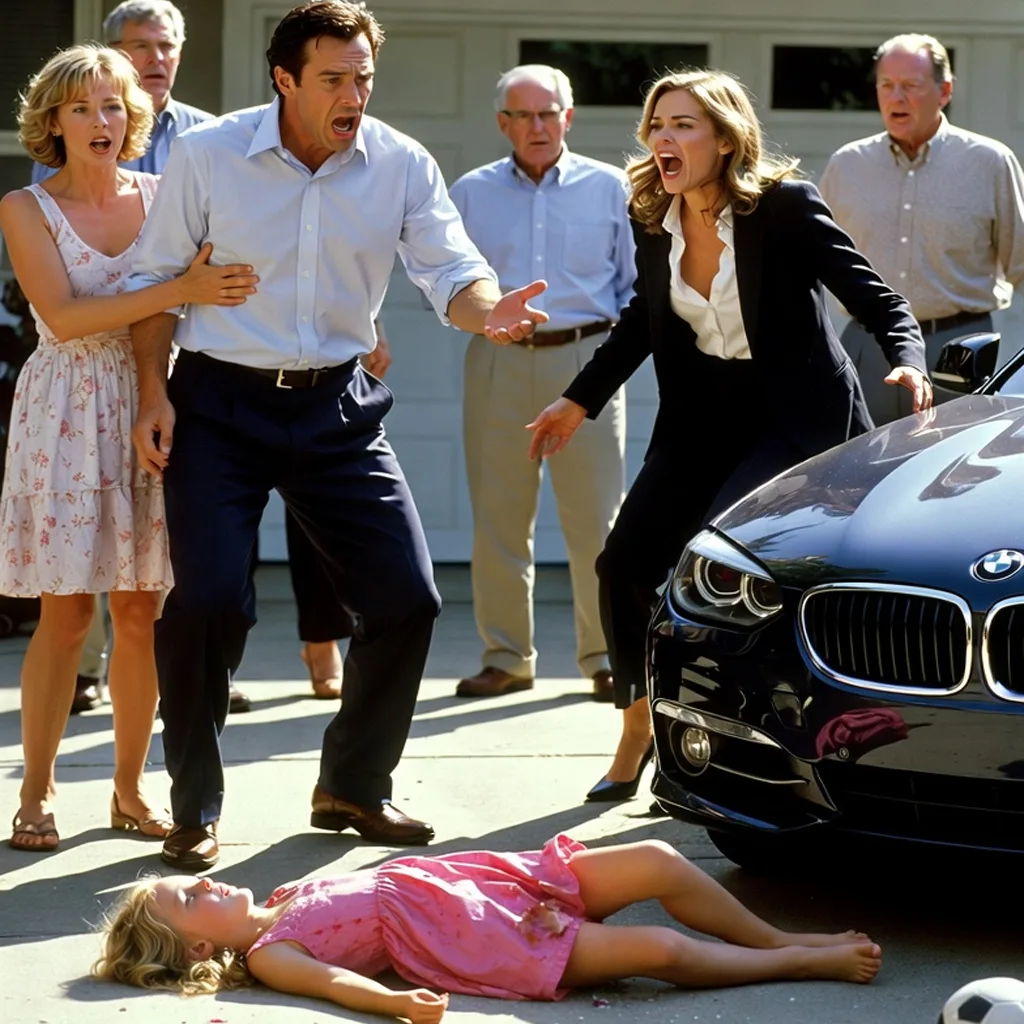
Then my parents arrived. Not to their granddaughter. To Serena. “Honey, what happened?” my father asked, arm around her shoulders, while my mother’s eyes—cool and appraising—landed on me. “Look what your daughter did. Please… go away.” Serena’s heels clicked toward me, hand raised, fury coalescing. The screen door banged open. My husband stepped outside, saw our child, and something in him went very, very still.
This wasn’t new. It was simply louder. Serena—two years older, golden from birth—had been the family’s fixed star and I, the dimmer echo. She dazzled with debate ribbons, law school, a corner office; my nursing degree earned a polite nod and a reminder to bring a casserole. My parents curated Serena’s triumphs like heirlooms and spoke of mine as chores already overdue. They loved the idea of family; they adored the appearance of it.
Zara was the axis of my small, ordinary life—six years old, all questions and orbiting joy. She chased butterflies on Sundays, counted freckles like constellations, slept with her palms open. My husband, Quinn, was a quiet constant—soft-spoken, methodical, a builder of calm rooms in a noisy world. We came for lunch to keep the peace. We stayed because you always do, until you can’t.
That afternoon had been tame as a brochure: trimmed lawn, hydrangeas, the straight spine of the house smiling white. A security camera sat under the eaves like a blinking eyelid. Zara chased a monarch’s wavering path—near the grass line, not the drive—while I tracked her with the grazing attention of a mother who knows every sound of her child’s body. Then the squeal. Then the wrong thud. Then the truth of what our family had always been, suddenly in the open air.
Quinn didn’t raise his voice. He walked to Serena, took her shoulders, moved her back with the unarguable steadiness of a man removing a hazard from a workbench. He knelt beside Zara, checked airway, breathing, the glassy pupils. “Call 911,” he said. My father waved a dismissive hand. “No need. She’s probably just shaken.” Quinn’s eyes lifted, flat with warning. “We’re calling an ambulance. If you have a problem, discuss it with the police.” He dialed.
Serena laughed—a brittle ring. “Are you serious? I have a client meeting tomorrow. Do you know what you’ve cost me? Do you know what this car costs?” Quinn stood, phone still in his hand, and pointed to the black dome under the eaves. “Your parents’ security system recorded everything,” he said, each word placed like a brick. “Your speed. Your angle. Your dragging an unconscious child. Your words. Your threats. You’re an attorney; you understand what that means.” My father paled. My mother crossed her arms like an objection.
The ambulance took our afternoon. In the fluorescent stead of an ER bay, a pediatrician with calm hands confirmed what I already suspected: a concussion, a broken arm, bruising in cruel places. “She’s lucky,” the doctor said, which is another way of saying we aren’t haunted by a different ending. On the drive home, Quinn’s jaw set. “We’re pressing charges,” he said. “This stops now.”
Serena’s anger didn’t bend; it calcified. My parents called to bargain and then to scold. “Family shouldn’t involve the courts,” my mother said, which meant: forgive without accountability. Discovery said otherwise. Phone records placed Serena’s thumbs on her screen at the moment of impact: running late as usual. These family things are so boring. Prior citations surfaced—parking lot scrapes, warnings for speed, a choreography of carelessness. The video from my parents’ camera—admitted into evidence—blared a single, damning chorus: impact, indifference, blame.
Depositions undressed us all. Under oath, Serena conceded she hadn’t checked a pulse, hadn’t called 911, hadn’t considered spinal injury as she yanked my daughter from asphalt. “Children are resilient,” she said into the record. My mother, faced with the audio of “Please, go away,” claimed shock. My father said, when asked if he’d shown Zara the same care as Serena, that “Serena’s needs were more complex.” The court reporter’s keys clicked like rain on a lid.
The case found its shape. Criminal charges—vehicular assault, child endangerment—moved forward. The jury took three hours. Guilty. At sentencing, the judge, a mother of three, spoke with the measured heat of someone containing a deeper fire. “After negligence,” she said, “you chose indifference.” Six months in jail. Probation. Community service at a children’s hospital. Anger management. The bar suspended Serena’s license. Her firm put her on leave. The world that had applauded her polish went quiet.
Civilly, the insurance company settled before a jury could give the story new teeth. The settlement covered what needed covering: hospital bills, therapy, the architecture of a future for Zara that no longer touched the driveway where she learned something cruel about love. A no-contact provision drew a clear border where our family had once pretended hedges would suffice.
The internet, which loves a villain until it finds another, loved our video long enough to make our mailbox a hazard. Quinn installed cameras at our new house and a doorbell with a patience I didn’t have. We moved across districts, into a smaller place with a broader sky. Quinn set his desk beneath a window and learned the light. I transferred to a different hospital where the hallways didn’t smell like my mother’s fundraisers. Zara met a teacher who crouched to her height and a friend who traded stickers without keeping score. She started sleeping without flinching at cars, then started running toward them again—under our rules, within our lines.
My parents called to negotiate the terms of regret. They offered money, then guilt, then the possibility of cutting Serena out like a tumor they’d suddenly discovered. I said no to all of it. The problem wasn’t a sister; it was the muscle memory of choosing the wrong person over a hurt child. They stopped calling. The quiet that followed felt like fresh paint—chemical at first, then clean.
Quinn never wavered. He coached Zara’s soccer team and learned to love the chaos of shin guards and grass stains. He kept the photo from the ER—Zara’s left arm in plaster, her right hand wrapped around two of his fingers—in his desk drawer, a witness not to suffering but to the line we drew and kept.
Four years pulled us forward. Zara grew into her cast stories, then shed them for bicycle scars and spelling words. When she asked, once, why Grandma told me to go away, I told her the truth version that fits into a child’s ear: some people get confused about what matters most. We do not. She nodded, then asked for another slice of apple.
I used to think the worst sound I’d ever hear was the thud of my daughter’s head on concrete. Now I know the worst sound is silence where care should be—the pause in which a grandparent steps over a child to comfort the adult who caused harm. But silence can be a cure, too, when you place it carefully. The rooms of our new house hold a quieter kind of noise—pencil shavings, oven timers, the squeak of Velcro cleats, the low hum of a man who measures twice.
Family isn’t who shares your name in a courtroom or who likes your holiday photos; it’s who kneels first beside a small, still body and says, “Call 911,” with a voice that makes the world obey. Love is not the grand gesture; it’s the steady correction—this is the line, this is the care, this is the child. Everything else can go.
I don’t visit the old driveway. I don’t need to. I carry its lesson in my pocket like a stone worn smooth by thumb: When the bang comes—and life promises it will—watch who moves toward the harm and who moves around it. Build your life with the ones who move toward.
News
A Mafia Boss Threatened Dean Martin on Stage—Dean’s Reaction Was Pure Genius
A Mafia Boss Threatened Dean Martin on Stage—Dean’s Reaction Was Pure Genius Prologue: A Gun in the Spotlight Dean…
The Billionaire Had No Idea His Fiancée Was Poisoning His Son—Until the Maid Exposed Everything
The Billionaire Had No Idea His Fiancée Was Poisoning His Son—Until the Maid Exposed Everything Prologue: A Whisper That…

The Billionaire Catches Maid ‘Stealing’ Food… But When He Sees Who It’s For, He Breaks Down in Tears
The Billionaire Catches Maid ‘Stealing’ Food… But When He Sees Who It’s For, He Breaks Down in Tears Prologue:…
The Billionaire’s Fiancée Sets a Trap for the Maid — Until His Silent Daughter Exposed the Truth
The Billionaire’s Fiancée Sets a Trap for the Maid—Until His Silent Daughter Exposed the Truth Prologue: The Whisper That…
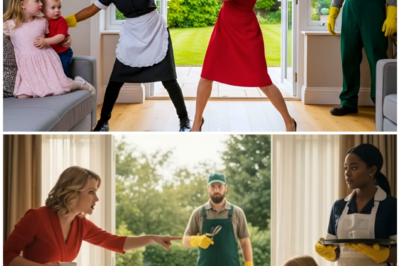
The Billionaire Went Undercover as a Gardener — Until the Maid Saved His Children from His Fiancée
Richard Whitmore’s hands trembled on the garden shears as he watched through the kitchen window. His new wife, Vanessa, stood…
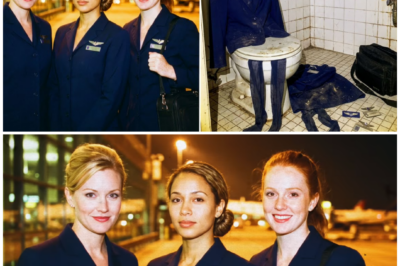
Three Flight Attendants Vanished From a Vegas Hotel in 1996 — 28 Years Later a Hidden Wall Is Opened
.Every hotel, every casino, every neon-lit alley has a story, most of them ending in forgetfulness or denial. But some…
End of content
No more pages to load






