
The city that morning was gray and restless — traffic thick with impatience, horns echoing off the damp glass of downtown Chicago. In the passenger seat of a silver sedan, Martha Collins pressed her gloved hands together, watching raindrops race down the window. Her son, Daniel, gripped the steering wheel as if it were a lifeline.
“Mom, it’s not punishment,” he said. “Golden Acres is one of the best senior communities in the city.”
Martha turned her head slightly, her voice soft but certain. “Daniel, I still cook my meals. I tend my garden. I’m not ready to be stored away like a family heirloom.”
Daniel exhaled sharply — that sound of irritation disguised as concern. “You’re being unreasonable.”
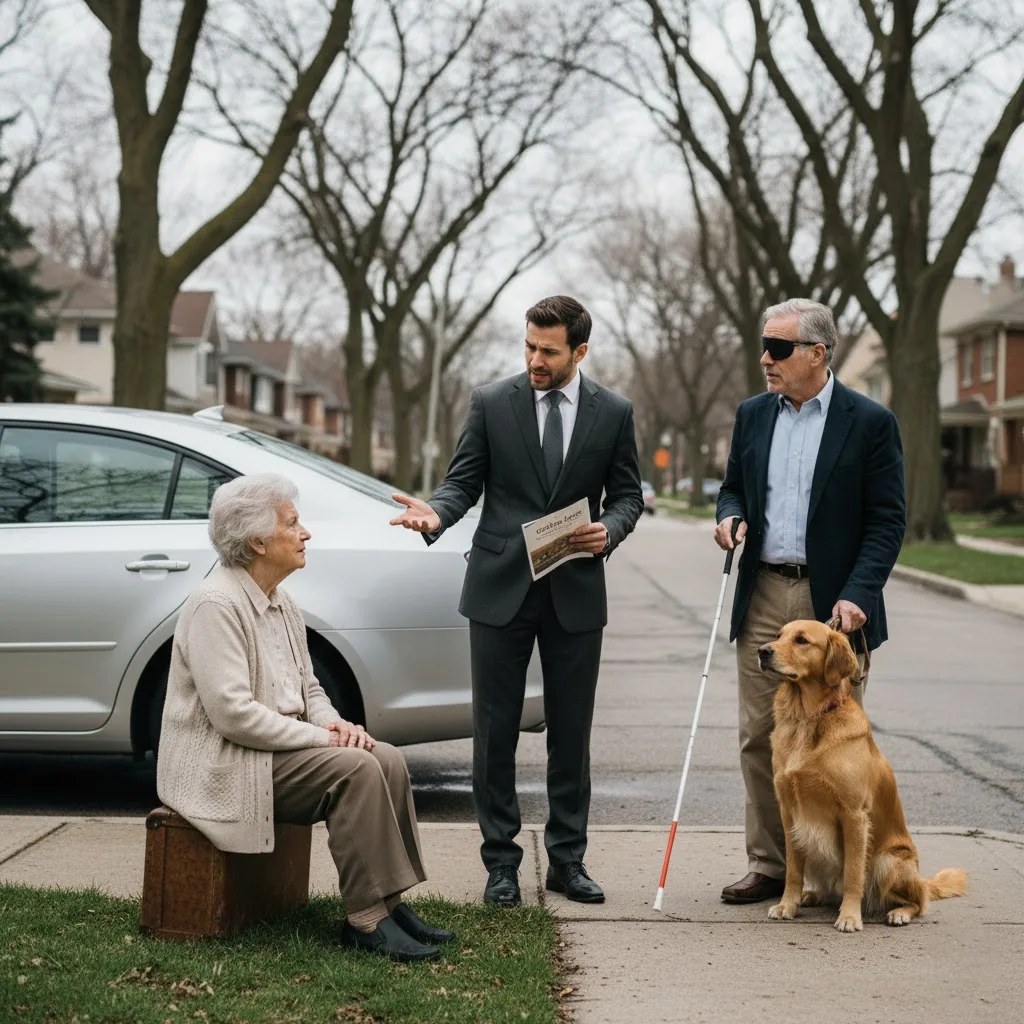
She didn’t argue. She just looked out at the blur of people crossing Michigan Avenue, each one carrying a life she would never know. Her son’s voice, once the safest sound in the world, now felt distant.
Then the car jerked. Tires scraped against the curb. Daniel parked hard.
“If you want to be independent,” he said, his tone cutting, “find your own way home.”
Before Martha could speak, he reached over, unlocked the doors, and waited.
She stepped out slowly, rain tapping her shoulders like disbelief. Daniel’s car pulled away before she even shut the door.
Her purse was still on the floor. Her phone battery blinked red.
The city was vast and loud, but in that moment, she heard nothing. Only the small, collapsing sound of her own heart.
Martha Collins was seventy-two years old and had lived a life devoted to gentleness — thirty years teaching literature, forty-two building a home anchored in quiet decency. She had raised Daniel to read poetry before bedtime, to say please and thank you, to remember that kindness was strength.
But kindness, she was realizing, could also make one invisible.
She sat at a bus stop, rain seeping through her coat, and tried to steady her breath. That was when a man’s voice cut through the downpour — warm, calm, and deliberate.
“Excuse me,” he said. “I couldn’t help overhearing. Do you need help?”
The voice came from a man in his early seventies, sharply dressed despite the weather. His hair was silver, his eyes hidden behind dark glasses. A white cane rested against his knee.
“I’m fine,” Martha said, embarrassed.
He smiled faintly. “You don’t sound fine. My name is Robert Wilson. And I believe your son made a terrible mistake.”
Before she could respond, he tilted his head. “Would you do me a favor, Mrs. Collins? Pretend you’re my wife.”
Martha blinked. “What?”
“My driver’s on his way. Let him see you leave with dignity. The world is kinder to a woman who looks like she belongs.”
Moments later, a black car pulled to the curb. The driver opened the door. “Mrs. Wilson,” he said smoothly, playing along.
Martha hesitated only a moment before taking Robert’s arm. Inside, the car smelled faintly of sandalwood and leather — a scent that reminded her of the library she used to visit as a girl.
“Where are we going?” she asked.
“Somewhere safe,” Robert said. “And somewhere warm.”
His home was not what she expected. Behind the iron gates and manicured gardens stood a mansion filled not with cold marble, but with warmth — worn books, soft music, the comforting smell of earl grey tea.
Over tea, she told him her story: the years of widowhood, of teaching, of raising a son who now treated her like an inconvenience.
Robert listened quietly, his hands folded neatly on the table. “My daughter did the same,” he said finally. “When I lost my sight, she began deciding my life for me. My meals, my house, even my friends. Blindness didn’t take my vision — it took their trust.”
There was a pause. Martha studied him. “And now?”
“Now,” he said with a sad smile, “I let them think I’m still broken.”
When he offered to have his driver take her home, she expected Daniel to be gone. Instead, he was waiting at the curb — pacing, furious, and afraid.
“MOM!” he shouted as the black car stopped. “Where have you been? I’ve been calling hospitals!”
Robert stepped out first, standing tall, the picture of calm authority. He took Martha’s hand and said, “Until tomorrow, my dear. We’ll finish our conversation then.”
Daniel froze. “Who is this man?”
Martha looked at her son — at the boy she had once comforted through every scraped knee and broken heart — and answered simply, “Someone who sees me.”
For once, Daniel said nothing.
But that night, Martha could not sleep. Something about Robert didn’t fit — the way he had turned toward her before she spoke, how he’d moved through his home without hesitation. Blindness didn’t seem to hold him at all.
When she visited him the next evening, she decided to ask.
They sat by the fire, the sound of rain against the windows. “Robert,” she said gently, “you turned your head toward your car before it arrived. You poured tea without feeling for the cups. You walk through this house as if you’ve memorized it.”
He stilled.
“Martha,” he said quietly, “I was not always blind.”
He removed his glasses. His eyes — clear, steady, and alive — met hers.
“I lost my vision once,” he said. “After years of treatment, I regained it. But by then, I was someone else — a target. I’d built a company powerful enough to attract enemies. They threatened my family. I needed to vanish, so I let the world believe I was helpless.”
Martha’s voice was barely a whisper. “And you stayed hidden all this time?”
“I learned,” he said, “that safety can feel like a prison when it costs you your truth.”
She understood that more than she could say. Both of them had been erased — by the very people they’d loved most.
Before she could respond, the front door burst open.
A young woman entered — sharp, elegant, her resemblance to Robert undeniable. “Dad,” she said urgently, “the press found out. Someone’s questioning your condition.”
Her eyes fell on Martha, then on the glasses in Robert’s hand. “You told her?”
“No,” Martha said softly. “I found out. And your secret is safe with me.”
The young woman hesitated, then nodded.
Later that night, when the house grew quiet, Robert and Martha sat together in the library. The rain had stopped.
“You don’t have to hide anymore,” Martha said.
He smiled faintly. “Neither do you.”
They sat in silence for a while, two people who had lost different kinds of sight — one literal, the other emotional — and who had somehow found each other in the blur.
Months passed. Martha refused the senior home. She moved into a small apartment near the university, where she volunteered teaching poetry to underprivileged students. Daniel visited often now, quieter, humbler.
And every Sunday, a black car waited outside her building. Robert would arrive, white cane in hand, smiling. They would walk together through the park — two souls who no longer needed to pretend to be less than they were.
One afternoon, as they sat on a bench overlooking the river, Robert said, “When I met you, I thought I was rescuing you. But it turns out, you rescued me.”
Martha smiled, her voice barely above a whisper. “We both just needed to be seen.”
The river shimmered under the setting sun — and for the first time in years, the world around them felt perfectly, profoundly clear.
News

A Mafia Boss Threatened Dean Martin on Stage—Dean’s Reaction Was Pure Genius
A Mafia Boss Threatened Dean Martin on Stage—Dean’s Reaction Was Pure Genius Prologue: A Gun in the Spotlight Dean…

The Billionaire Had No Idea His Fiancée Was Poisoning His Son—Until the Maid Exposed Everything
The Billionaire Had No Idea His Fiancée Was Poisoning His Son—Until the Maid Exposed Everything Prologue: A Whisper That…

The Billionaire Catches Maid ‘Stealing’ Food… But When He Sees Who It’s For, He Breaks Down in Tears
The Billionaire Catches Maid ‘Stealing’ Food… But When He Sees Who It’s For, He Breaks Down in Tears Prologue:…

The Billionaire’s Fiancée Sets a Trap for the Maid — Until His Silent Daughter Exposed the Truth
The Billionaire’s Fiancée Sets a Trap for the Maid—Until His Silent Daughter Exposed the Truth Prologue: The Whisper That…

The Billionaire Went Undercover as a Gardener — Until the Maid Saved His Children from His Fiancée
Richard Whitmore’s hands trembled on the garden shears as he watched through the kitchen window. His new wife, Vanessa, stood…

Three Flight Attendants Vanished From a Vegas Hotel in 1996 — 28 Years Later a Hidden Wall Is Opened
.Every hotel, every casino, every neon-lit alley has a story, most of them ending in forgetfulness or denial. But some…
End of content
No more pages to load






