
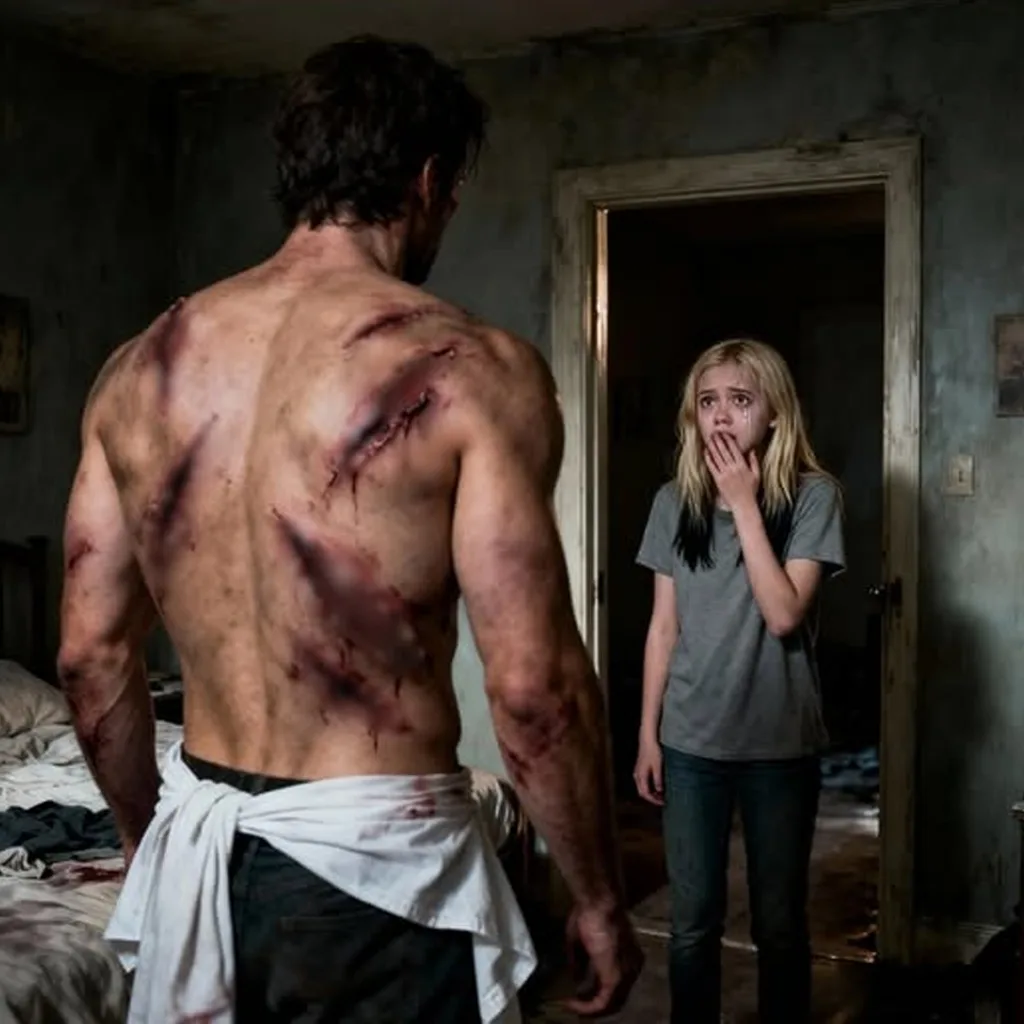
The door to his bedroom hadn’t latched. Anna nudged it with two knuckles, meaning only to ask if he wanted spaghetti or soup, and the room opened like a held breath let go. Her father—broad-shouldered, gentle, still in the faded T-shirt from the delivery center—was turning away from the dresser. The cotton slipped at the hem, lifted, and the world tilted. His back was a map of ruin—long raised lines, puckered seams, tracks like lightning frozen in flesh. For a heartbeat, neither of them moved. Then he yanked the shirt down, but the image had already burned into her: not a bruise or a scrape or a childhood scar, but devastation. Somewhere outside, sirens wailed and swelled, then skimmed past their block and fell away into the grid of Springfield night. Silence reassembled itself in the kitchen below, where plates waited and a single lamp cast a patient circle of light on the table. When her father turned, fear—not anger—lived in his eyes, the specific fear of a man who might lose the one person he had never failed. “Anna,” he said softly, hands open like he was approaching a skittish animal. “I can explain.”
Since she could remember, it had been two chairs at every table: Anna and David Miller. Her mother was a photograph on the mantel, a smile captured under soft summer light, a story told on birthdays. Her father was the one who showed up tired and uncomplaining, who knew how to braid a crooked ponytail and patch a lunchbox with duct tape. Mornings smelled like coffee and motor oil; nights, like laundromat steam and grocery-store rotisserie chicken. He worked where the work was—construction in spring, warehouse in winter, overnight loading when the foreman called. He never brought trouble home, never told stories about the men who did. He was good at disappearing his own needs. There was one rule without words: no bare back. No pools in July. No shirts slung over a chair. He changed in the bathroom with the exhaust fan humming. He mowed in long sleeves. If she noticed, she filed it in the drawer labeled Dad Things, alongside the bent nail he kept in the junk tray and the way he pronounced “Illinois” without the s.
At school, life blurred in ordinary ways—AP history, rented prom dresses, the cafeteria line. On a Tuesday that felt like any other, a crowd gathered by the lockers around a phone, the way they always did when news broke louder than gossip. A sketch on the screen: “Police Seek Robbery Suspect. Armed. Reward Offered.” The description ricocheted in the hallway air—male, mid-40s, limping, scars across the back like lash marks. Someone whistled low. Someone else laughed too loud. Anna felt something in her chest unhook. Memory stuttered: a morning years ago when his collar slipped as he bent for her spilled crayons, a blur of pale seam before the shirt fell back. She pushed the thought away like a hand from a hot stove. By last bell, the thought had returned as a drumbeat. On the bus home, she counted the streetlights instead of breathing. At the top of their steps, the whole house felt newly fragile, as if a secret could make the drywall thinner.
He sat with his elbows on his knees at the kitchen table, palms open on wood nicked by keys and homework. “At the plant,” he began. “Years ago. The safety shield failed. Steam and shrapnel. It wasn’t… I didn’t want you to look at me and see hurt.” He didn’t reach for her. He didn’t spin a myth. He let the facts sit between them, heavy as a toolbox. She nodded and couldn’t make belief rise to meet the words. The sketch bloomed behind everything like an afterimage. The broadcast repeated in her head: scars like lashes, burns from a robbery gone wrong. She hated herself for doubting. She hated what doubt did to his face when he read it there. They ate without tasting. They washed dishes shoulder to shoulder and didn’t speak. In her room that night, she stared up at glow-in-the-dark stars she’d stuck to the ceiling when she was nine and willed them to be real.
Two evenings later, the news rattled the quiet: the suspect had been sighted near the old warehouse district by the river, the place with brick molting into dust. She told him she had a group project at the library and walked past the stacks with the steady gait of a liar. The bus hissed her out into a part of town where light thinned and weeds made claims. The warehouses squatted like sleeping animals. A gull cried, the river answered. She told herself she was foolish. She told herself she needed to see the ghost, or it would keep living in her father’s shadow.
Behind a dented dumpster, a shape detached from the dark. Limping. A man, leaner, older, the eyes hollowed by a different life. He had the same terrible geometry across his back where his shirt gaped, the same sign the sketch had promised. He saw her, and want—shaped like hunger or need or calculation—entered his face. He took a step, then another. She backed toward the street, pulse in her teeth. “Hey,” he rasped, reaching. Red and blue erupted, the lot turned daylight-strange, and voices cracked the air: “Police! Hands where we can see them!” The man twisted, bolted, went down hard under a rain of commands. “I had no choice!” he howled as they pinned him. Anna stood rooted in the flicker, shaking, as if a current were running through her shoes. An officer with soft eyes turned to her and asked if she was hurt. She said no and meant yes in a way that didn’t bruise.
At the station, she learned his name—Mark Holden—and the facts of his ruin: a warehouse fire in the aftermath of a robbery, burns and scars as a ledger of bad decisions, a trail of petty violence, no daughter, no house with a lamp waiting on a kitchen table. The sketch was his, not her father’s. The scars were cousins, not twins. The world recalibrated, jerking back into a frame she recognized but would never see quite the same again.
She ran the last block home. He was on the porch, eyes scouring the street, a man who had already pictured every worst thing. When he saw her, something buckled and then held. He didn’t ask first. He pulled her into the kind of hug that refuses arguments, strong enough to steady, soft enough to say I was terrified. “I’m sorry,” she whispered into his shirt. “I doubted you.” His hand found the back of her head the way it had when she was small and feverish. “I should have told you,” he said. “I thought hiding it spared you. It only built a wall.”
In the days that followed, the house changed by degrees. He folded his shirts in the living room with the TV murmuring. In August heat, he wore a sleeveless tee to mow, the sun laying gold on what used to be secret. At first, she looked away from his back by reflex, then forced herself to look and keep looking until the lines stopped being only injury and began to be information. She asked about the plant. He told her in pieces: the scream of pressure venting, the smell that came after, how the men he worked with wrapped him in their shirts and kept him awake with jokes not worth repeating. He told her who visited him in the hospital and who didn’t. He told her about the foreman who drove his truck to their apartment with a bag of groceries and hid on the stairs so no one would have to see him cry. In return, she told him about the hallway whispers, about the way fear makes you invent, about the seduction of a story that explains everything too neatly.
They learned a new language that had no place for pretending. She went with him to a checkup and sat in the corner while the doctor, a woman with competent hands, checked skin that had survived more than it should have. At school, when the sketch came up again as rumor’s afterglow, she said, simply, “They got the wrong guy. Twice.” On weekends, they walked by the river and pointed out whatever beauty they could afford—light on water, a heron standing like patience, a rusted bolt glinting like jewelry in the weeds.
Years later, when people asked her why she was patient with strangers, she said it began the night sirens skimmed past her house and left her with the sound of her father’s breathing across a kitchen table. She kept a photo on her desk from a September afternoon: her father at a community pool for the first time in forever, in a faded blue rash guard he finally peeled off. His back in daylight looked less like a wound and more like a map—routes that hurt to travel, yes, but also proof that you can get somewhere from a terrible place and still come home in time to stir sauce. She learned that a scar is a verb in the past tense, not a prophecy. That secrets calcify into suspicion, and the cure for both is the same plain thing: tell the truth, even when it makes the room go quiet.
When a younger coworker flinched at the jag of a burn on her own wrist and called it ugly under her breath, Anna handed her a cup of ice and said, “That looks like something you healed from.” When a neighbor pointed a whisper at a man in line with jailhouse ink and a polite voice, she said, “You’re looking at the wrong story.” Not every scar comes from wrongdoing. Some are a receipt for what you paid to love someone, or for the shift you didn’t leave early, or for the moment you were in the wrong place and chose to live anyway. Her father’s back did not absolve him of everything; it did not condemn him of anything. It simply told the truth of a day at a plant and the years that followed, and the life he built in the shadow of both.
What changed her world wasn’t the sight of the scars. It was finally seeing the man who carried them.
News

A Mafia Boss Threatened Dean Martin on Stage—Dean’s Reaction Was Pure Genius
A Mafia Boss Threatened Dean Martin on Stage—Dean’s Reaction Was Pure Genius Prologue: A Gun in the Spotlight Dean…

The Billionaire Had No Idea His Fiancée Was Poisoning His Son—Until the Maid Exposed Everything
The Billionaire Had No Idea His Fiancée Was Poisoning His Son—Until the Maid Exposed Everything Prologue: A Whisper That…

The Billionaire Catches Maid ‘Stealing’ Food… But When He Sees Who It’s For, He Breaks Down in Tears
The Billionaire Catches Maid ‘Stealing’ Food… But When He Sees Who It’s For, He Breaks Down in Tears Prologue:…

The Billionaire’s Fiancée Sets a Trap for the Maid — Until His Silent Daughter Exposed the Truth
The Billionaire’s Fiancée Sets a Trap for the Maid—Until His Silent Daughter Exposed the Truth Prologue: The Whisper That…

The Billionaire Went Undercover as a Gardener — Until the Maid Saved His Children from His Fiancée
Richard Whitmore’s hands trembled on the garden shears as he watched through the kitchen window. His new wife, Vanessa, stood…

Three Flight Attendants Vanished From a Vegas Hotel in 1996 — 28 Years Later a Hidden Wall Is Opened
.Every hotel, every casino, every neon-lit alley has a story, most of them ending in forgetfulness or denial. But some…
End of content
No more pages to load






