
The clock above the kitchen door read 10:30 p.m. when Elena finally slid into a folding chair, every muscle in her legs humming with the ache of a fourteen-hour shift. The dining room of La Perla del Caribe still glowed under crystal chandeliers; linen napkins lay folded like small white flags across polished tables. Outside, Cancún’s night breathed warm and humid; inside, the restaurant breathed a different air—one of silverware rituals and invisible hierarchies.
She had spent the night polishing a glass worth more than her rent, smiling with the practiced softness that kept tips coming and complaints away. Then the doors opened and, like an answer to a prayer she’d never dared speak aloud, they entered: Julián Valdés, the hotel magnate whose name dominated the city’s glossy pages, and beside him, a woman who moved as if the room belonged to her memory rather than the people in it—Carmen Valdés, his mother. Her face was a map of years, her hands small and precise. For most, she was scenery; for Elena, she was suddenly a person.Elena had no illusions about the world she moved through. At twenty-two she worked to keep a small home for herself and her younger sister, Sofía, who was deaf. Their parents were gone; Elena wore their absence like a second skin. The specialized school that taught Sofía to read, to sculpt light into colors, cost more than Elena’s monthly wages. Everything she did—extra shifts, relentless smiles, scrubbed floors at dawn—was for the future of a girl who saw the world in brushstrokes and signs.
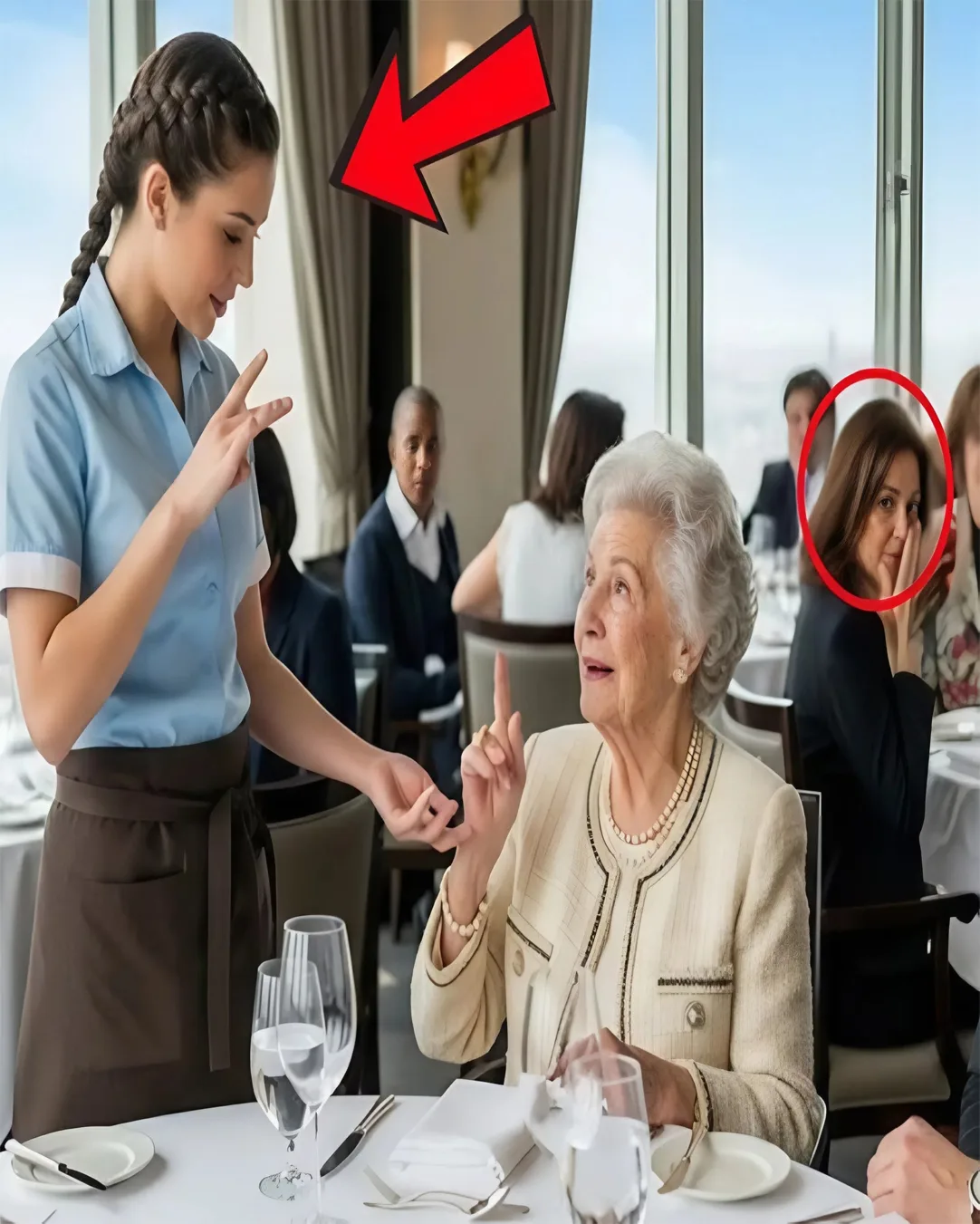
So when Carmen sat at the table and no one looked her way, Elena noticed. Servers hovered and murmured to Julián; waiters consulted tablet menus and spoke into earpieces; but no one addressed Carmen directly. Julián asked for her wine twice; Carmen stared out at the ocean and did not answer. She was present and alone at once, adrift on a sea of people who mistook manners for compassion.Elena stepped forward and, without thinking of rules or reprimands, signed the greeting she used every night with Sofía: Good evening. Welcome. Carmen’s head turned; her green eyes found Elena’s and a quiet, stunned joy spilled across her face. It was a small thing—two hands forming letters in air—but it rebalanced the room. Carmen began to sign back, and laughter, like a bell, bubbled out of her.
Julián watched, curiosity folding into something softer. “You sign?” he asked aloud, astonished. Elena told him in halting words that Sofía was deaf and that she’d learned to sign to speak home into the silence. For Carmen, Elena’s gestures were a bridge; for Julián, they were revelation. Over the next hours Elena translated ingredients and jokes, described textures and aromas, offered Carmen agency in conversations that had previously passed over her head. Carmen lit up; the table’s conversation shifted from indulgence to connection.
But kindness has its price in places governed by protocol. Mrs. Herrera, the maitre d’ whose power came from enforcing invisible rules, moved like a vindictive tide. She pulled Elena into a narrow office and announced, with the cruel blandness of someone who had sharpened her cruelty into a career, that Elena had broken protocol and would be punished with dawn shifts and extra labor. “You’re replaceable,” she sneered. Elena learned then that the restaurant’s gilded world rewarded invisibility, not courage.Word of Elena’s signing reached Julián in a way nothing else had: his mother would not stop asking about the young server. He returned a week later unannounced, sought Elena out, and asked her to be Carmen’s interpreter at his foundation’s big gala—just one night, he said, but the pay he offered would transform a month of their lives. Elena accepted, aware that saying yes would invite Mrs. Herrera’s wrath. The manager retaliated predictably, changing schedules to punish her. Julián, with the deliberate authority of someone used to doors opening when he asks, intervened. Elena’s Saturday was cleared; Mrs. Herrera’s posture faltered for the first time under someone else’s command.
The gala became a passage. In a borrowed dress and with hands steady from years of work, Elena stood beside Carmen beneath a canopy of lights and made that woman visible to a room that rarely learned the habit. Cameras flashed; the city’s elite gaped; Carmen’s laughter threaded through speech and applause. Elena was paid handsomely, but what mattered more was less tangible: the recognition that what she offered—attention, language, dignity—was worth something that could not be cheapened.
When Elena returned to her neighborhood the next morning, Sofía met her at the door with a new set of paints and a grin that swallowed the kitchen. Elena spread the money across bills and school fees and then pinned a small, crayon drawing to the fridge: Carmen and Elena beneath a big moon, hands speaking in the dark. The work at the restaurant continued, and Mrs. Herrera’s small cruelties did not vanish overnight. But Elena moved differently now—less afraid to look someone in the eye; less willing to hide the shape of who she was.
There is a brittle economy in places that prize appearance over presence: people are counted in plates served and problems deflected rather than in the space they occupy. Elena’s story pivots on a simpler arithmetic: to see someone—truly see them—and to give them the small dignity of being understood, multiplies worth in ways a ledger cannot record.
Carmen found a voice in sign language; Julián found a humility he had long allowed to gather dust. For Elena and Sofía, a night that began with a borrowed dress ended with the slow, steady accumulation of possibility: school secured, art supplies lined up, a sister’s future stretched just a little wider. Mrs. Herrera kept her job; the restaurant stayed polished. But a new rule had taken hold: some people will not be invisible because others remember how to notice.
In the hush after a long night, Elena and Sofía traced signs at their small kitchen table—two hands making words that did not need sound. Outside, the city throbbed on, indifferent and magnificent. Inside, a quiet truth had settled: kindness is a language everyone can learn, and dignity is the first gift worth giving.
News
A Mafia Boss Threatened Dean Martin on Stage—Dean’s Reaction Was Pure Genius
A Mafia Boss Threatened Dean Martin on Stage—Dean’s Reaction Was Pure Genius Prologue: A Gun in the Spotlight Dean…

The Billionaire Had No Idea His Fiancée Was Poisoning His Son—Until the Maid Exposed Everything
The Billionaire Had No Idea His Fiancée Was Poisoning His Son—Until the Maid Exposed Everything Prologue: A Whisper That…

The Billionaire Catches Maid ‘Stealing’ Food… But When He Sees Who It’s For, He Breaks Down in Tears
The Billionaire Catches Maid ‘Stealing’ Food… But When He Sees Who It’s For, He Breaks Down in Tears Prologue:…

The Billionaire’s Fiancée Sets a Trap for the Maid — Until His Silent Daughter Exposed the Truth
The Billionaire’s Fiancée Sets a Trap for the Maid—Until His Silent Daughter Exposed the Truth Prologue: The Whisper That…

The Billionaire Went Undercover as a Gardener — Until the Maid Saved His Children from His Fiancée
Richard Whitmore’s hands trembled on the garden shears as he watched through the kitchen window. His new wife, Vanessa, stood…

Three Flight Attendants Vanished From a Vegas Hotel in 1996 — 28 Years Later a Hidden Wall Is Opened
.Every hotel, every casino, every neon-lit alley has a story, most of them ending in forgetfulness or denial. But some…
End of content
No more pages to load






